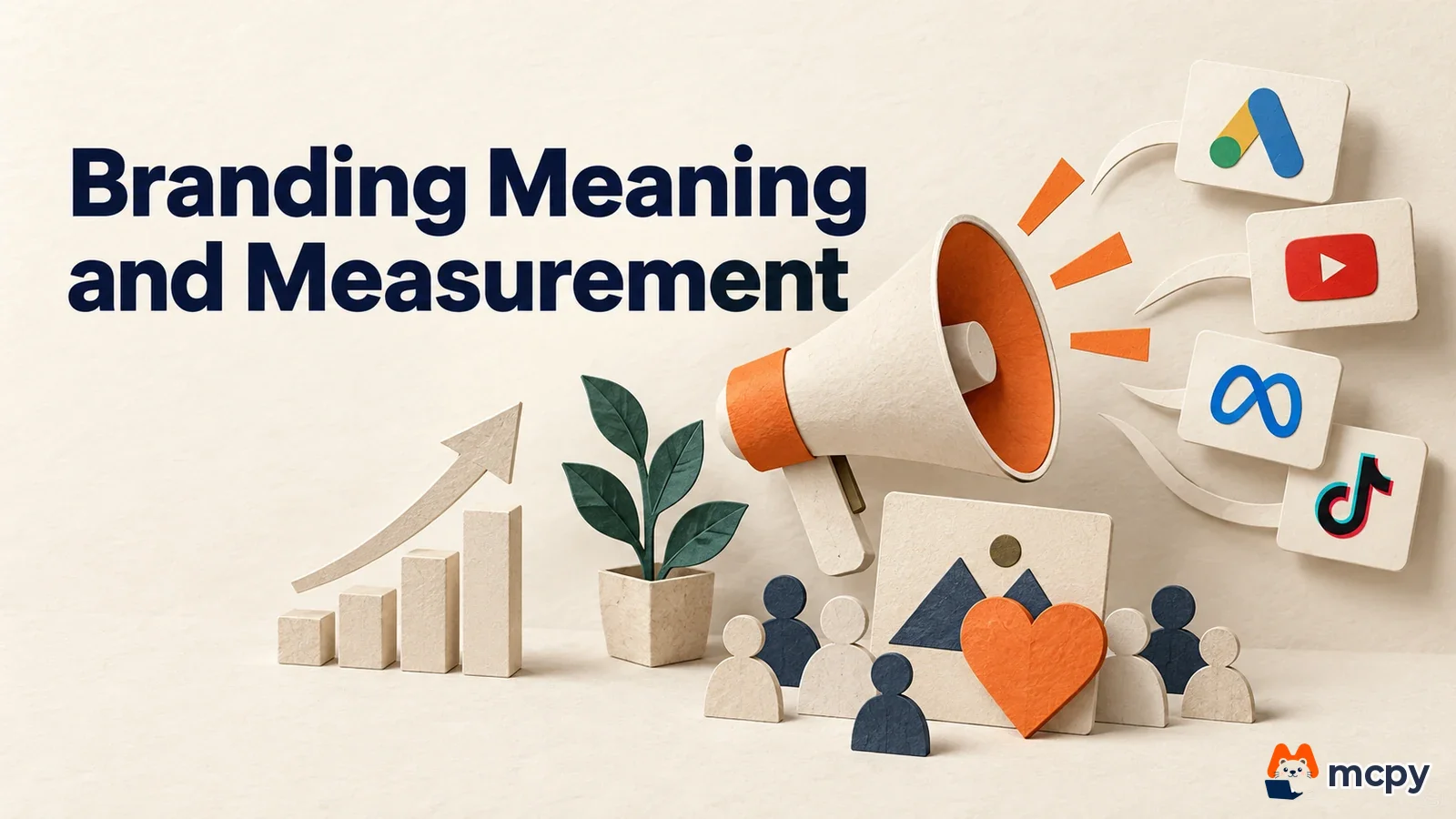
Branding is the work of making customers recall a brand from its name, logo, tone of voice, and experience, and tell it apart from other brands. Branding through ads aims to make your name known and remembered before any click or purchase. Google Ads Help describes the goal of a brand awareness campaign as raising awareness of your company and products and creating positive associations. This article covers the difference between brand marketing and performance marketing, the ads that build awareness, and how to measure their effect, based on official Google documents as of October 10, 2026.
Branding means making your name memorable
Branding is more than making a logo. It is the work of keeping every point where customers meet your brand consistent: business name, logo, product description copy, support tone, packaging, and ad creative. As this consistency builds up, customers see only your name in an ad and know which company it is.
A brand and branding are not the same. A brand is the impression left in the customer's mind. Branding is the activity of building that impression in the direction you intend. So the results of branding show up first as changes before purchase, such as awareness, ad recall, and consideration, not as a single sale.
Brand marketing refers to carrying out this branding through ads and content.
How to do branding in 4 steps
Branding runs in this order: set your identity, write your message, apply it to customer touchpoints, then measure the change in awareness. If the order is reversed, you only start thinking about what to promote after the ad budget is spent.

- Set your identity: Write in one sentence which problem your brand solves and for whom. Your business name, logo color, and tone of voice come from this sentence.
- Write your message: Align ad headlines, the first sentence of product pages, and profile bios so they all state the same promise.
- Apply it to touchpoints: Use the same business name and visual elements in search results, social media profiles, ad creative, and landing pages.
- Measure awareness: Decide on metrics such as the number of people reached and the share who remember the ad, then compare them before and after the campaign.
Small business owners can finish steps 1 and 2 lightly. Step 3 starts when you pick a business name and a one-line description, and use the same wording on Naver Place (the business listing on Naver, Korea's largest search engine), Instagram, and your ad creative.
Brand marketing and performance marketing differ in goals
Brand ads aim to show your name to many people and leave it in memory. Performance ads aim to drive actions such as clicks, sign-ups, and purchases. Different goals mean different bidding methods and different metrics.

According to Google Ads Help, bidding for brand ads generally works well with CPM, which is the cost per 1,000 impressions. This is because the goal is to maximize impressions on relevant sites. Results are read through reach, frequency, and brand lift. Ads aimed at clicks or purchases must be read with action metrics such as conversions, so judging both goals in one campaign distorts the results.
The two types of ads do not replace each other. They play different roles. Many advertisers plan them in sequence: build name recognition with brand ads, then capture action with search and conversion ads.
How to run ads that raise brand awareness
To raise brand awareness in Google Ads, follow the advice in Google Ads Help: choose placements, use rich media formats such as images, HTML5 animation, and video, and bid with CPM.
- Placement targeting: On the Google Display Network, you run ads on specific websites or on certain sections of a site. You can pick sites by topic or by the audience you want to reach, or pick sites that meet your brand standards.
- Rich media formats: Google advises using rich media formats when interaction with your target audience is the main goal. On the Display Network you can use static images, HTML5 animation, and video.
- CPM bidding: Because you need to maximize impressions on relevant sites, bidding by cost per 1,000 impressions generally works well.
- Using YouTube: The same help page also describes uploading video ads made for TV to YouTube and using a channel with your brand design as a base.
How to measure brand awareness: Brand Report and Brand Lift
Check awareness first through reach and frequency, and measure the change in ad recall through Brand Lift. The two answer different questions.
| Tool | What it tells you | Conditions |
|---|---|---|
| Brand Report | Deduplicated reach and frequency across campaigns, split by age and gender | Single account level, date range up to 92 days, campaign impressions of 10,000 or more, Search, Shopping, and Performance Max campaigns excluded |
| Brand Lift | Changes in ad recall, brand awareness, and consideration | Used for in-stream and bumper ads bought through bidding, not available for in-feed video ads, accessed through your Google account representative |
To open Brand Report in Google Ads, click the campaign icon, then choose Brand Report from the Insights and reports menu. According to Google's documentation, reach data can take up to 3 days to appear, so a blank last few days is not an error.
Brand Lift shows a survey before a YouTube video plays to people who saw the ad and to people who were eligible to see it but did not. It then calculates the ad's impact from the difference in answers between the two groups. So read this result as a difference in survey responses, not as a click count. Small ad accounts may not be able to use it because they have no account representative. In that case, look at reach, frequency, and the change in brand name search volume after the campaign instead.
Common mistakes in branding ads
- Judging brand ads by click-through rate: Awareness campaigns aim for reach and memory, not clicks. If you stop a campaign because clicks are low, you end without ever seeing the target metric.
- Using different names and copy on each channel: If the same person gets a different impression from search, social media, and video, memory does not build up.
- Running ads without a measurement baseline: If you do not record reach and brand name search volume before you start, you cannot compare the change after the campaign.
Frequently asked questions
Does personal branding follow the same order?
The only difference is that you treat a person as the brand. The order is the same. Decide in one sentence what expertise you want to be remembered for, then use the same wording in your profiles and posts.
When should you rebrand?
Rebrand when a change in business name, logo, or main product means the existing impression no longer matches the current business. After the change, replace the information at all touchpoints, including search, social media, and ads, at the same time to keep confusion low.
Found this useful? Share it
Latest posts
Kakao Share Thumbnail Not Showing? Here's the Fix (JavaScript SDK 2025)
Learn why Kakao Share thumbnails don't appear even with a valid imageUrl, and fix it using scrapImage to convert your URL into a KAGE CDN URL. Step-by-step guide.
How to Generate CRM User Manuals in 20 Minutes with Claude Code Sub-Agents
Learn how Claude Code sub-agents can analyze your CRM codebase and auto-generate user manuals and visual guidebooks in just 20 minutes. See the real-world results.
GEO Generative Engine Optimization: The Complete 2025 AI Marketing Strategy Guide
Learn what GEO (Generative Engine Optimization) is, how it differs from traditional SEO, and discover 5 proven AI marketing strategies to get cited by AI search engines in 2025.
Related projects
Get new posts by email
Insights on marketing, analytics, and dev, delivered to your inbox.