
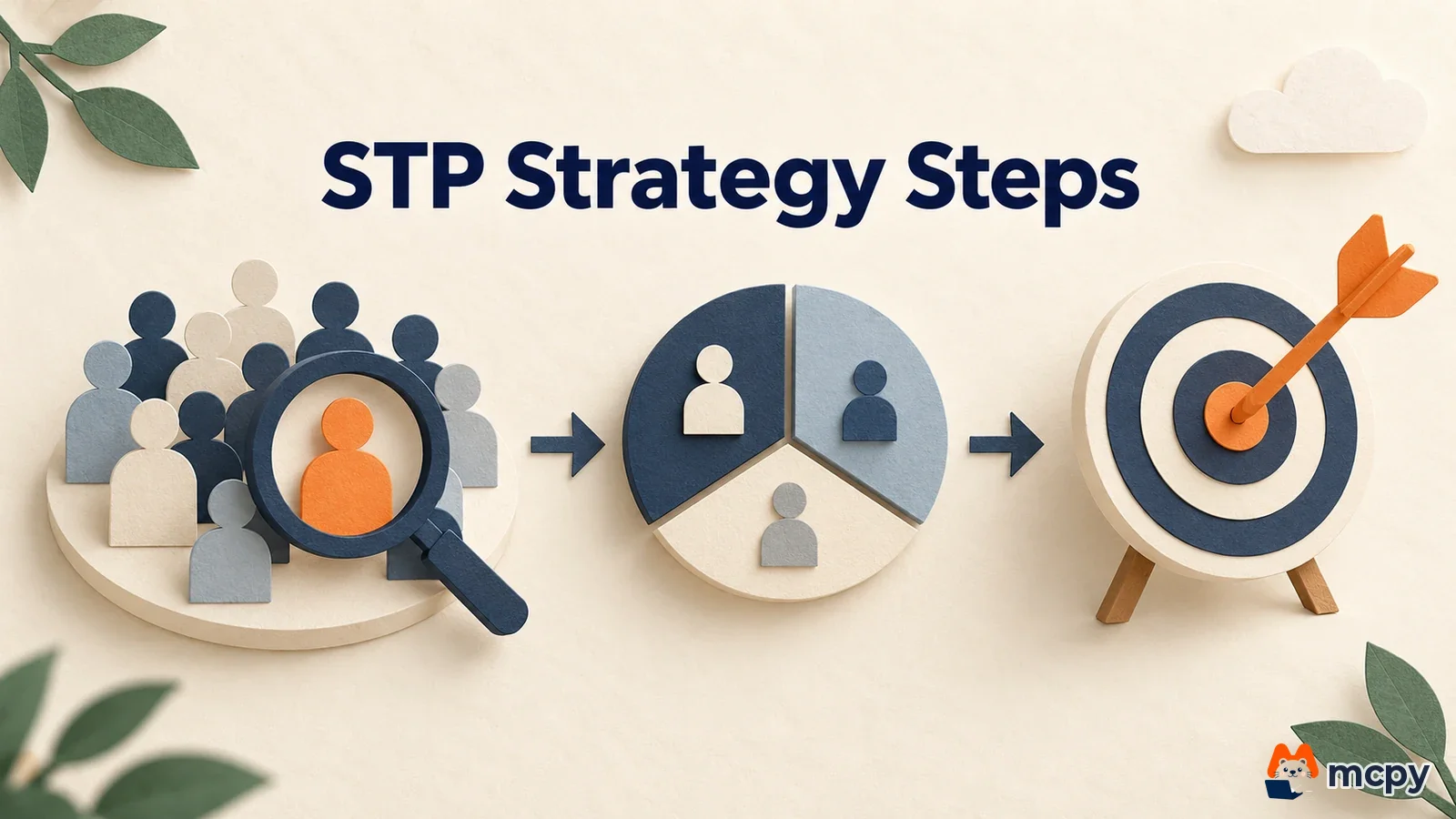
STP strategy is a three-step marketing framework. You divide the market into groups of similar customers (Segmentation), choose the group to pursue (Targeting), and decide the place you want that group to associate with you (Positioning). It exists to settle "who are we speaking to, and what should they remember us for" before you spend on ad creative and budget. Without this order, ad targeting tends to drift into guesswork. The option names for Google Ads and Meta follow their official help pages as of October 12, 2026.
STP strategy is a three-step framework with a fixed order
Wikipedia's STP entry describes segmentation as sorting consumers into categories called segments, targeting as choosing the most attractive (usually most profitable) segments, and positioning as offering a distinct competitive advantage for each segment. The order matters because positioning depends on the group you picked. If you have not chosen who you serve, a line like "we are an affordable brand" leaves open who it is affordable for.
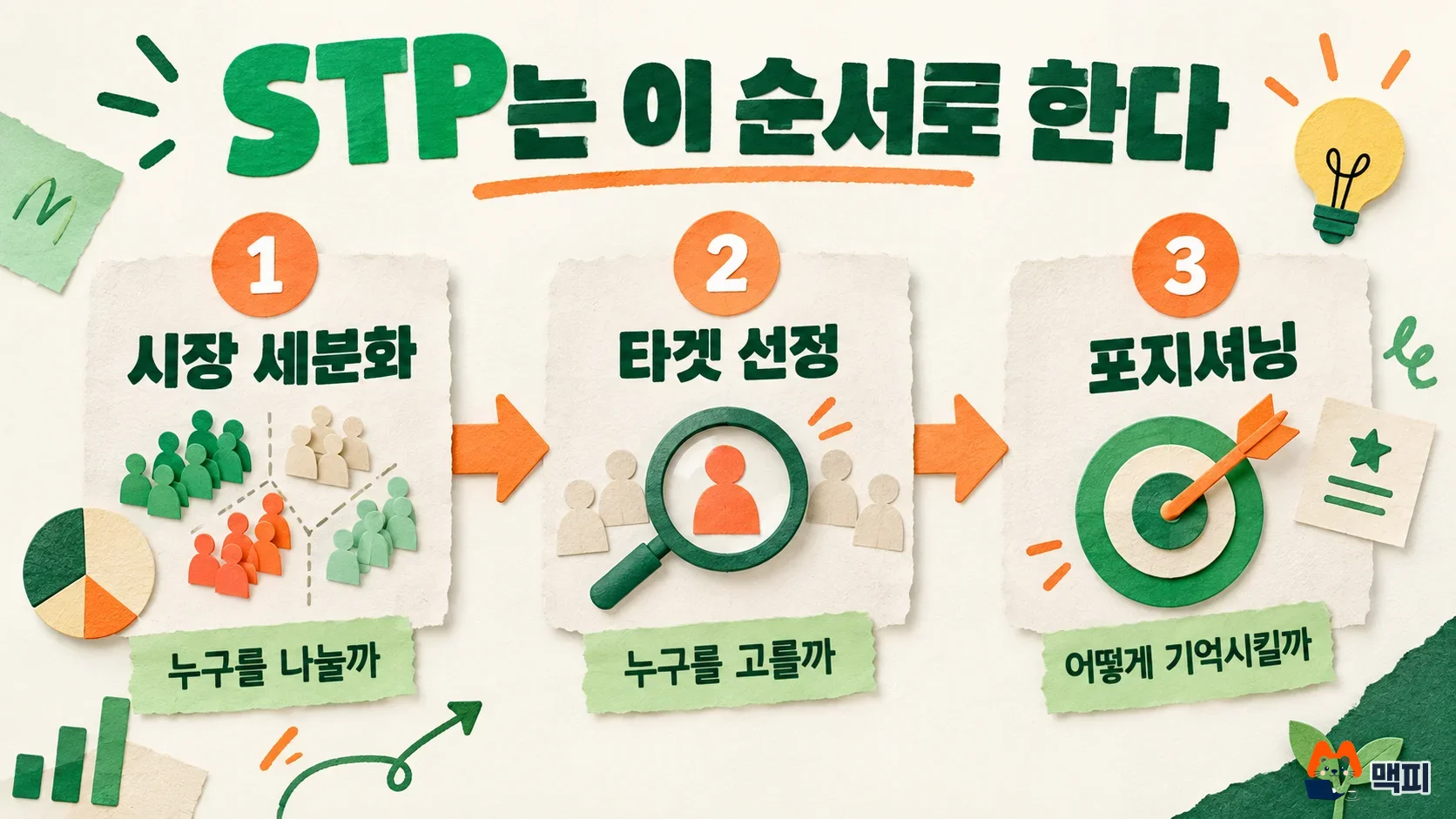
In its article on target audiences, Harvard Business School Online explains segmentation as grouping consumers with similar needs and preferences into segments. It defines a target audience as the group most likely to be interested in a product or service. The same article says it is very hard to define a target audience without customer data. If you already have purchase and visit data, STP becomes a way of reading that data in order.
Build your STP strategy in five steps
Follow the steps below and you end up with a one-page STP document. The output of each step is the input of the next.
- Find one criterion in your customer data that splits customers by reason for buying. Purchase timing and frequency in order records, site visit paths and customer inquiries are good starting points. The output is one sentence: "Customers split by ○○ because of ○○."
- Build two or three segments on that criterion and compare their size and revenue contribution. Drop any segment that fails the measurable, accessible, sustainable and actionable tests Wikipedia describes. The output is a prioritized list of segments.
- Pick the top segment as your target and choose a coverage approach (undifferentiated, differentiated or niche). The output is a decision such as "This quarter we pursue only the ○○ segment."
- Place competitors on two axes to find the empty space, then write a positioning statement: "For (target), we are chosen over (competing alternative) because of (benefit)."
- Put that statement as-is on the first screen of your ad creative and landing page, and set the segment in the targeting options of your ad manager.
Four segmentation bases and how to choose one
Wikipedia lists four segmentation variables: geographic, psychographic, demographic and behavioral, and notes the classification was proposed by Philip Kotler. Which base fits depends on where the reasons for buying your product diverge. If reasons differ by age, use demographics. If they differ by trade area, use geography. If they differ by how people use the product, use behavior.
| Basis | Example split | Where it maps in ad targeting options |
|---|---|---|
| Demographic | Age, gender, income, occupation | Detailed demographics in Google Ads, demographics in Meta Detailed Targeting |
| Geographic | Province or city, trade area, home and workplace | Location targeting in each ad platform |
| Psychographic | Interests, values, lifestyle | Affinity segments in Google Ads, interests in Meta Detailed Targeting |
| Behavioral | Purchase count, visit timing, cart abandonment | In-market and Your data segments in Google Ads, Meta Custom Audiences |

Behavioral bases connect most directly to ad data. HBS Online's article on behavioral segmentation defines it as grouping users by their behavior and interactions with a company, product or service. It gives examples such as first-time buyers and repeat buyers, cart abandoners, and regular users and power users. The same article recommends reviewing segments regularly because customer behavior changes.
Targeting means choosing which segment to pursue
According to Wikipedia, a useful segment must be measurable, accessible, sustainable and actionable. In advertising terms, you must be able to count its size, have a way to reach those people on an ad platform, avoid a segment so small it is used once and finished, and be able to write a message made only for that group.
A real example is Nike, cited by HBS Online. According to the same article, because 40% of Nike's audience is women, Nike tailors its sponsorship of female athletes, its diverse models and its messaging about overall health to that group. It shows how choosing a segment changes the message around that group.
After choosing, you decide how to cover the market. Wikipedia divides coverage approaches into three: undifferentiated, differentiated and niche.
| Approach | What it does | When it fits |
|---|---|---|
| Undifferentiated | Sends one message to the whole market | The product is simple and reasons for buying are nearly the same |
| Differentiated | Sends a different message to each of several segments | Each segment buys for different reasons and the budget can support several messages |
| Niche | Concentrates on one small segment | The budget is small or competitors have left a group unserved |
MCPY recommends that small-budget advertisers start with a niche and expand to adjacent segments once results come in. This is not a rule from any official documentation. It is an operational reason: splitting ad spend across many messages leaves fewer clicks and conversions per message, which makes it hard to compare which one works.
Positioning turns your target into one reason to choose you
Positioning is the work of writing, in one sentence, "the reason to choose us over others" for your chosen group. Wikipedia separates positioning into three types: functional (meets a need), symbolic (fulfills self-esteem) and experiential (connects through senses or emotion), and notes that using all three together works well. Which type to lead with depends on what your target looks at when choosing.
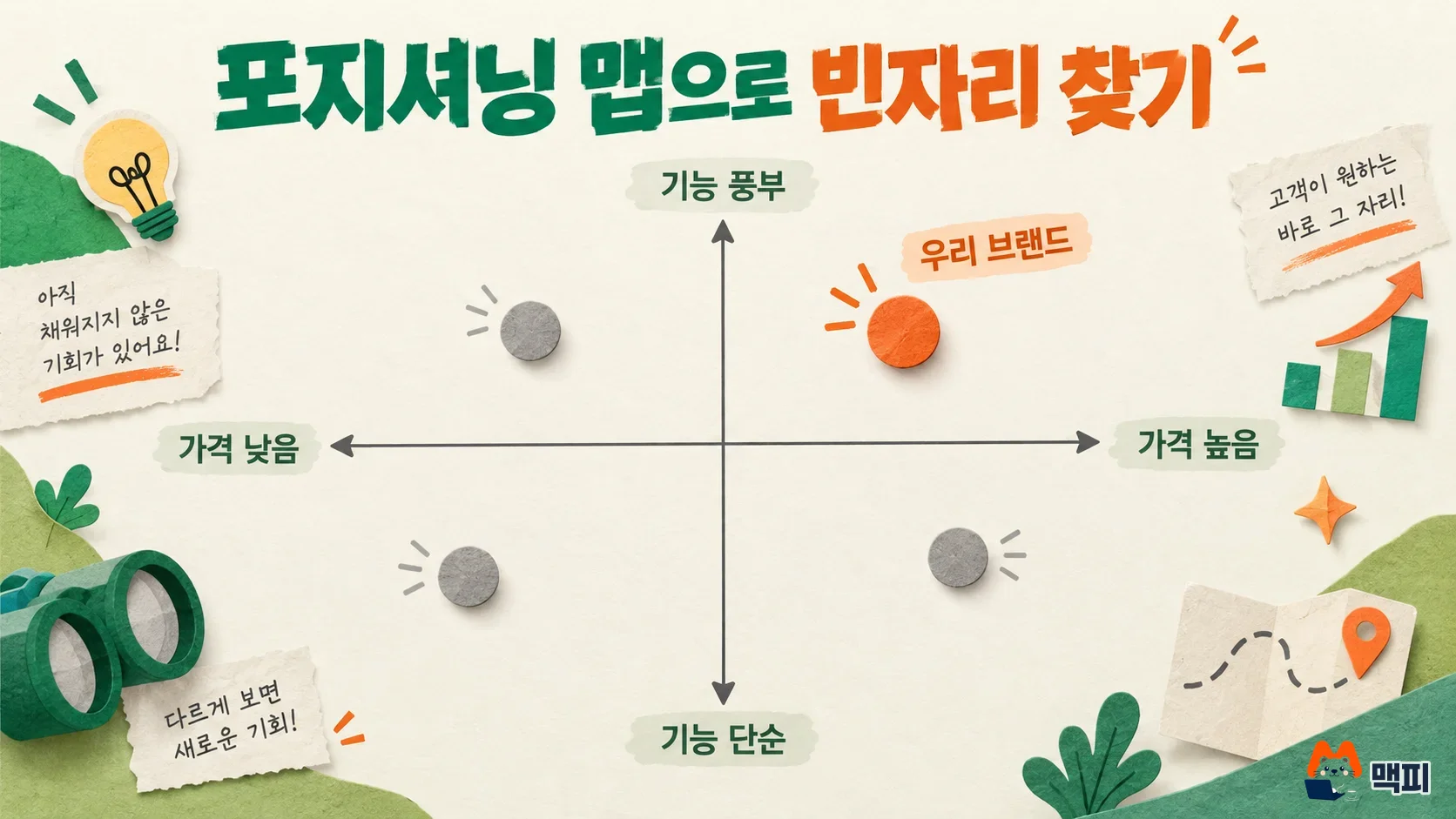
Drawing a positioning map, which places competitors on two axes such as price and features, reveals the empty spaces. The two axes must be criteria your target actually compares. A crowded cell is a place where you are already being compared. To check whether an empty cell has demand, use the segment sizes you built earlier.
Move your STP results into ad targeting
Once your segments are set, move them into the targeting options of your ad manager. Google Ads help divides audience segments into affinity, custom, detailed demographics, life events, in-market, your data and more. According to the same help page, affinity reaches users by their passions, habits and interests. Custom lets you enter keywords, URLs and apps to reach the audience you want. In-market reaches users who are actively researching similar products or services. Your data means users who have interacted with your website, app or customer data.
Meta's business help explains that Detailed Targeting refines audiences by demographics, interests and behaviors. Custom Audiences are built from an advertiser's own data sources or Meta engagement data and are used for retargeting and new customer campaigns. Lookalike Audiences find other users most similar to a Custom Audience source. Google Ads audience targeting is available only for some campaign types, so first check whether the campaign type you plan to use supports it.
| What STP decided | Google Ads | Meta |
|---|---|---|
| Demographic segment such as age and gender | Detailed demographics | Demographics in Detailed Targeting |
| Interest and lifestyle segment | Affinity | Interests in Detailed Targeting |
| People who already bought or visited | Your data | Custom Audiences |
| New customers similar to existing customers | Lookalike segments (Demand Gen campaigns only) | Lookalike Audiences |
STP strategy example: a neighborhood cafe (hypothetical)
This is an illustrative assumption, not a real case. Say a cafe sells coffee within its trade area. Its order records show that weekday-morning office workers buying takeout and weekend-afternoon customers who sit and work come to the same shop for different reasons. For segmentation, it uses a behavioral basis: timing and way of using the cafe. For targeting, the budget is small, so it takes a niche approach and picks only one group, weekday-morning takeout office workers. For positioning, it uses the functional type and settles on "coffee in your hand within 3 minutes on your way to work."
These decisions carry straight into the ad settings. Narrow the location to office-dense areas within a radius of the shop, schedule ad hours around the start of the workday, and use only one message in the creative: short waiting time. Keep the message and budget shown to weekend customers separate so the results of the two groups do not mix.
Check whether your STP worked with segment-level results
Right after setup, check in the ad manager whether impressions and clicks are actually accumulating for each segment. Then put the conversion count and cost per conversion for each segment side by side over the same period. If only one segment is unusually weak, revisit the targeting choice or the message. To judge whether the positioning worked, check whether the click-through rate and conversion rate of creatives using that statement beat the earlier creatives.
A common mistake is defining segments only by demographics such as age and gender. As the HBS Online article above says, a target should rest on customer data, so look first at the purchase and visit behavior data you already have. Another common mistake is building segments once and leaving them. When customer behavior changes, the segment criteria need to be read again.
Frequently asked questions
Is STP analysis different from STP strategy?
Usually they refer to the same framework. Analysis stresses the research side of dividing the market and evaluating segments. Strategy stresses the side that sets messages and budget from the result.
How many segments are right?
There is no set number. Keep only as many as pass Wikipedia's criteria (measurable, accessible, sustainable, actionable). Starting with two or three and comparing results is easier to manage.
Where do I start if I have almost no customer data?
Ask the few customers you already have why they bought, and look first at purchase timing and frequency in your order records. Once ads are running, segment-level results become the fastest source of data.
Found this useful? Share it
Latest posts
Kakao Share Thumbnail Not Showing? Here's the Fix (JavaScript SDK 2025)
Learn why Kakao Share thumbnails don't appear even with a valid imageUrl, and fix it using scrapImage to convert your URL into a KAGE CDN URL. Step-by-step guide.
How to Generate CRM User Manuals in 20 Minutes with Claude Code Sub-Agents
Learn how Claude Code sub-agents can analyze your CRM codebase and auto-generate user manuals and visual guidebooks in just 20 minutes. See the real-world results.
GEO Generative Engine Optimization: The Complete 2025 AI Marketing Strategy Guide
Learn what GEO (Generative Engine Optimization) is, how it differs from traditional SEO, and discover 5 proven AI marketing strategies to get cited by AI search engines in 2025.
Related projects
Get new posts by email
Insights on marketing, analytics, and dev, delivered to your inbox.