
SWOT analysis is a framework that splits the current state of a business or campaign into four boxes: strengths, weaknesses, opportunities and threats. You then combine the boxes to pull out what to do next. Strengths and weaknesses are internal factors you can change. Opportunities and threats are external factors that are hard to control. In marketing, each box needs GA4 and search data behind it, or the table ends up as a pile of opinions (as of October 12, 2026).
SWOT analysis means four boxes, internal and external
The Salesforce Korean blog introduces SWOT as a strategy tool for objectively evaluating the performance of your company and your competitors. Strengths and weaknesses are internal factors an organization can change through its own effort, such as reputation, team, company location and intellectual property. Opportunities and threats are external factors that are hard to control, such as competitors, market trends and material prices. Think of it as a 2×2 table: internal versus external on one axis, helpful versus harmful on the other. That keeps the boxes from getting mixed up.
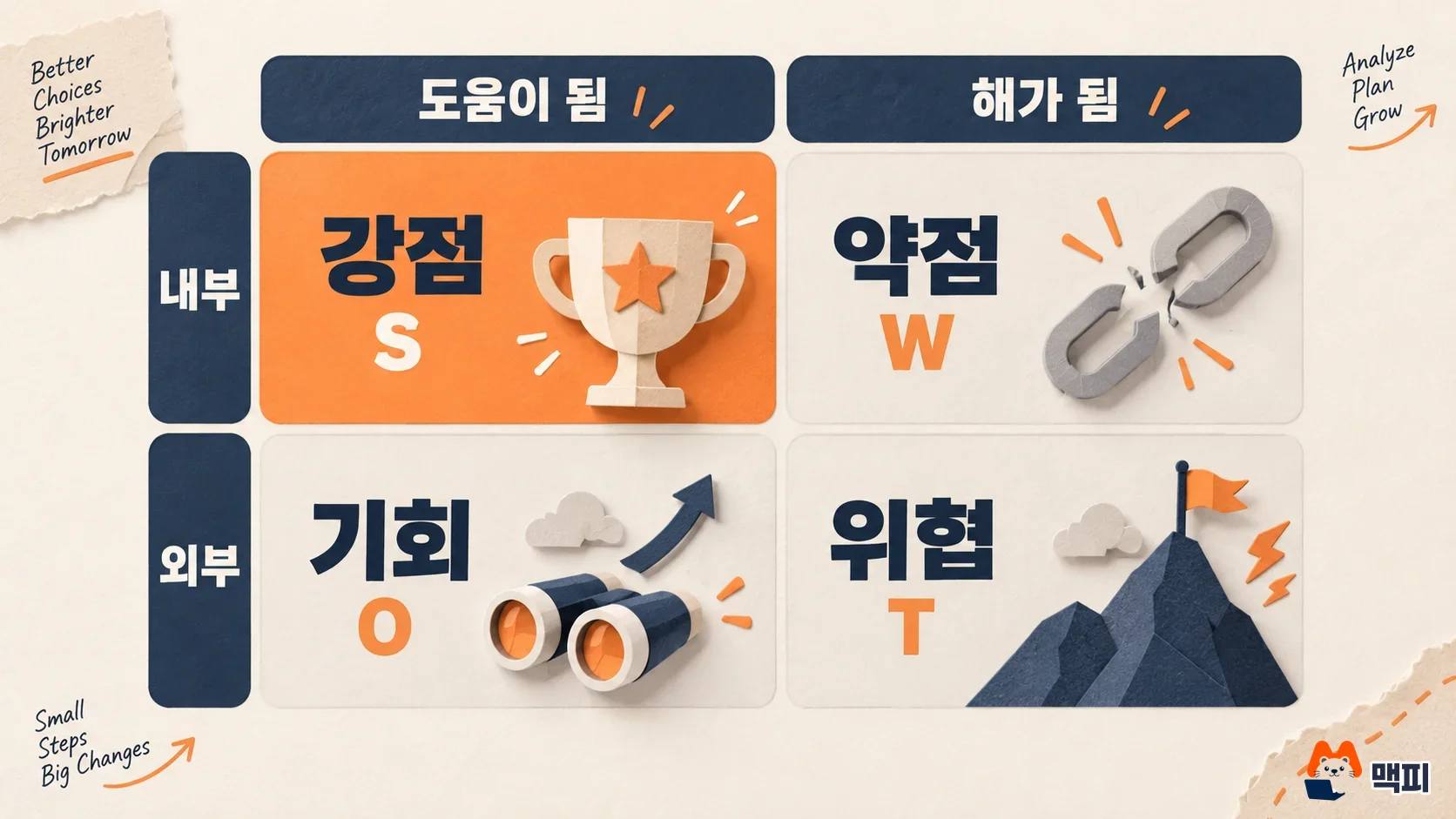
| Box | Internal or external | Marketing examples |
|---|---|---|
| Strength (S) | Internal, helpful | A product with a high repurchase rate, a product with many reviews, fast delivery |
| Weakness (W) | Internal, harmful | Drop-off at the checkout step, new traffic depending on one channel, low ad conversion rate |
| Opportunity (O) | External, helpful | Rising interest in related search terms, low-competition keywords, a new ad channel opening |
| Threat (T) | External, harmful | Competitor ads at a similar price point, higher channel fees, falling demand |
Marketing SWOT analysis: what to fill each box with
If you write by feel, like "the quality is good" or "competition is fierce," every reader interprets it differently. The Adobe Korean blog also advises setting the purpose and goals as measurable numbers, and expressing factors as numbers rather than subjective judgments where possible. Here is how to back each box with public tools marketers already use.
| Box | Data to use as evidence | Where to look |
|---|---|---|
| Strengths and weaknesses | Key event count, engagement rate, bounce rate | GA4 landing page and user acquisition reports |
| Opportunities | Search interest trend, related queries | Google Trends, Naver keyword tool |
| Threats | Competitors' active ads, falling interest | Meta Ad Library, Google Trends |
This pairing of boxes and data is not a rule set by official documentation. It is a layout that is easy to use in practice. It carries over the internal and external split of SWOT directly. Strengths and weaknesses are internal factors measured directly on your channels and site, so you fill them with GA4 and ad account data. Opportunities and threats are market factors outside your business, so you fill them with search interest and competitor ads.
GA4 describes key events as events that measure actions especially important to business success, and says the landing page report and the user acquisition report have a "Key events" column. If you compare key events by channel in the same report, the traffic sources that lead to the target action become evidence for the strengths box. Sources with almost no conversions become evidence for the weaknesses box. For GA4 setup and key event configuration, follow the article How to sign up for and install Google Analytics GA4.
Bounce rate in GA4 is the share of sessions that were not engaged. According to the Google help page, an engaged session is one that lasts 10 seconds or longer, has at least 1 key event, or has at least 2 screen or page views. If a high share of visitors from ads view one page and leave within 10 seconds, that is evidence the landing page is a weakness.
Fill opportunities and threats with market-side data. The 0 to 100 values in Google Trends are relative popularity, not absolute search volume, and queries with low volume show as 0 or carry a lot of statistical noise. So write only trends that rise over several months or more into the opportunities box, and do not use a spike of a day or two as evidence. If your business depends heavily on Naver search traffic, like a Korean online shop or blog (Naver is Korea's largest search engine), Google Trends alone will not show all the demand, so also check the monthly search counts in the Naver Search Ads keyword tool. How to use it is in the article How to use the Naver keyword tool. Anyone can search which ads a competitor is running right now in the Meta Ad Library. Usage is covered in the article How to use the Meta Ad Library.
How to write a SWOT analysis in order
There are four steps: set the goal, fill the boxes, combine them, and decide what to do. If you start by filling the table, the items grow without end. So first write in one sentence what decision you are writing this for.
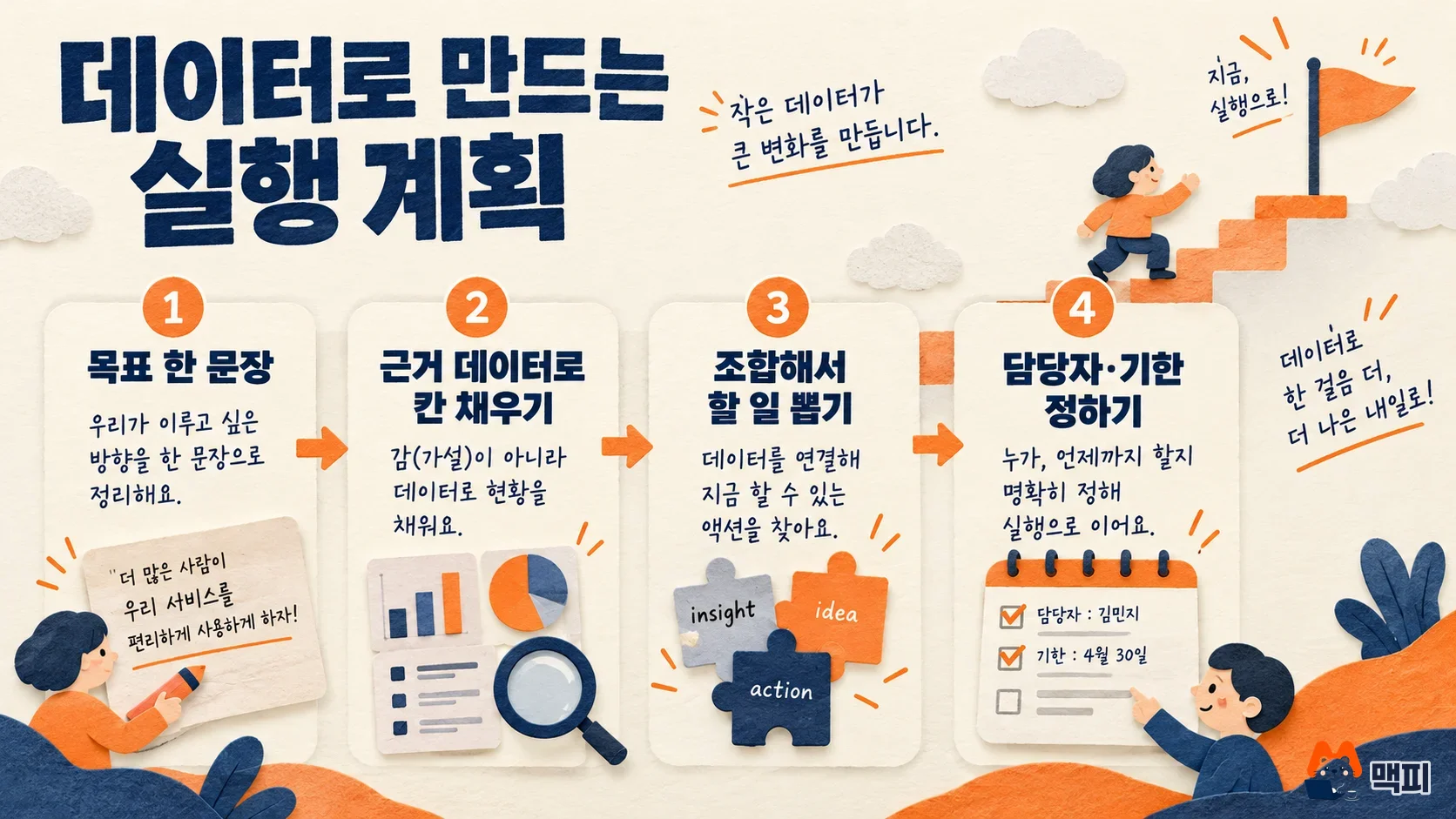
- Write the goal in one sentence. For example, "Increase repeat orders on our own store next quarter." Make the period and the target visible. If the goal is vague, you cannot even judge whether the same factor is a strength or a weakness.
- Fill the four boxes with the data in the table above. You do not need the same number of items in each box. Start with the factors that most affect the goal. Mark which values are confirmed by evidence and which are still assumptions.
- Combine the boxes with each other to pull out strategy candidates. This is covered in the next section.
- As the Salesforce blog advises, set priorities starting with the most important factor and assign an owner to each task. Also write down the deadline and the metric to check.
SWOT analysis example and cross strategies
Take a fictional handmade cookie shop that runs both a Smartstore (Naver's online marketplace) store and its own online store. The goal is "increase repeat orders on our own store next quarter," and the numbers below are assumptions made up for explanation.
| Box | Example items (assumed) |
|---|---|
| Strengths | Own-store buyers have a high repurchase rate. There are many reviews of the gift packaging. |
| Weaknesses | Many shoppers drop off at the checkout step. Most new orders come from one channel. |
| Opportunities | Search interest in "handmade cookie gift" rises ahead of year-end. |
| Threats | A competitor has increased ads for gift sets at a similar price point. |
After filling the four boxes, cross them with each other. The Adobe blog introduces cross analysis, which combines strengths with opportunities, strengths with threats, weaknesses with opportunities, and weaknesses with threats. You do not need to run all four combinations. Pick the one or two closest to your goal.
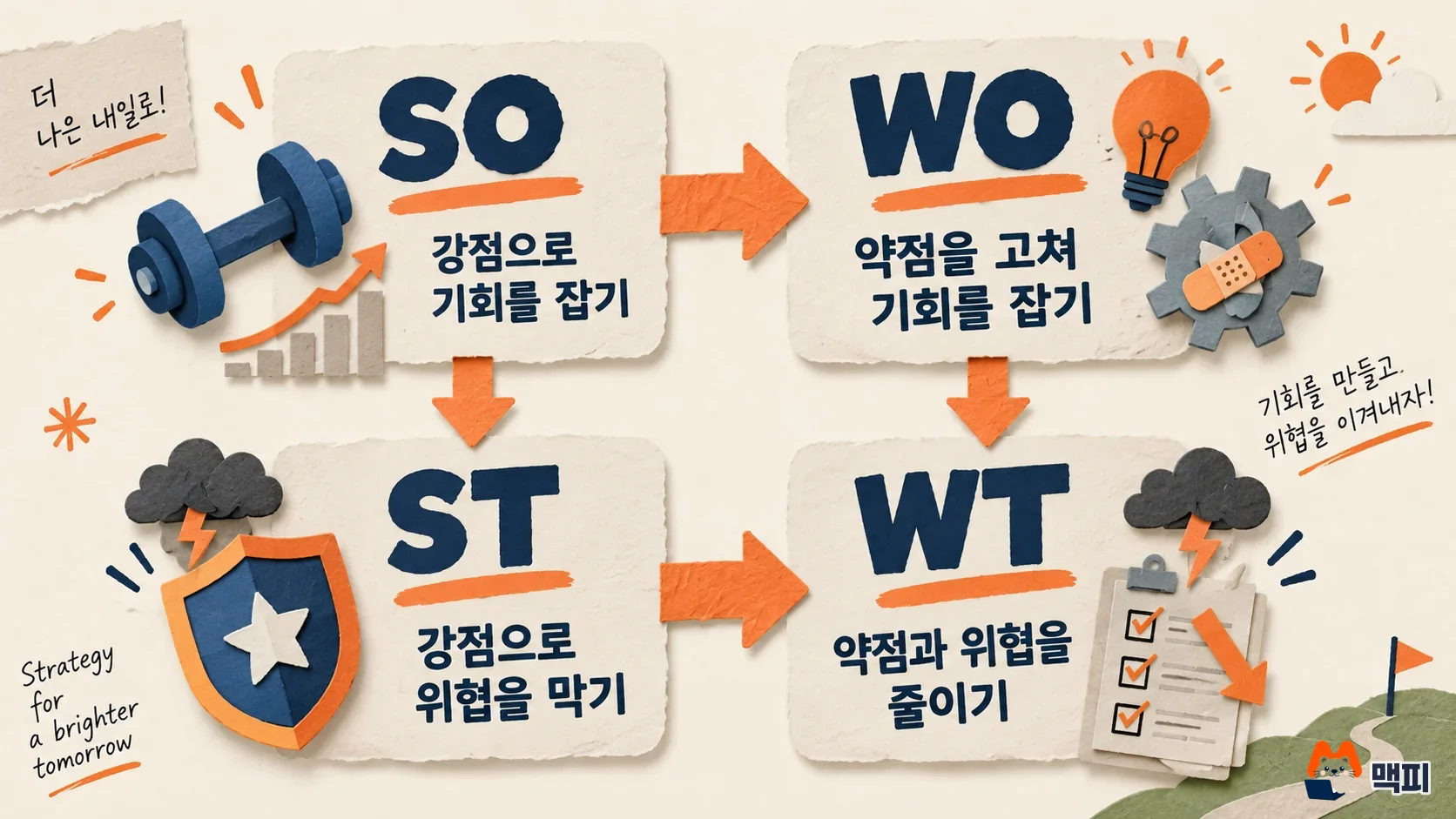
| Combination | Question | Action from the example above |
|---|---|---|
| SO (strength × opportunity) | How do we seize the opportunity with our strength? | Concentrate ads on the year-end search interest window with the gift packaging set that has many reviews |
| WO (weakness × opportunity) | How do we avoid missing the opportunity because of our weakness? | Reduce checkout drop-off first, then increase gift season ads |
| ST (strength × threat) | How do we avoid the threat with our strength? | Skip the price fight and use repurchase benefits and packaging reviews in ad copy |
| WT (weakness × threat) | How do we avoid the worst case? | Shift part of the search ad budget to other channels to reduce dependence on one channel |
Once you decide what to do, write the metric to check after execution. In the example above, compare the own store's key event count and engagement rate in GA4 against 4 weeks earlier. How to choose metrics is covered next in the article What KPI means and how to set marketing KPIs.
There are two things to do this week. Write the goal in one sentence. Then copy the key event count and engagement rate by channel for the last 4 weeks from the GA4 landing page report into your table. Even with just these numbers, the strengths and weaknesses boxes are filled with evidence, not opinion.
Common mistakes in SWOT analysis
The most common mistake is mixing opportunities and strengths. The Adobe blog points out that a product that fits a trend is not automatically a strength. Write the market trend in the opportunities box, and write your own inventory, reviews and technology that can respond to that trend in the strengths box. Mixing internal and external factors blurs the cross strategies.
The second mistake is stopping once the table is filled. Filling only the boxes produces a table you can put in a report, but it produces no actions. The analysis is finished only when you pull out the cross strategies and attach owners and deadlines.
The third mistake is writing it once and leaving it for a long time. The Salesforce blog also recommends redoing the analysis after a period, because many factors change over time. Reopen it when ad seasons or channel policies change, and at the start of each quarter.
SWOT analysis FAQ
How many items should I write in each box?
There is no fixed number. Do not force boxes to match in count. Write the items that most affect the goal first, then set priorities.
Can the same factor be both a strength and a weakness?
The Adobe blog explains that depending on the viewpoint, the same factor can be either a strength or a weakness. Decide which side it is closer to based on the goal, and if it is unclear, attach evidence data to decide.
How often should I redo a SWOT analysis?
The Salesforce blog advises redoing the analysis after a period of time. Write it again when you set new goals each quarter, or when ad channel policies or the competitive situation change significantly.
Found this useful? Share it
Latest posts
Kakao Share Thumbnail Not Showing? Here's the Fix (JavaScript SDK 2025)
Learn why Kakao Share thumbnails don't appear even with a valid imageUrl, and fix it using scrapImage to convert your URL into a KAGE CDN URL. Step-by-step guide.
How to Generate CRM User Manuals in 20 Minutes with Claude Code Sub-Agents
Learn how Claude Code sub-agents can analyze your CRM codebase and auto-generate user manuals and visual guidebooks in just 20 minutes. See the real-world results.
GEO Generative Engine Optimization: The Complete 2025 AI Marketing Strategy Guide
Learn what GEO (Generative Engine Optimization) is, how it differs from traditional SEO, and discover 5 proven AI marketing strategies to get cited by AI search engines in 2025.
Related projects
Get new posts by email
Insights on marketing, analytics, and dev, delivered to your inbox.