
If you were paid or given a product for a post, you must place an ad or sponsorship label in the title or at the very start of the post, where readers can see it. As of September 30, 2026, the biggest change is the penalty. From July 1, the look-back period for repeat violations grew from 3 years to 5 years, and a fourth violation or more can add up to 100% to the fine.
The short version
- Hidden ad standard: cash is not the only compensation. Free products, discounts and affiliate link revenue all count as economic compensation. If you received any, disclose it.
- Where to disclose: on a blog, in the title or the first part. On Instagram, in the first hashtag or on the photo. In video, in the title and the opening of the video. A label placed behind "See more" is not treated as a disclosure.
- What changed: the December 1, 2024 guideline revision set the blog placement rule. The virtual person labeling duty followed on June 1, 2026, and the stronger fines on July 1, 2026.
What counts as a hidden ad
"Hidden ad" (backad, literally "back-door ad") is the Korean term for a review or recommendation post where the writer received compensation from an advertiser but did not say so. It is not a legal term. The Korea Fair Trade Commission (KFTC) treats it as a deceptive labeling and advertising practice, because it leads consumers to believe the post is a pure, unpaid review.
Economic compensation is read broadly here. It is not only a writing fee. A free product, a discount, and a sales commission earned through an affiliate link all count. The endorsement and testimonial review guideline revision that took effect on December 1, 2024 also asks you to disclose compensation you have not yet received but were promised, and conditional compensation. An example is an event where writing a review enters you in a prize draw.
The revision of the deceptive labeling and advertising review guideline, in effect since October 30, 2025, states clearly that not disclosing compensation is a form of deception. An advertiser running an account that poses as a third-party recommendation falls under the same type.
Where to place the sponsorship label and what to write
There is one standard. A consumer seeing the post for the first time must be able to notice the label without scrolling or clicking. The KFTC's revised endorsement and testimonial guideline handbook (press coverage on December 2, 2025) breaks this into four principles: accessibility, noticeability, clarity, and language consistency. Language consistency means that if the post is in Korean, the label is also written in Korean.
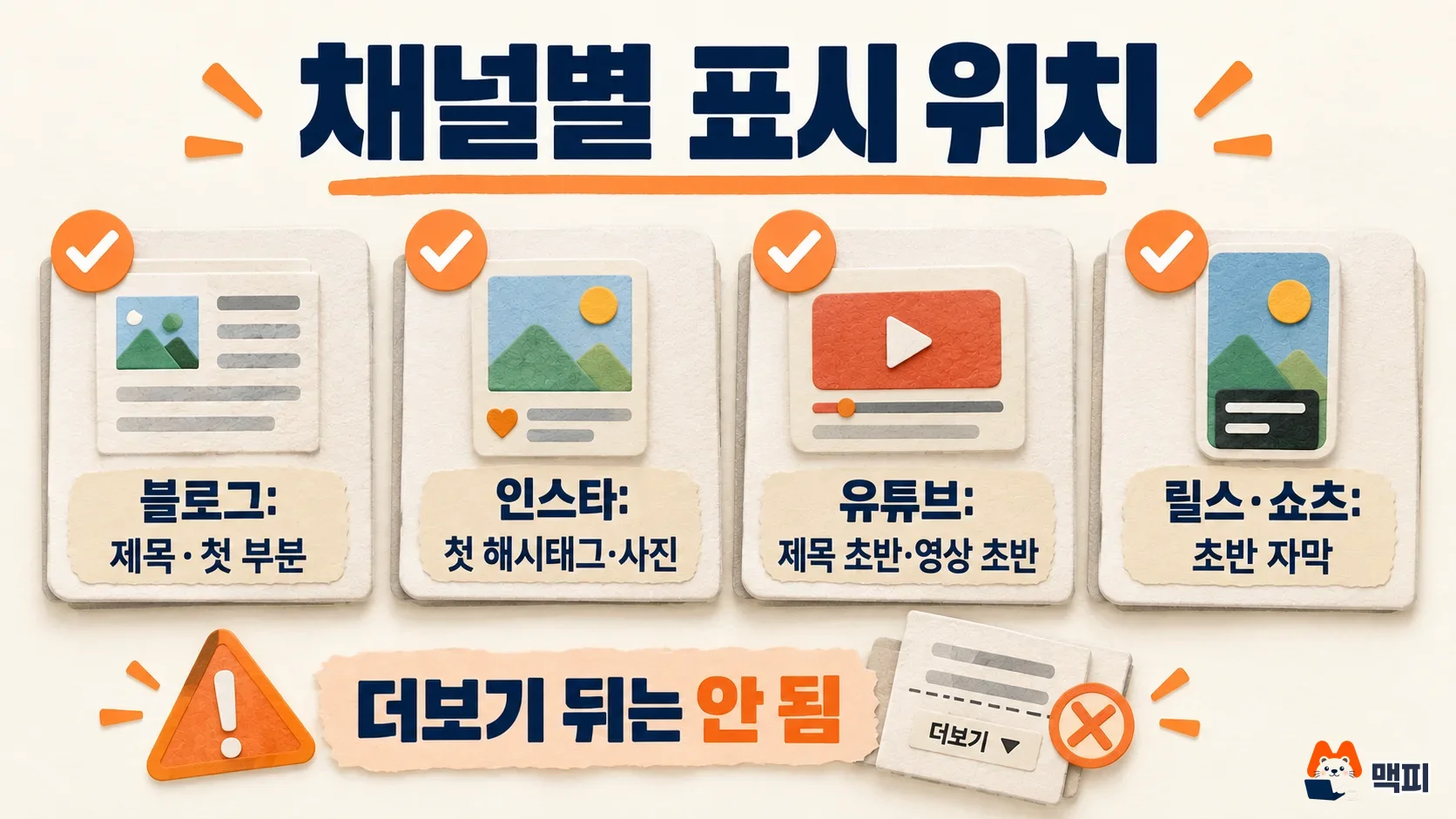
The methods by channel, taken from the handbook and material summarizing it, are below.
| Channel | Safe placement | Risky placement |
|---|---|---|
| Blog | The post title or the first part | Only in the middle or at the very bottom of the body |
| Instagram and Facebook | The first hashtag, or text on the photo | Anywhere that needs a tap on "See more", or the second hashtag and later |
| YouTube | The start of the title, the paid promotion label feature, the start of the video | Only at the bottom of the description |
| Reels and Shorts | A caption or voice-over near the start of the video | A caption in the last 1 second |
The wording only needs to be short and clear, such as "Ad", "Sponsored", or "Written with a provided product" (in Korean: gwanggo, hyeopchan, or a phrase saying the product was provided). These three are examples to help you. They are not fixed phrases set by the KFTC. MCPY recommends the Korean words gwanggo (ad) and hyeopchan (sponsored) over English abbreviations like "#ad" or vague phrases like "a modest writing fee". Consumers should be able to read the label at a glance.
What changed from December 2024 to July 2026
| Effective date | Announced | What changed |
|---|---|---|
| December 1, 2024 | November 15, 2024 | Revised endorsement and testimonial review guideline took effect. Blog posts must carry the label in the title or first part, and future or conditional compensation became subject to disclosure. |
| October 30, 2025 | Not confirmed | The deceptive labeling and advertising review guideline now names non-disclosure of economic compensation as a type of deception. |
| N/A | Reported December 2, 2025 | Revised endorsement and testimonial guideline handbook was released. Prize draw reviews were added as a case, along with a 25-question Q&A. |
| June 1, 2026 | Reported May 31, 2026 | AI-generated virtual persons became the fifth type of endorser. A blog puts a phrase like "includes virtual person" in the title or first part. |
| July 1, 2026 | Press release June 9, 2026 | The enforcement decree of the Fair Labeling and Advertising Act and the fine notice were revised. Repeat violation surcharges were strengthened and reductions were cut. |
Virtual person labeling is a different matter from hidden ads, but it sits in the same guideline, so check both together. Even if you disclose that the person is virtual, writing as if they actually tried the product can be judged unfair advertising when the content is untrue. In photo and video ads, mark "virtual person" close to the person for as long as the virtual person appears.
How much heavier the fines became
The basic frame of the sanctions is unchanged. The administrative fine is up to 2% of related revenue, or up to KRW 500 million when revenue is hard to calculate. Criminal penalties can reach 2 years in prison or a fine of up to KRW 150 million. According to KFTC guidance, influencers as well as advertisers can be subject to these penalties.
What changed is the calculation used to set the fine. The revision effective July 1, 2026 has three parts.
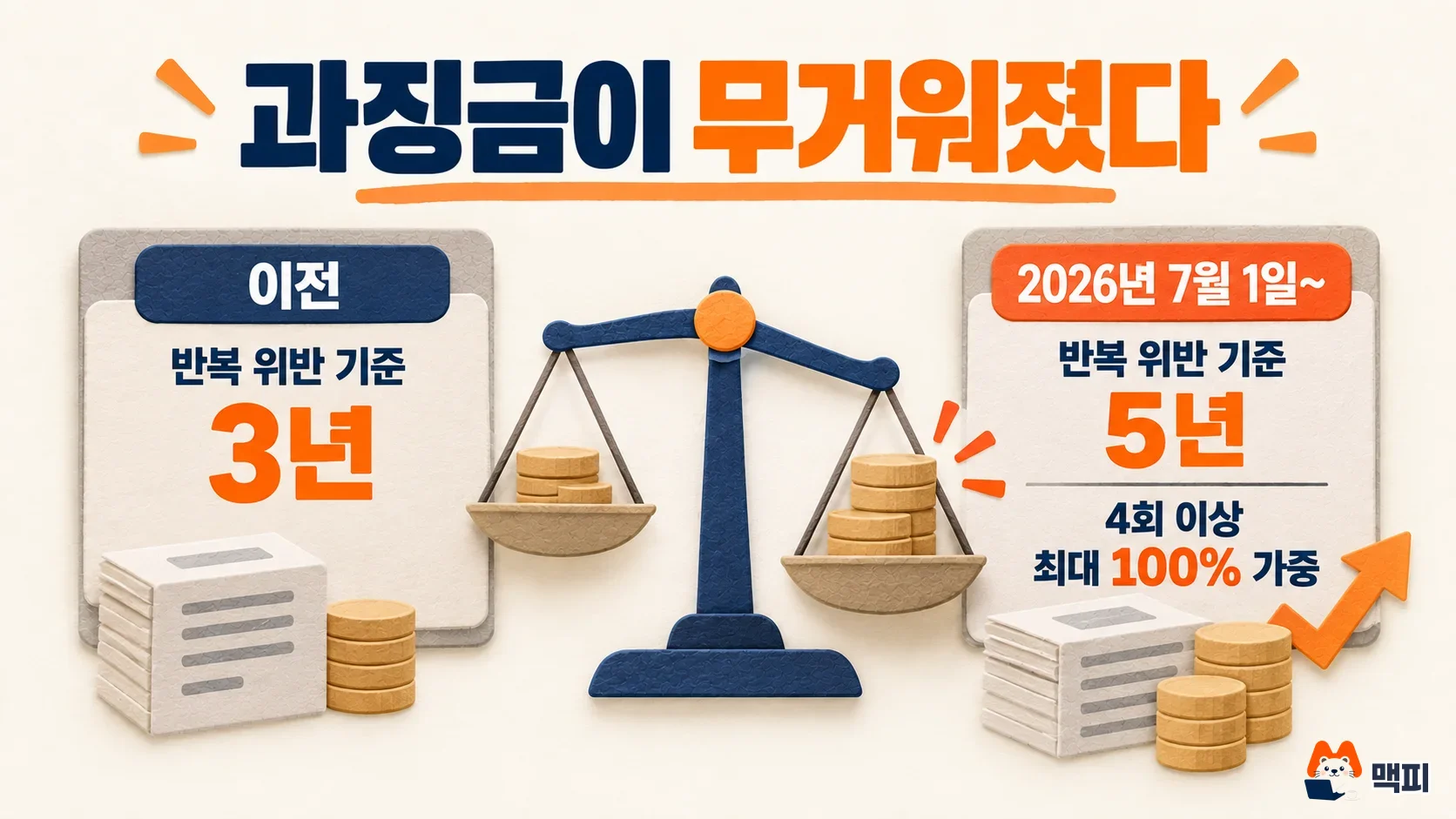
- Surcharge standard: the period for counting past violations grew from 3 years to 5 years. A single violation within 5 years can add up to 50%, and 4 or more can add up to 100%.
- Base rate: for serious violations it rose from 0.8-1.6% to 1.5-1.8%, and for very serious violations from 1.6-2.0% to 1.8-2.0%.
- Reduction: you must cooperate with both the investigation and the deliberation to get a reduction, and the total is capped at 10%. Before, each earned up to 10%, for a maximum of 20%.
It is rare for an individual blogger to face this calculation in full. Still, advertisers and agencies that run review programs ("chehumdan" in Korean, where influencers get free products in exchange for reviews) should update even their contract language.
What to check before you post
Most cases where a label was added and there was still a problem come down to placement. Go through the three steps below once before posting and once after.
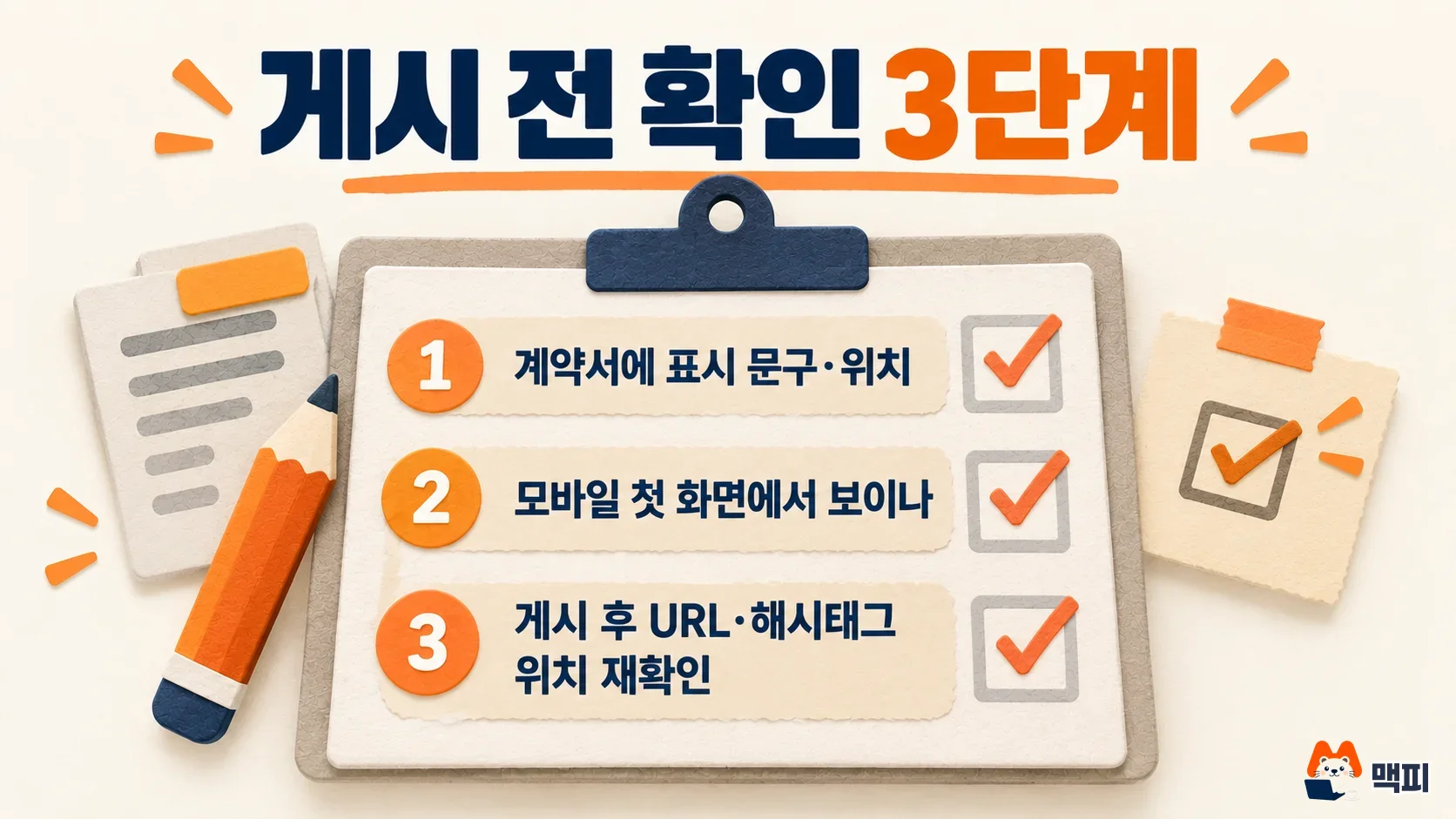
- Write the disclosure wording and its position into the contract or guide. Let the advertiser review it.
- Before posting, check that the label is visible on the first mobile screen. On Instagram, the standard is the point where the caption folds behind "See more".
- After posting, open the actual URL again. Platforms sometimes reorder hashtags or truncate titles, which can hide the label.
What to check specifically in Korea
Review program posts and affiliate link posts on Naver Blog (Naver is Korea's largest search engine and portal) are the easiest to fall into this category. In a review program post, state in the first part that you received the product. In an affiliate link post, state in the first part that you earn a commission through the link. For Naver Blog, check the platform's own guidance separately to see whether it has a built-in sponsorship label feature or a standard opening phrase. MCPY could not confirm this point from a KFTC source, so it is not included in the table above.
Common mistakes
- Writing "naedon-naesan" (Korean slang for "bought with my own money") when the product was free. If there was compensation, the phrase itself creates a misunderstanding.
- Putting the label at the very bottom of the post or in the middle of 20 hashtags. A label in an unnoticeable spot is treated much like no label.
- A celebrity ad model not stating on a personal account that they are the ad model. Even without payment for the post, the ad model relationship must be shown. The exception is when it is clearly an ad right away, such as an ad photo or behind-the-scenes shot.
- Assuming fines go only to the advertiser. Influencers can be subject to them too.
Frequently asked questions
If I received a product but reviewed it honestly, do I still need to disclose?
Yes. The standard is not the content of the review. It is whether a compensation relationship existed.
Can I put "#hyeopchan" (the Korean hashtag for sponsored) at the very end of the hashtags?
No. For Instagram, the safe placement in the handbook is the first hashtag or on the photo.
Is this article legal advice?
No. It summarizes KFTC materials and press coverage. If a contract or dispute is involved, you need the original KFTC text and expert confirmation.
Before you post, open the first screen of the post on mobile and check once more that the ad or sponsorship label is visible without scrolling.
Sources
- Korea Fair Trade Commission, revision of the deceptive labeling and advertising review guideline (effective October 30, 2025)
- Korea Fair Trade Commission, release of the revised handbook on disclosing economic interests
- Ajunews, report on the KFTC endorsement and testimonial guideline handbook revision and release (December 2, 2025)
- Financial News, AI virtual person ad labeling duty (effective June 1, 2026)
- BKL, notice on the revised Fair Labeling and Advertising Act enforcement decree and fine notice
- Seoul city economy news, posting of the KFTC press release on the revised enforcement decrees of three laws and the fine notice (effective July 1, 2026)
- Asia Economy, revision of the enforcement decrees of the three consumer laws (effective July 1, 2026)
- Syncly, influencer labeling and advertising checklist
The reference date is September 30, 2026. KFTC guidelines and handbooks can change, so check the latest documents on the KFTC website before you post.
Found this useful? Share it
Latest posts
Kakao Share Thumbnail Not Showing? Here's the Fix (JavaScript SDK 2025)
Learn why Kakao Share thumbnails don't appear even with a valid imageUrl, and fix it using scrapImage to convert your URL into a KAGE CDN URL. Step-by-step guide.
How to Generate CRM User Manuals in 20 Minutes with Claude Code Sub-Agents
Learn how Claude Code sub-agents can analyze your CRM codebase and auto-generate user manuals and visual guidebooks in just 20 minutes. See the real-world results.
GEO Generative Engine Optimization: The Complete 2025 AI Marketing Strategy Guide
Learn what GEO (Generative Engine Optimization) is, how it differs from traditional SEO, and discover 5 proven AI marketing strategies to get cited by AI search engines in 2025.
Related projects
Get new posts by email
Insights on marketing, analytics, and dev, delivered to your inbox.