
CPC (Cost Per Click) is the amount you pay each time your ad is clicked. The formula is ad spend ÷ clicks, so 600 KRW of spend with 2 clicks gives a CPC of 300 KRW. The max CPC you enter as a bid is different from the CPC you are actually charged. CPM, CPA and CTR differ in the denominator: impressions, conversions and clicks. This article is based on the official help pages of Google, Naver (Korea's largest search engine) and Meta, checked on October 3, 2026.
CPC meaning: the ad cost you pay per click
In cost-per-click (CPC) bidding, Google explains that you pay for each click on your ad. This model is also called pay-per-click (PPC).
How to calculate CPC
Average CPC is the total cost of clicks divided by the total number of clicks. The example in the Google help page is this: two clicks cost 200 KRW and 400 KRW, so the total cost of 600 KRW divided by 2 gives an average CPC of 300 KRW.
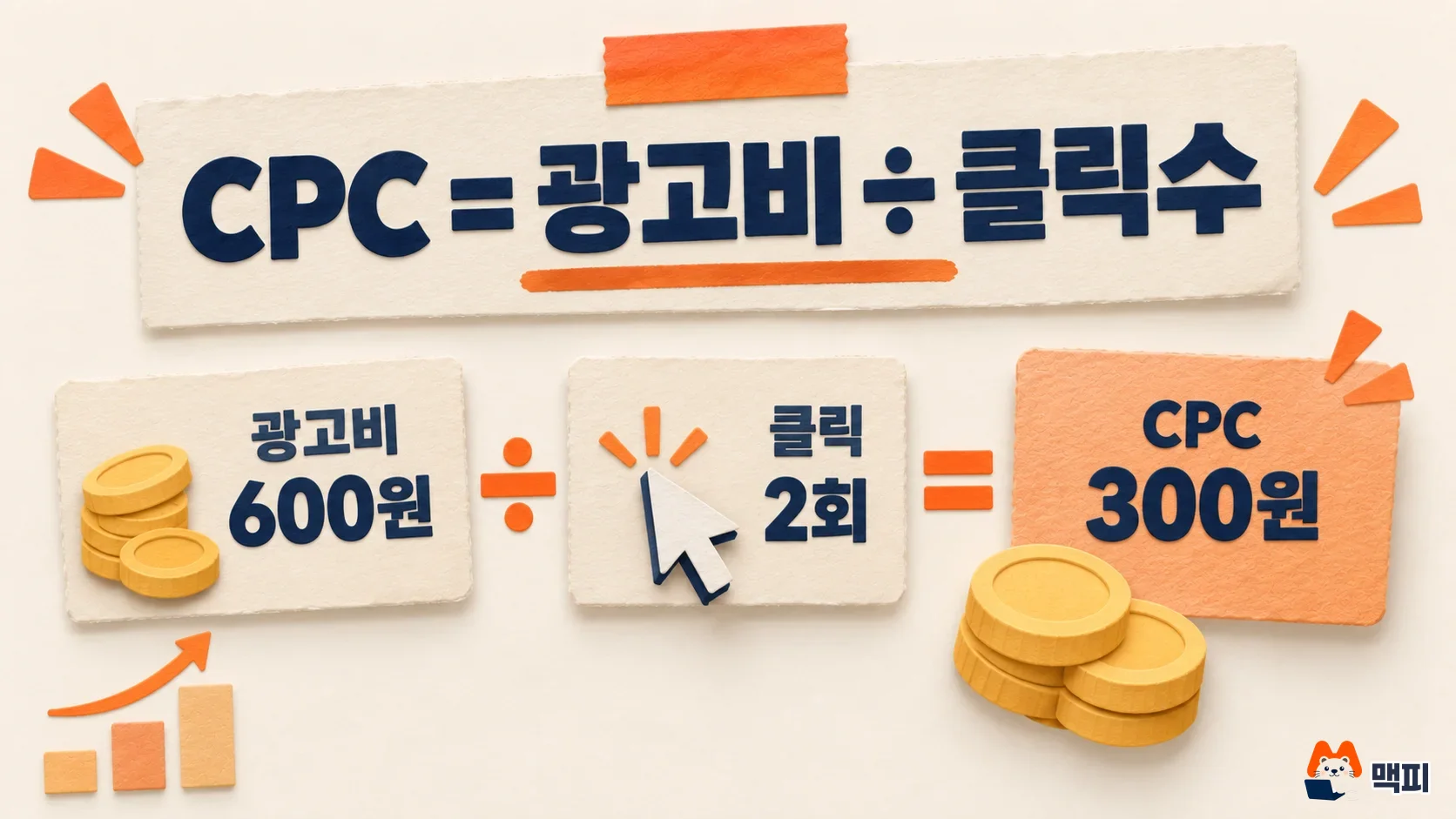
Meta uses the same formula. In the Meta advertising glossary, CPC (cost per link click) is the amount spent divided by the number of link clicks. CPC (all) counts every click, not only link clicks, and is the amount spent divided by the number of clicks (all). So the same ad can show two different values.
The difference between max CPC and actual CPC
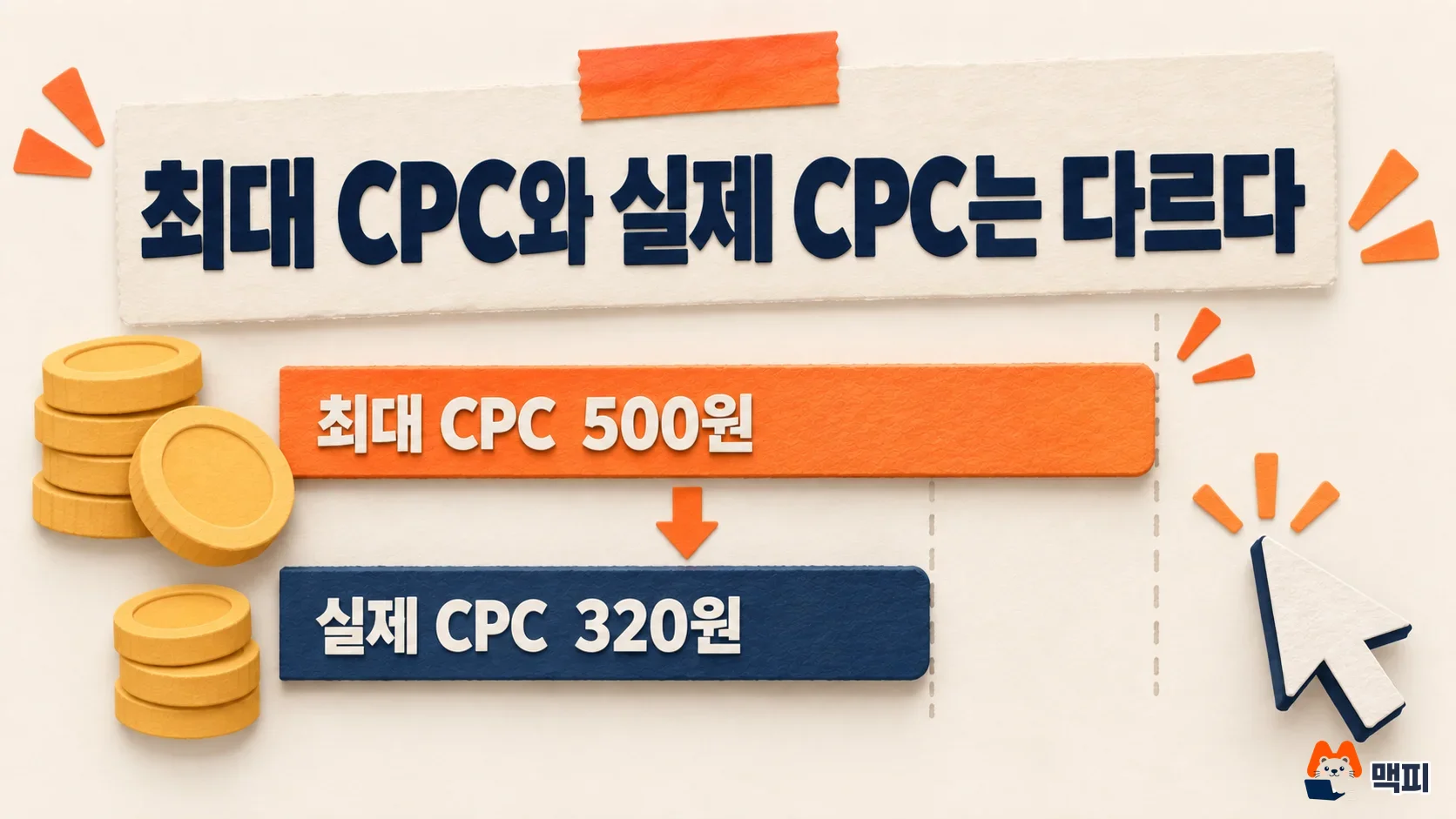
The bid you enter when creating an ad is the max CPC, and Google calls the amount you are actually charged the actual CPC. Max CPC is the upper limit you are willing to pay for one click, and the Google help page explains that the amount actually charged is usually lower. In your Google account, the actual CPC appears in the 'Avg. CPC' column.
On Naver Search Ads, you buy Power Link, Shopping Search Ads and Power Content by bidding. According to the Naver Advertiser Center help page (last updated March 29, 2026), you can set a bid from 70 KRW (50 KRW for Shopping Search Ads) up to 100,000 KRW. Ad rank is decided not only by the bid but also by how relevant the search term and site content are, and by creative quality. For advertisers just starting out, Naver advises setting the default bid as the minimum bid and adjusting it little by little while watching impressions, clicks and ad spend in the ad performance report.
CPM, CPA and CTR meanings and how they differ from CPC
CPC, CPM and CPA differ in what they divide ad spend by. CPC is based on clicks, CPM on 1,000 impressions, and CPA on conversions. A conversion is an action the ad is aiming for, such as a purchase or a form submission. CTR is not a cost. It is the ratio of clicks to impressions.
| Metric | Meaning | Formula | Example from official help pages |
|---|---|---|---|
| CPC | Cost per click | Ad spend ÷ clicks | 2 clicks at 200 KRW and 400 KRW → 300 KRW (Google) |
| CPM | Cost per 1,000 impressions | Ad spend ÷ impressions × 1,000 | $50, 10,000 impressions → $5 (Meta) |
| CPA | Cost per conversion | Total conversion cost ÷ total conversions | 2 conversions at 2,000 KRW and 4,000 KRW → 3,000 KRW (Google) |
| CTR | Share of impressions that became clicks | Clicks ÷ impressions | 5 clicks, 100 impressions → 5% (Google) |
The sources are Google's help pages on CPM, average CPA and CTR, and the Meta advertising glossary. In Google, CPM refers to a bidding method on the Display Network.
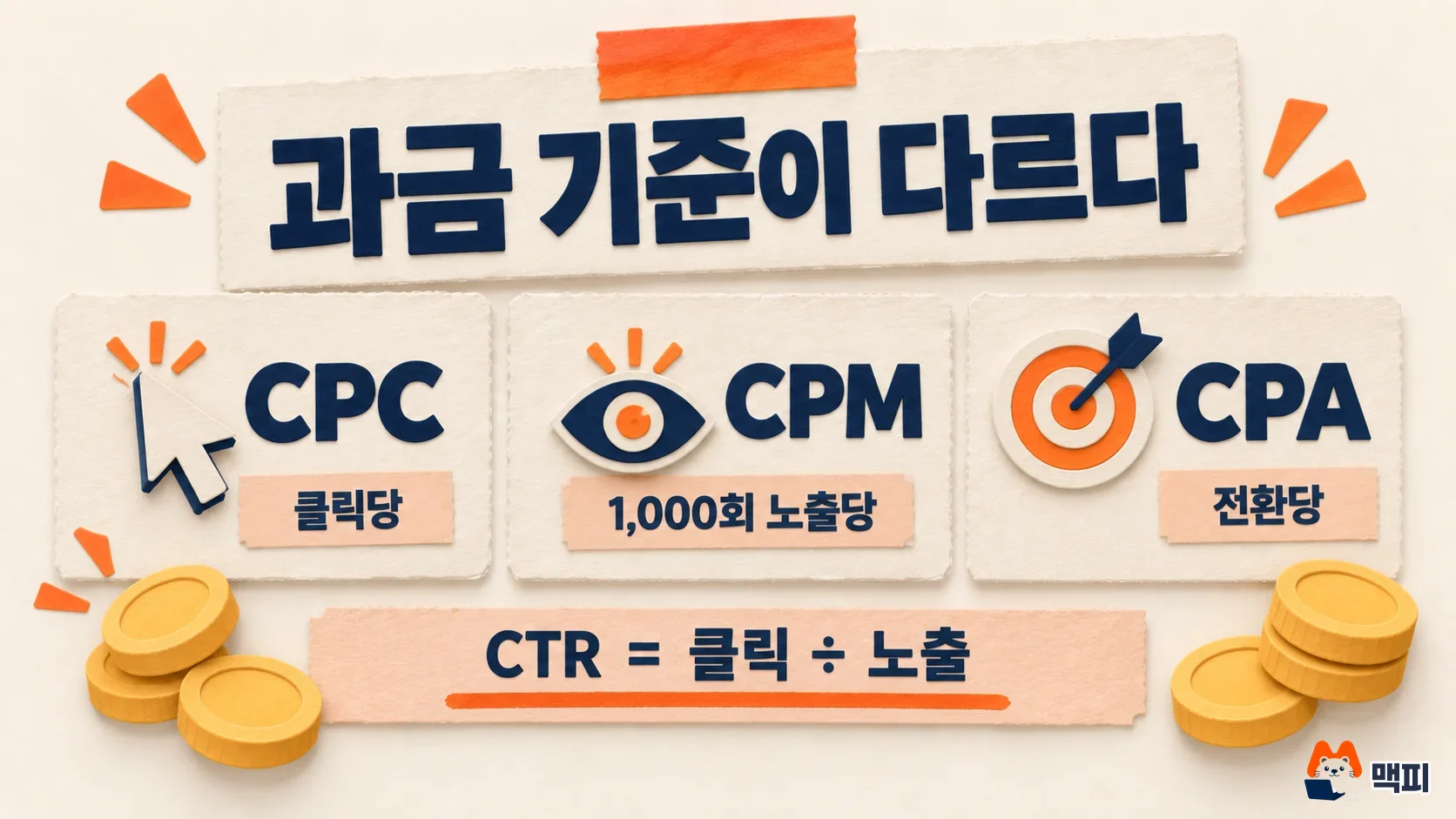
The four metrics look at the same numbers of one ad from different angles, so you can convert between them. The two formulas below are simple divisions that chain the definitions above, and the numbers are examples.
- Getting CPC from CPM: CPC = CPM ÷ 1,000 ÷ CTR. If CPM is 5,000 KRW and CTR is 1%, then 1,000 impressions cost 5,000 KRW and bring 10 clicks. CPC is 500 KRW.
- Getting CPA from CPC: CPA = CPC ÷ conversion rate. The conversion rate is the share of people who clicked and then converted. If CPC is 300 KRW and 100 clicks bring 2 conversions, you divide the 30,000 KRW of spend by 2 conversions, so CPA is 15,000 KRW.
Which metric to check first for each ad goal
Google's guide to bid strategies by goal points to click-based strategies such as maximize clicks, target CPC and manual CPC for increasing website traffic. It points to impression-based strategies for brand awareness and conversion-based strategies such as target CPA for increasing conversions. When the bidding basis differs, the metric you check first differs too.
| Ad goal | Check first | Check alongside |
|---|---|---|
| Increase site visits | CPC | CTR |
| Build brand awareness | CPM | CTR |
| Increase purchases or inquiries | CPA | CPC, conversion rate |
The metrics to check alongside are not from the official documents. They are our interpretation drawn from the formulas above. Even if CPC is low, CPA rises when the conversion rate is low, so for ads aimed at purchases or inquiries, do not lower the bid based on CPC alone.
How to check CPC in an ad report
- Set the report period and write down ad spend, clicks, impressions and conversions. On Naver, check impressions, clicks and ad spend in the ad performance report described in the help page.
- Divide ad spend by clicks to calculate CPC yourself.
- Compare the average CPC on screen with your calculated value. In Google, it is the 'Avg. CPC' column. In Meta, first check which column you are reading: CPC (cost per link click), based on link clicks, or CPC (all), based on all clicks.
- Compare the calculated CPC with your bid. If it is much lower than the bid, you have room under the ceiling. The Naver help page also advises adjusting the bid little by little while watching the figures in the performance report.
- If your goal is purchases or inquiries, divide ad spend by conversions to get CPA as well.
If your own calculation and the on-screen value are almost the same, you have read the report correctly. If they differ a lot, first make sure the period, the click basis (link clicks or all clicks) and the conversion counting method match.
Common CPC mistakes
- Reading max CPC as the actual cost. A bid of 500 KRW does not mean 500 KRW is charged for every click. It means you can pay up to 500 KRW. Look at the average CPC in the report for the actual cost.
- Trying only to lower CPC. If cheap clicks do not lead to conversions, CPA goes up.
- Mixing link-click CPC and all-click CPC in one table. The denominators differ, so they cannot be compared.
- Thinking a high CTR means lower cost. CTR is only a click ratio and is separate from ad spend.
Frequently asked questions
Can the actual CPC ever be higher than the max CPC?
Yes. The Google help page explains that the actual bid can exceed the max CPC when you use Enhanced CPC bidding, manual bidding on Search Partners, or bid adjustments. In ordinary CPC bidding without these settings, the max CPC is the upper limit.
What CTR percentage is good?
The Google CTR help page does not give a benchmark number. It explains that CTR is used to tell apart ads that perform well from ads that need improvement. It is reasonable to compare only ads that ran under the same conditions.
Which matters more, CPA or CPC?
It depends on the goal. Google's bid strategies by goal also separate visits and conversions into different strategies. If the goal is visits, look at CPC first. If the goal is purchases or inquiries, look first at CPA, which reflects what happens after the click.
Official sources used
- Google Ads Help: Definition of cost per click (CPC)
- Google Ads Help: Definition of average cost per click (average CPC)
- Google Ads Help: Definition of max CPC bid
- Google Ads Help: Definition of cost per 1,000 impressions (CPM)
- Google Ads Help: Definition of average CPA
- Google Ads Help: Definition of click-through rate (CTR)
- Google Ads Help: Choose a bid strategy based on your goals
- Naver Advertiser Center Help: What is a bid?
- Meta Business Help Center: Meta advertising glossary
Official documents checked on: October 3, 2026. The content of this article is a standing definition, not a new announcement, so the Google and Meta documents list no announcement date or effective date. The Naver bid help page was last updated on March 29, 2026. Each platform's definitions and screen names may change. The images are generated illustrations that explain the concepts and are not actual ad screens. The numbers in the images and text are calculation examples.
Found this useful? Share it
Latest posts
Kakao Share Thumbnail Not Showing? Here's the Fix (JavaScript SDK 2025)
Learn why Kakao Share thumbnails don't appear even with a valid imageUrl, and fix it using scrapImage to convert your URL into a KAGE CDN URL. Step-by-step guide.
How to Generate CRM User Manuals in 20 Minutes with Claude Code Sub-Agents
Learn how Claude Code sub-agents can analyze your CRM codebase and auto-generate user manuals and visual guidebooks in just 20 minutes. See the real-world results.
GEO Generative Engine Optimization: The Complete 2025 AI Marketing Strategy Guide
Learn what GEO (Generative Engine Optimization) is, how it differs from traditional SEO, and discover 5 proven AI marketing strategies to get cited by AI search engines in 2025.
Related projects
Get new posts by email
Insights on marketing, analytics, and dev, delivered to your inbox.