
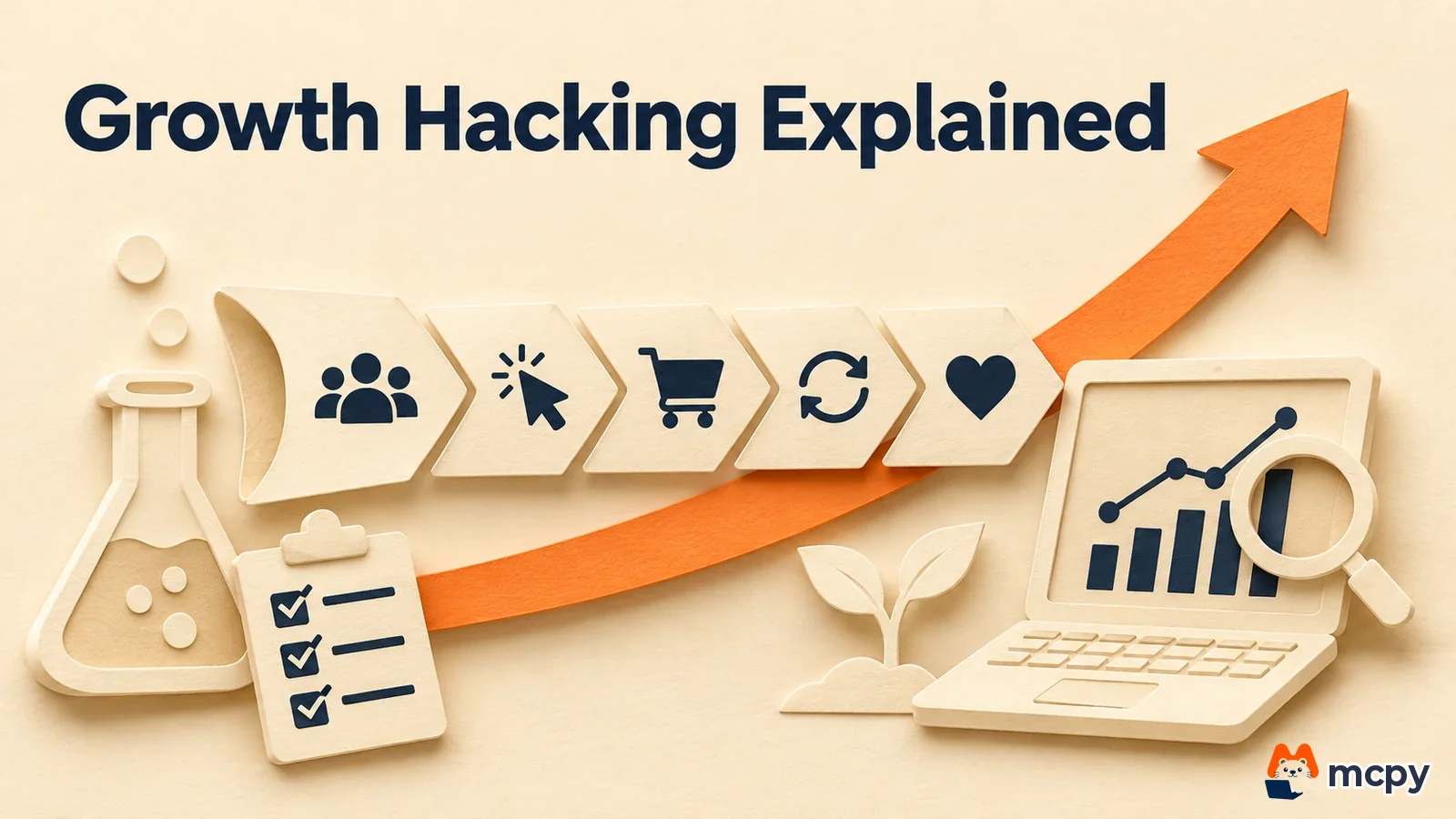
Growth hacking is a way of working that runs small experiments fast and keeps only the growth methods confirmed by the numbers. The term started with a post written by Sean Ellis in 2010. It is less about spending more on ads and more about finding "at which stage do people drop off?"
Growth hacking meaning: when ad spend rises but sales stay flat
Say you doubled your ad budget and sign-ups barely moved. You first need to know whether the ads are weak or the sign-up screen is the problem. It is like pouring water harder into a bucket with a hole in the bottom. The level barely changes. You have to find the leak and plug it first, and only then does the extra water matter. Growth hacking works in the same order. Before you bring in more traffic, you use numbers to find the stage where customers drop off. Finding the hole does not mean it is fixed, though. The numbers have to tell you again that it is closed.

The person who first used the term was Sean Ellis. In his 2010 post "Find a Growth Hacker for Your Startup", Ellis defined a growth hacker as "a person whose true north is growth." According to this Wikipedia summary, the term then spread widely through Andrew Chen's post "Growth Hacker is the new VP Marketing." So it helps to see growth hacking less as a job title and more as "a way of judging every task by how much it affects growth."
In Korea, growth hacking and growth marketing are used as near synonyms. In this article, growth hacking means the whole approach of finding growth through experiments, including product improvements.
Growth hacking vs marketing and performance marketing
The three terms overlap, which makes them confusing. The table below is not an official definition. It is based on the scope of work at MCPY.
| Type | What it mainly watches | Scope of work |
|---|---|---|
| Marketing | All activity that helps customers know and choose your product | Branding, content, ads, events, and more |
| Performance marketing | Ad performance numbers (clicks, conversions, revenue per ad spend) | Running ad channels and improving creatives |
| Growth hacking | Numbers at each stage, from sign-up to return visits, payment, and referral | Not only ads but also product-side fixes such as the sign-up screen, onboarding (a guide to first-time use), and pricing information |
If you run ads, you are probably already watching the metrics of performance marketing. Growth hacking goes one step further. It looks at the whole flow of people who click, sign up, come back, and pay. If you want the big picture of marketing, start with the marketing meaning guide.
Growth hacking AARRR 5 stages: a framework for splitting growth metrics
AARRR is a framework that splits the customer journey into five stages and tracks metrics for each one. It was created by Dave McClure, a founder and investor. It sounds like a pirate's cry, so it is also called "pirate metrics." According to Amplitude's explanation, the question and example metric for each stage are as follows.

| Stage | Question to check | Example metric |
|---|---|---|
| Acquisition | How do users first find us? | New sign-ups, number of leads |
| Activation | Do they reach the moment they first feel the product's value? | Activation rate |
| Retention | Do they come back? | Retention rate |
| Referral | Do they recommend it to others? | Invites shared by active users |
| Revenue | Do active users become paying customers? | Monthly recurring revenue (MRR) |
The acquisition stage covers people who arrive from ads and search, so it overlaps most with performance marketing. The retention stage connects to CRM, the work of keeping relationships with existing customers. The referral stage links to viral marketing. When you look at revenue against ad spend in the revenue stage, use the ROAS calculation guide alongside it.
The stage order in the table follows the order introduced in the Amplitude article. Which stage to look at first can change with the type of service, so start with the stage that has the biggest hole right now.
Growth hacking experiment in 4 steps: the order for starting small
The core action of growth hacking is repeating this loop: "set a hypothesis, run a small experiment, check the numbers, and decide whether to keep it." The order below is not an official rule. It is a recommendation MCPY put together for small sites.

- Pick one blocked stage. Choose only the one AARRR stage with the worst numbers. If you change several stages at once, you cannot tell what worked.
- Write the hypothesis in one sentence. State what you will change and which number should move, for example: "If we change the sign-up button text to 'Start for free', the share of sign-up screen visitors who finish signing up will rise."
- Change only one thing per experiment. Show version A and version B during the same period, or compare periods of equal length before and after the change. On a site with few visitors, leave enough time after the change before you read the result.
- Decide with the numbers. If the metric you set at the start (marketing KPI) went up, keep the change. If it did not, roll it back. Record a failed hypothesis too, as the result "this method did not work for our customers."
For example, say 400 of 1,000 monthly visitors reach the sign-up screen and 40 people finish signing up. That means 90% leave at the sign-up screen. These numbers are assumed for illustration. In this case, it is worth checking the form fields and guidance text on the sign-up screen before increasing ads. If the sign-up completion rate stays the same after your fix, drop that hypothesis and look for another cause.
| Stage | People |
|---|---|
| Visit | 1,000 |
| Sign-up screen | 400 |
| Sign-up complete | 40 |
How to find drop-off stages in GA4
To find the blocked stage, use the funnel exploration report in Google Analytics 4 (GA4). According to the Google Analytics Help page, this report shows the steps users take to finish a target task, along with completions and drop-offs at each step.
- In the left menu of GA4, open Explore, then choose the Funnel exploration template under Start a new exploration.
- Click the edit (pencil) icon, name each step, and add the matching event as the condition. In the example above, that means three steps: visit, sign-up screen view, and sign-up complete.
- Click Apply and find the part between steps where the most users drop off.
To build the steps, events such as sign-up complete must already be collected in GA4. See the events guide. According to the help page, only users who finish every step in order are counted in the last step, so users who skip a middle step drop out of later steps. In an open funnel, users can enter at any step. In a closed funnel, they can enter only at the first step.
To judge success, check whether the drop-off rate for the same stretch fell after the experiment. If the drop-off numbers stayed the same and only total sign-ups grew, that came from more traffic, not from the experiment.
Common misunderstandings about growth hacking
The most common misunderstanding is treating growth hacking as "a collection of success tricks that others used." Wikipedia points out this misunderstanding and explains that well-known tactics are the result of a repeatable process. If you copy a method that worked at another company, you can still get different results because your customers' numbers differ. So it is better to build the process of finding blocked stages in your own data than to memorize tricks.
Another is the idea that only developers can do it. Ellis's original post describes a growth hacker as close to a mix of marketer and coder. But setting hypotheses from stage-by-stage numbers can be started without code.
Frequently asked questions
Are growth hacking and growth marketing different terms?
In Korea, the two terms are mostly used with the same meaning. Some teams draw a line: growth marketing for a narrower focus on ads and content, and growth hacking for a wider scope that includes product improvement.
Can a site with few visitors run experiments?
Yes. But with few visitors, the numbers swing a lot from small coincidences. Limit the change to one item and use a long enough period before and after the change.
Found this useful? Share it
Latest posts
Kakao Share Thumbnail Not Showing? Here's the Fix (JavaScript SDK 2025)
Learn why Kakao Share thumbnails don't appear even with a valid imageUrl, and fix it using scrapImage to convert your URL into a KAGE CDN URL. Step-by-step guide.
How to Generate CRM User Manuals in 20 Minutes with Claude Code Sub-Agents
Learn how Claude Code sub-agents can analyze your CRM codebase and auto-generate user manuals and visual guidebooks in just 20 minutes. See the real-world results.
GEO Generative Engine Optimization: The Complete 2025 AI Marketing Strategy Guide
Learn what GEO (Generative Engine Optimization) is, how it differs from traditional SEO, and discover 5 proven AI marketing strategies to get cited by AI search engines in 2025.
Related projects
Get new posts by email
Insights on marketing, analytics, and dev, delivered to your inbox.