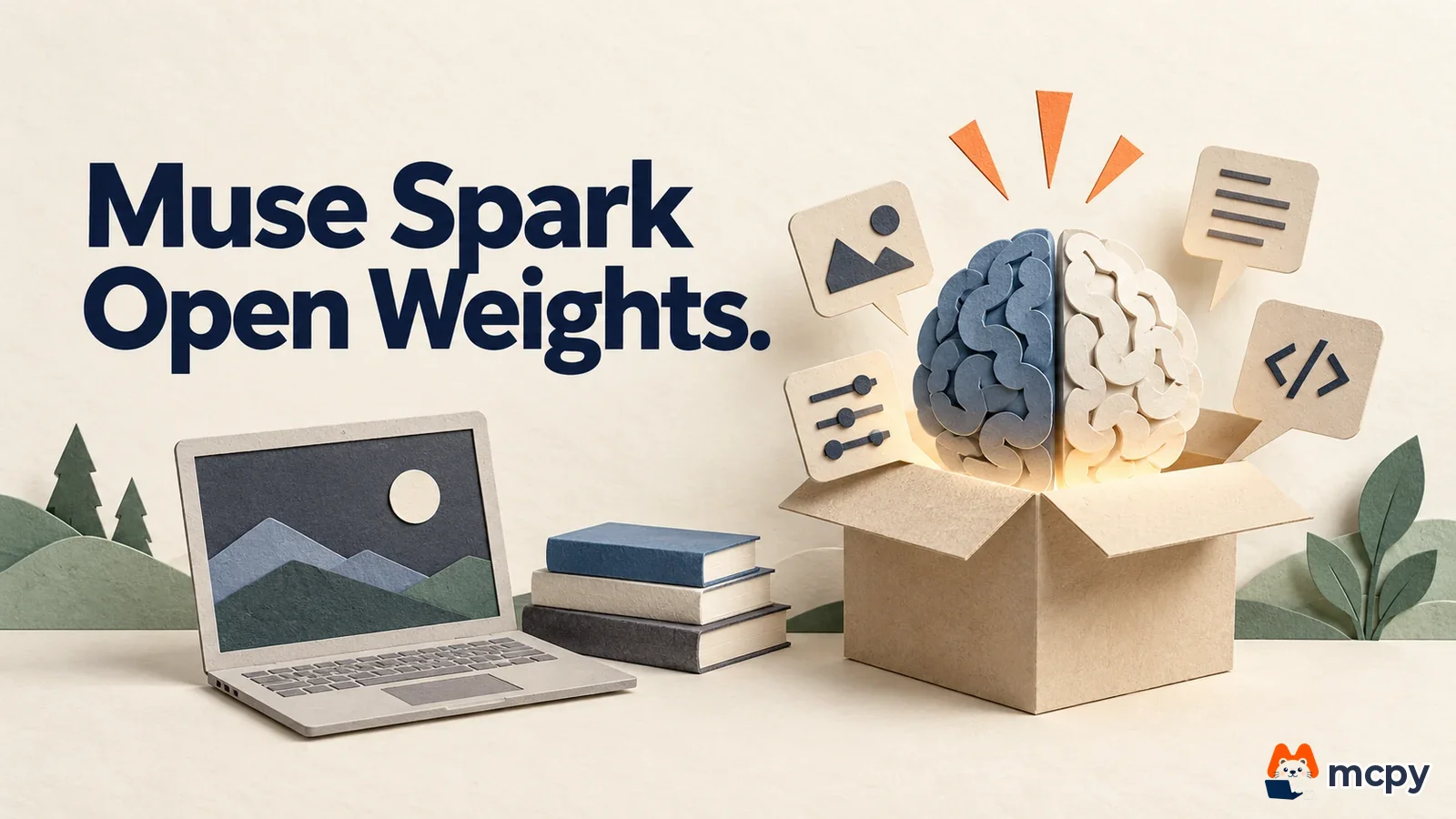
Muse Spark Open is an open-weights AI model whose weights Meta released on October 15. You can download and run it yourself, but the model card recommends at least 700GB of GPU memory, so without your own servers you will need a cloud provider or a hosted API. Weights are the files of values a model learns during training. According to the Meta AI research blog, the model has 816 billion parameters in total, uses only 42 billion at a time, and reads 1 million tokens at once.
What changed Until now, Meta offered the Muse Spark family only through its own services and API. This is the first time it has released the models as downloadable weights.
Who is affected Developers who want to host the model themselves or build it into a service, and teams comparing models for coding and agent work. Regular users who only use chatbot apps see no change.
What to do now Pick how you will use it (self-hosting, cloud, or hosted API). If you plan to put it in a product, read the license's attribution text and prohibited uses first.
What Meta released with Muse Spark Open
According to the Meta blog, Muse Spark Open is a multimodal model (it handles text and images together) focused on coding and multi-step agent tasks. It uses a mixture-of-experts (MoE) design that picks only some of its many experts for each step. The total size is 816B (816 billion), but only 42B (42 billion) parameters are active for each answer.

| Item | Details |
|---|---|
| Release date | October 15, 2026 |
| Parameters | 816B total, 42B active (mixture of experts) |
| Context length | 1 million tokens |
| Weight formats | BF16, NVFP4 (per the Hugging Face model card) |
| Download and availability | Hugging Face, Amazon SageMaker AI, Google Cloud Model Garden, Microsoft Foundry |
| Hosted APIs | Baseten, Fireworks AI, Groq, Modal, Nebius, OpenRouter, Together AI |
Meta said it added safety post-training ahead of the open release and that the model met the release criteria of its own risk assessment framework. It said it will publish the full evaluation report soon. Detailed results are in the model card.
Can you run Muse Spark Open yourself? Check if this applies to you
The Hugging Face model card lists recommended specs of at least 700GB of GPU memory in NVFP4 format and 2TB in BF16 format. This is too large for a personal PC or a single GPU. In its announcement post, Meta also describes running the model with MLX on two Apple M5 Ultra Mac Studio machines linked together. Each machine has up to 512GB of unified memory, so together they come close to 1TB.
So people who used the model in an app, and small teams without the hardware, are not the audience for self-hosting. It fits development teams that already have their own GPU servers or an existing cloud contract.

To use it without hardware, choose a cloud provider such as Amazon SageMaker, Google Cloud Model Garden or Microsoft Foundry, or a hosted API such as OpenRouter. Before sending company documents to a hosted API, check the provider's data handling terms and your internal security and privacy rules. This is a general adoption check, not a Meta requirement.
If you have your own servers, start one with a single line in vLLM, as the model card describes: vllm serve "meta-models/Muse-Spark-Open-816B-A42B". SGLang, Transformers, Docker Model Runner and TensorRT-LLM are also supported.
Meta did not publish separate figures for Korean. The model card says only that the model was trained on data in more than 100 languages, but that performance may drop outside the languages it supports strongly.
What to check first in the Muse Spark Open license
In its announcement post, Meta says it released the model under the Muse Model License, which carries limited commercial terms, and that many developers can use it for free. The model card lists three conditions.
| Condition | Details |
|---|---|
| Attribution | Products that use the model must prominently show "Built with Muse Spark Open" in one of these places: the screen, documentation, website or settings menu. |
| Revenue threshold | A provider that offers the model as a service must notify Meta and sign a separate written agreement if its total revenue exceeds $20 million for 12 consecutive months. |
| Prohibited uses | Illegal activity, malware, weapons, disinformation, impersonation and unlicensed professional practice are banned, and use aimed at people under 18 is not intended. |

Derived models that fine-tune this model or train on its outputs must follow the same attribution and usage policy. Meta does not claim ownership of outputs. Teams that use it only as an internal work tool face a lighter attribution duty, but it is safer to get a legal review before putting it in a customer-facing service. The full license text is in the model card.
What to do now and how to check it
- Choose how you will use it. If your own GPU memory is not around 700GB, pick a cloud provider or a hosted API.
- If you plan to put it in a service, read the attribution text and prohibited uses in the model card's license and confirm them with your legal contact.
- Write Korean test questions and send the same ones to your current model and to Muse Spark Open. For example, prepare 4 summaries, 3 table extractions and 3 code fixes based on your real work documents.
Check step 3 with one table. Make columns for question number, each model's answer, factual error or not, and response time, and fill in 10 rows. If the number of answers without factual errors and the response time are similar to or better than your current model, keep it as a candidate. If the Korean answers read awkwardly or the model misses the start of a long document, keep using your current model. If you started a server yourself, first confirm that a single short question gets a reply before running the test.
There are also common mistakes. Some people treat open weights as the same thing as open source and drop the attribution text. Some miss that the same attribution and usage policy apply to derived and fine-tuned models. Some try a single GPU without checking the model card specs. The first two mean missing the attribution and policy the model card requires, and in the third the server will not start because memory runs short.
What to watch next
Meta said it will publish the full evaluation report soon, so you can compare coding and agent benchmark numbers then. The Muse Wonder API, released the same week, is a product available only through Meta's model API, so it is used differently from this model, whose weights you download.
Frequently asked questions
Can I use Muse Spark Open right away in an app, like ChatGPT?
This announcement centers on weights and developer-facing providers. To use it like an app, you need a service built on a hosted API or a cloud console.
Can I use it in a commercial service?
Meta released it under the Muse Model License, which has limited commercial terms. If you put it in a service, you need the attribution text, and a provider that offers the model as a service needs a separate agreement once total revenue exceeds $20 million.
Found this useful? Share it
Latest posts
Kakao Share Thumbnail Not Showing? Here's the Fix (JavaScript SDK 2025)
Learn why Kakao Share thumbnails don't appear even with a valid imageUrl, and fix it using scrapImage to convert your URL into a KAGE CDN URL. Step-by-step guide.
How to Generate CRM User Manuals in 20 Minutes with Claude Code Sub-Agents
Learn how Claude Code sub-agents can analyze your CRM codebase and auto-generate user manuals and visual guidebooks in just 20 minutes. See the real-world results.
GEO Generative Engine Optimization: The Complete 2025 AI Marketing Strategy Guide
Learn what GEO (Generative Engine Optimization) is, how it differs from traditional SEO, and discover 5 proven AI marketing strategies to get cited by AI search engines in 2025.
Related projects
Get new posts by email
Insights on marketing, analytics, and dev, delivered to your inbox.