

Content marketing is creating helpful content such as articles, videos, and images, distributing it, and turning the people who find it into customers. The Content Marketing Institute (CMI) defines it as a strategic approach focused on creating and distributing valuable, relevant, and consistent content to attract and retain a clearly defined audience. If you are just starting, follow this order: choose a reader, collect questions, write, distribute, and check the numbers.
Content marketing is what keeps inquiries coming when ads stop
Imagine a shop that gets inquiries only while ads run and goes quiet when they stop. That shop needs a way for customers to find it on their own, apart from ads. Say a neighborhood bakery posts a note at the door: "Why salt bread gets soggy and how to make it crisp again." People who never bought bread read it and remember the shop. Content marketing is the work of piling up notes like this online. Search services such as Google and Naver (Korea's largest search engine) also work by picking and showing posts that answer a question well. But customers do not grow right away just because notes pile up, so it takes time before results show.
According to the CMI explanation, content marketing does not stop at selling a product directly. It stresses giving content that solves a customer's work or personal problem. The same document also explains that content is integrated into other marketing channels such as email, social media, search engine optimization (SEO), PR, and paid ads. So content marketing is not the name of one channel. It is closer to a way of deciding what goes into every channel. If you need the big picture of marketing first, start with the meaning of marketing, the 4Ps, and how it differs from ads and sales.

Content marketing, ads, and social media marketing differ in how they work
The three overlap, but their standards differ. Ads buy exposure with money. Content marketing builds content itself as an asset. Social media marketing is communicating through accounts such as Instagram and YouTube, so what you post on those accounts becomes part of content marketing.
| Category | Content marketing | Ads | Social media marketing |
|---|---|---|---|
| Core | Create and distribute helpful content | Pay to buy exposure | Run accounts and talk with customers |
| When results appear | After content builds up and search and sharing happen | Right after the campaign starts | After followers and reactions appear |
| If you stop | Content already posted stays | Exposure stops | Reach may drop without new posts |
| Related reading | This article | Performance marketing meaning | How to choose social media marketing channels |
It is also easy to confuse with viral marketing, which deliberately creates word of mouth. Viral focuses on prompting shares. Content marketing focuses on steadily making content that solves customer problems, whether it gets shared or searched.
Content marketing starts with 5 steps
At the start, it is better to narrow down to one reader, one question, and one channel than to widen your channels. Following the order below makes it easy to see which step you are stuck on.
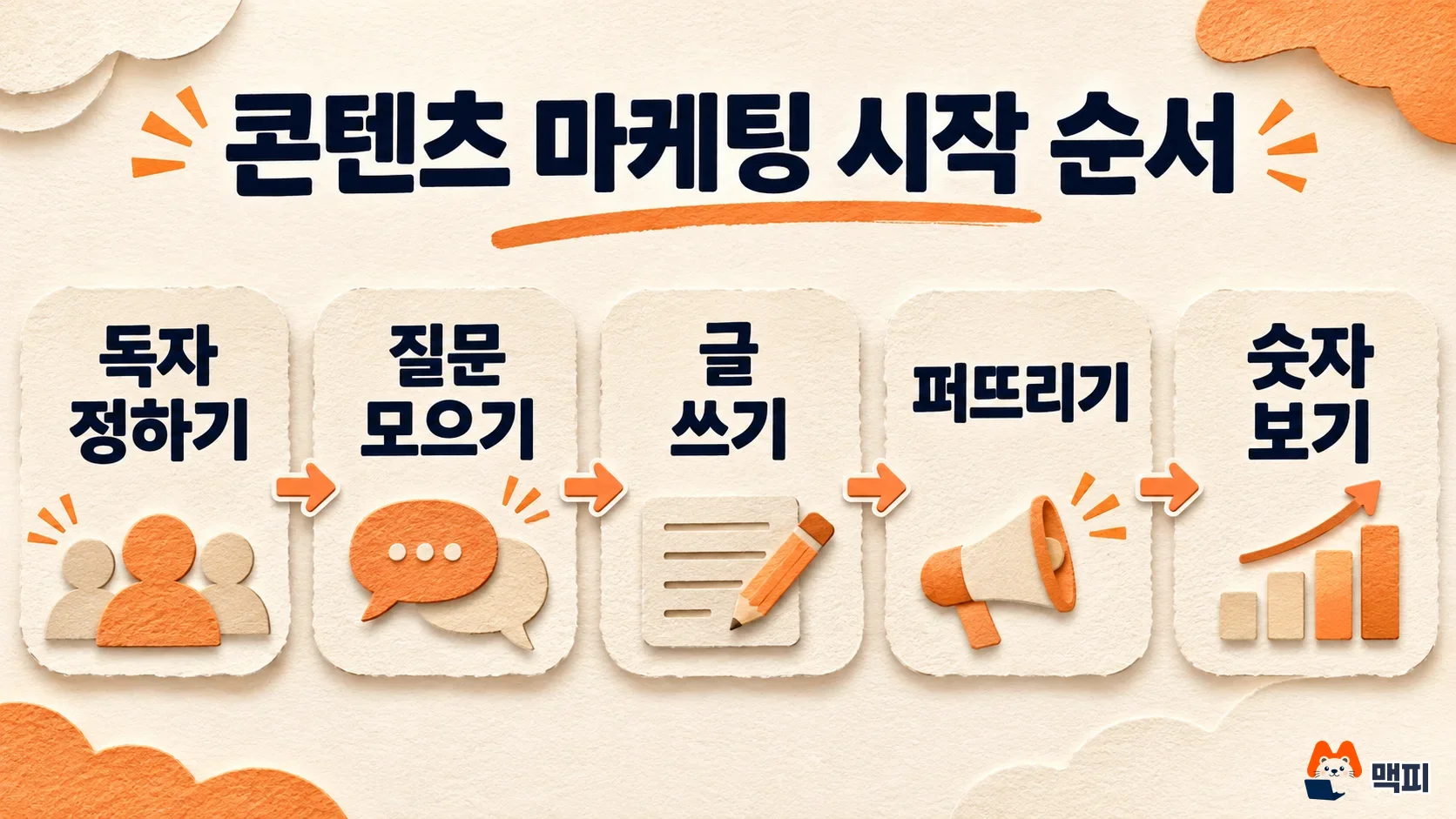
- Choose a reader. Write in one sentence who the article is for. For example, "an online store owner with fewer than 3 employees." The more specific it is, the narrower your topics become. The CMI definition also starts from a clearly defined audience.
- Collect questions. Gather the words your reader actually searches and asks. In its SEO starter guide, Google says users who know a topic well and users who are new to it search with different words, so you should consider both. Sources include customer inquiry messages, questions you often get during sales, and related searches in the Naver Search Ads keyword tool.
- Write. Answer one question with one article. Google's SEO starter guide says to split long text into paragraphs and subheadings, and to write from what you know instead of reworking articles from other sites. It is enough to link to your own product once, at the end of the article.
- Distribute. Do not stop at posting. Tell readers where they are, such as a newsletter, Instagram, or a KakaoTalk channel (Kakao is Korea's main messaging app). Instead of copying the same article to every channel, summarize it to fit each channel's format.
- Check the numbers. After about 4 weeks, check whether there are impressions and visits. For articles with no response, fix the title and the first paragraph. Where to check is explained in the section below.
When one topic grows into several articles instead of ending in one, it helps to link the articles to each other. In the same guide, Google says to link to related resources and to write link text that shows what the linked page is about. For example, when the measurement discussion in this article gets long, hand it off to the article for the next question, such as growth hacking and finding drop-off points in GA4.
Content that survives in search meets Google's standards
For content marketing to lead to search traffic, you need to know which articles search services view favorably. In its guidance on helpful content made for people, Google names "why was it created" as the most important question. If the main purpose is to draw search engine traffic, it does not meet the standard. It should help people who visit directly.
The same Google document also gives questions for self-checking. Does it offer original information or analysis? Does it explain the topic fully? Does it have more real value than other pages in search results? Would a reader bookmark it or recommend it to a friend? There is also guidance to show who wrote it clearly, and, if you used automation or AI heavily, to disclose that fact and the reason.
So before posting, first check this question from the list above: "Does this article have at least one thing the top results lack?" Material found nowhere else is the answer, such as your store's real return reason ratios, photos you took yourself, or steps you tried yourself. Summarizing other people's articles and adding one more similar piece will struggle to pass this standard.
Search Console and GA4 show content marketing results
Split results into whether the article shows up in search and whether the people who arrived read it. Search Console tells you the first, and GA4 tells you the second.

| What you want to see | Where to look | Meaning |
|---|---|---|
| How often the article appeared in Google Search | Impressions in the Search Console performance report | Google Help defines impressions as the number of times your site appeared in Google search results |
| How many of those were clicked | Clicks, CTR | CTR is clicks divided by impressions |
| What position it appeared in | Average position | In the table, it shows the average position for the URL or query shown in the row |
| Whether people who arrived stayed | GA4 report: Engagement > Landing page | It compares visitors and engagement by the first page viewed in a session. For the full definition, see GA4 Help |
Small experiment: Pick one article you already posted, filter by its URL in Search Console, and note the impressions, clicks, and average position for the last 28 days. Fix the title and first paragraph to match the reader's question, then look at the same period again 4 weeks later. You can then compare CTR (clicks ÷ impressions) before and after the change yourself. Four weeks is the check cycle this article recommends, not a period set by Google.
The method is simple. Four weeks after posting, filter by the article's URL in Search Console and first check whether impressions are 0. If impressions are 0, the problem is indexing or search terms. If there are impressions but few clicks, it is time to fix the title and description. If there are clicks but engagement time in the GA4 landing page report is short, the first paragraph did not answer the promise made by the title. The cause differs at each stage, so do not rewrite the whole article by looking at one number.
Read the order this article recommends separately from the official explanations of Google and CMI. Among the 5 starting steps, choosing a reader, collecting questions, and writing it yourself are what the official documents say directly. The 4-week check cycle and starting with one channel are recommendations for teams that are just starting.
Where to find search terms when starting in Korea
You can see Korean readers' search terms in the keyword tool of Naver Search Ads, which shows monthly PC and mobile search volume and related searches. Volumes under 100 are sometimes shown only as a range such as "< 10". So use it to compare which words are used more, not as an exact visit count. For the same topic on Google, check the query list in Search Console. If readers use different words in the two places, put the more common word in the title and include the other expressions in the body.
Common mistakes
- Writing only product boasts. Readers search for their own problem, not a product name, so product pages draw few visitors. Link to your product once, at the end of an article that solves the problem.
- Opening all channels at once. If you start a blog, Instagram, and YouTube together, none of them builds up enough to judge after 4 weeks. Start with one, and widen to the next channel once the numbers show.
- Posting and leaving it. Google's SEO starter guide says to review previously published content, update it if needed, and delete content that is no longer relevant. Start by fixing the title and first paragraph of articles that have impressions but low clicks.
Frequently asked questions
How long does content marketing take to work?
Official sources give no fixed period. An article must be indexed and earn a ranking for its search terms, so judge by checking every 4 weeks whether Search Console impressions are rising.
How much does content marketing cost?
If you write it yourself, you can start with no production cost. Google Help describes Search Console as a tool for checking a site's search performance. Costs come from outsourced production or from promoting articles with ads.
Is it okay to write with AI?
In its guidance on content for people, Google says that if you used automation or AI heavily, it is good to tell readers that fact and the reason. Auto-generated content made to manipulate search rankings violates the spam policy.
Found this useful? Share it
Latest posts
Kakao Share Thumbnail Not Showing? Here's the Fix (JavaScript SDK 2025)
Learn why Kakao Share thumbnails don't appear even with a valid imageUrl, and fix it using scrapImage to convert your URL into a KAGE CDN URL. Step-by-step guide.
How to Generate CRM User Manuals in 20 Minutes with Claude Code Sub-Agents
Learn how Claude Code sub-agents can analyze your CRM codebase and auto-generate user manuals and visual guidebooks in just 20 minutes. See the real-world results.
GEO Generative Engine Optimization: The Complete 2025 AI Marketing Strategy Guide
Learn what GEO (Generative Engine Optimization) is, how it differs from traditional SEO, and discover 5 proven AI marketing strategies to get cited by AI search engines in 2025.
Related projects
Get new posts by email
Insights on marketing, analytics, and dev, delivered to your inbox.