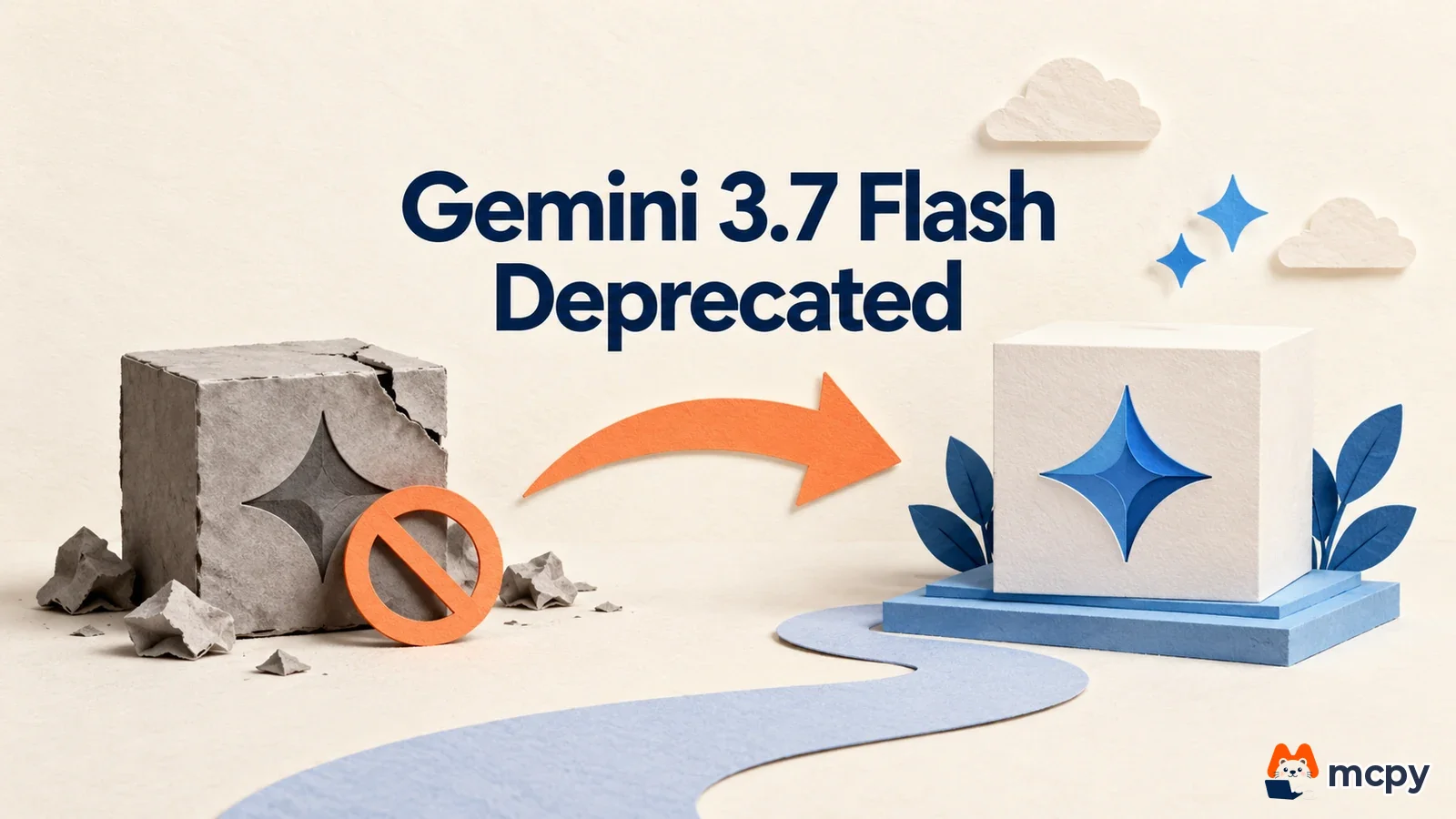
In the Gemini API, gemini-3.7-flash was deprecated on October 8, 2026, and requests are automatically forwarded to gemini-3.8-flash. The Google Gemini API release notes tell you to change the model name to gemini-3.8-flash. On the same day, gemini-3.5-flash was also deprecated and began forwarding to gemini-3.6-flash (or gemini-3.8-flash). Your code does not stop working right now. But if you leave the model name as is, your code no longer shows which model is actually answering (as of October 13, 2026).
Gemini API model changes: recent deprecations at a glance
Deprecation is the stage where Google announces it no longer supports a model. Shutdown is the stage where the endpoint is turned off completely. According to the deprecations schedule page, the shutdown date in the table is the earliest possible date, and the actual date is announced separately in advance. The table below lists the items announced on October 6 and 8.
| Old model | Replacement | Shutdown date | Current status |
|---|---|---|---|
| gemini-3.7-flash | gemini-3.8-flash | N/A | Not selectable in AI Studio, API requests are forwarded automatically |
| gemini-3.5-flash | gemini-3.6-flash or gemini-3.8-flash | N/A | Not selectable in AI Studio, API requests are forwarded to gemini-3.6-flash automatically |
| deep-research-pro-preview-12-2025 (agent) | deep-research-preview-04-2026 or deep-research-max-preview-04-2026 | October 23, 2026 | Scheduled to shut down |
| gemini-3.1-flash-image | gemini-nano-banana-2.1 | Not announced | Deprecation notice (October 6) |
In this table, only the Deep Research agent has a fixed date. For 3.7 Flash and 3.5 Flash, the deprecations schedule page says “the endpoint will not be shut down and API requests are forwarded automatically.” For gemini-3.1-flash-image, there is only a notice and no shutdown date has been announced.
What happens to code that uses Gemini 3.7 Flash
A request sent to gemini-3.7-flash is received and answered by gemini-3.8-flash on Google's servers. The release notes state two things together. 3.7 Flash has disappeared from the AI Studio model picker, and API requests are forwarded to 3.8 Flash automatically.
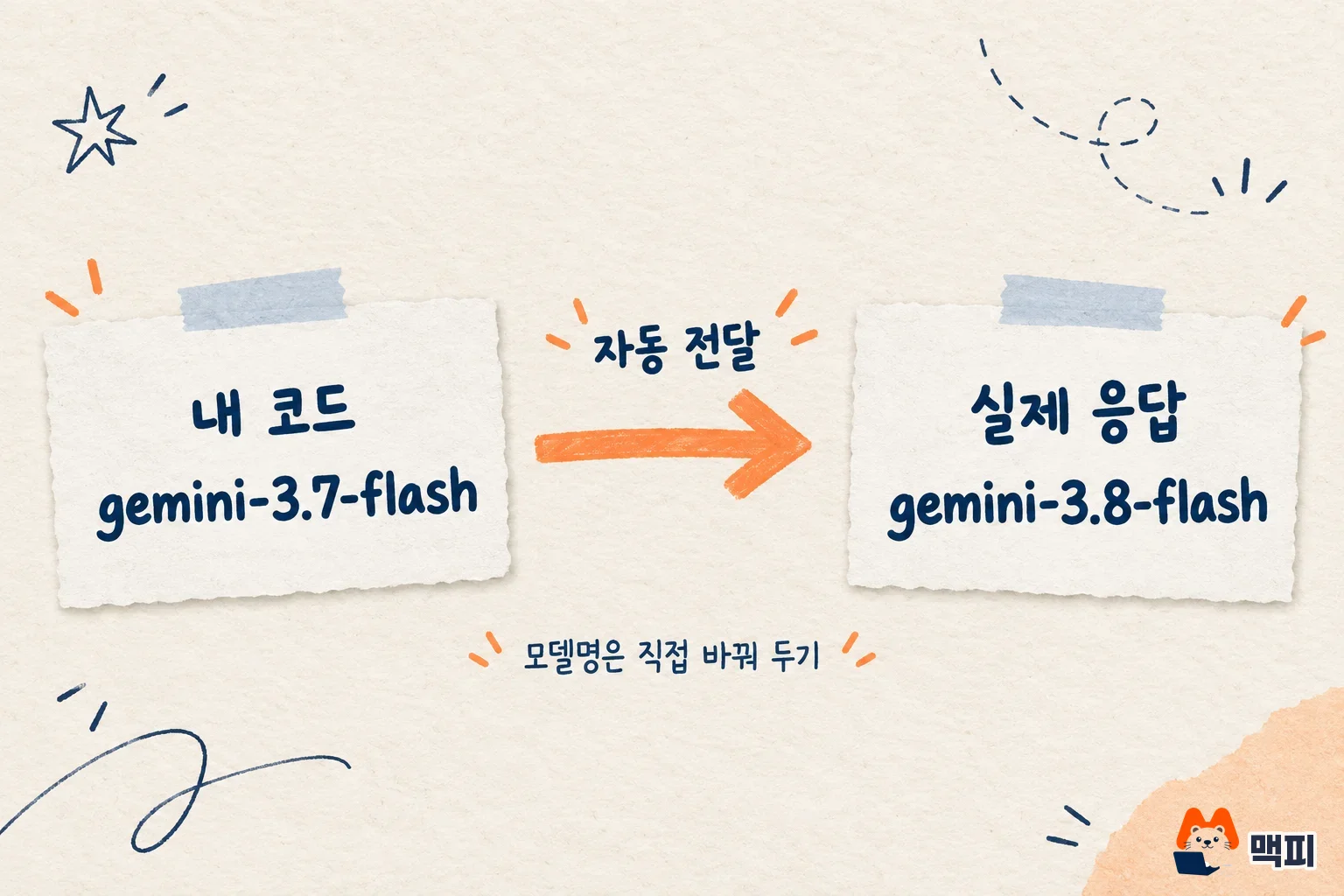
So requests do not fail even if you do not change the model name. But the response now comes from 3.8 Flash, so check once whether the prompts and output formats you tuned for 3.7 Flash have changed. Google recommends reading the Gemini 3.8 Flash guide alongside.
Replacing the model name means changing one string in your code. If you keep the model name in one place, such as an environment variable or a config file, it is a one-line change.
- Search your code and config files for gemini-3.7-flash and gemini-3.5-flash.
- Change 3.7 to gemini-3.8-flash, and change 3.5 to gemini-3.6-flash or gemini-3.8-flash.
- Resend one or two of your existing prompts as they are and compare the format and length of the answers with the earlier results.
How to confirm the change took effect
The generateContent response includes a modelVersion field, and the API reference describes this value as “the model version that generated the response.” Send one request from a deployment where the model name is changed to gemini-3.8-flash, read modelVersion in the response, and check in your logs or the response body that the value is gemini-3.8-flash. This field records which model answered, so use it to find out whether an old model name is still left in your config after deployment.
Because 3.7 Flash has disappeared from the model picker in AI Studio, retest your AI Studio prompts in a new chat with the model set to 3.8 Flash.
Gemini 3.8 Flash pricing: doubles on January 1, 2027
When a model changes, the first question is whether the unit price changes with it. In the Gemini API pricing page, the paid tier standard rate for gemini-3.8-flash is $0.75 for input and $3.75 for output (including thinking tokens) per 1 million tokens, and these values apply through December 31, 2026. From January 1, 2027, it becomes $1.50 for input and $7.50 for output. The gemini-3.6-flash table on the same page shows the same standard rates.
| Item | Through December 31, 2026 | From January 1, 2027 |
|---|---|---|
| Input | 0.75 | 1.5 |
| Output | 3.75 | 7.5 |
Batch and Flex rates are half of standard. That is $0.375 for input and $1.875 for output, and from January 1, 2027 they become $0.75 for input and $3.75 for output. The free tier is free for both input and output at the standard level, and the pricing page states that Google may use content sent on the free tier to improve its products. The previous unit price for 3.7 Flash is not listed separately in the current pricing page, so check your past invoices directly if you want to compare against what you paid before.
If your service has high monthly usage, it is safer to assume your January 2027 cost will be double today's unit price. To see where 3.8 Flash sits on price among Google models, compare it with Claude and GPT models in the table in our Gemini 4 Argon pricing guide.
Shutdowns with fixed dates: Deep Research and speech models
Unlike the automatic forwarding of model names, requests to the two items below fail once the date passes. If you use these models, they are the top priority.
- Deep Research agent: According to the release notes, deep-research-pro-preview-12-2025 shuts down on October 23, 2026. Change the
agentvalue in yourinteractions.createrequest to deep-research-preview-04-2026 (suited to speed, efficiency and streaming to the screen) or deep-research-max-preview-04-2026 (the broadest source gathering and synthesis). - Speech (TTS) models: According to the deprecations schedule page, gemini-3.1-flash-tts-preview shuts down on November 17, 2026, and the page advises moving to gemini-3.8-flash-tts or gemini-3.8-flash-lite-tts.
Common mistakes
- Reading “deprecated” as “shut down” and taking the service offline in a hurry. 3.7 Flash and 3.5 Flash have no shutdown date and requests are still processed.
- Assuming there is nothing to check because requests are forwarded automatically. The model producing the answers has changed, so check whether the format, length and tone of the answers differ from earlier results.
- Thinking the only replacement for 3.5 Flash is 3.8 Flash. The automatic forwarding target is gemini-3.6-flash, and the guidance also lists gemini-3.8-flash as an option.
- Missing the January 2027 price increase. Your current cost calculation uses the unit price valid through December 31.
Three things to do today
- If you use the Deep Research agent, change the
agentvalue before October 23. It is the only item where requests fail once the date passes. - Search for the strings gemini-3.7-flash and gemini-3.5-flash and replace them, then compare one or two prompt results. Forwarding works for now, but if your code does not state which model answers, it is hard to find the cause during an outage.
- Recalculate your 3.8 Flash cost once using the January 2027 unit price ($1.50 for input, $7.50 for output).
Gemini API models: frequently asked questions
Will the Gemini 2.5 models be shut down soon?
No shutdown is scheduled. The deprecations schedule page states that the 2.5 models are not deprecated and remain available until further notice. However, for capacity management, access is limited to users who have used them before, and the page advises new projects to use 3.5 Flash Lite or 3.8 Flash.
Which model should a new project start with?
The same page recommends gemini-3.5-flash-lite and gemini-3.8-flash for new projects. You can see the model list in the Gemini API models page.
Can I use it for free?
In the pricing page, the free tier for gemini-3.8-flash covers standard requests at no cost. Batch and Flex requests are not available on the free tier.
Found this useful? Share it
Latest posts
Kakao Share Thumbnail Not Showing? Here's the Fix (JavaScript SDK 2025)
Learn why Kakao Share thumbnails don't appear even with a valid imageUrl, and fix it using scrapImage to convert your URL into a KAGE CDN URL. Step-by-step guide.
How to Generate CRM User Manuals in 20 Minutes with Claude Code Sub-Agents
Learn how Claude Code sub-agents can analyze your CRM codebase and auto-generate user manuals and visual guidebooks in just 20 minutes. See the real-world results.
GEO Generative Engine Optimization: The Complete 2025 AI Marketing Strategy Guide
Learn what GEO (Generative Engine Optimization) is, how it differs from traditional SEO, and discover 5 proven AI marketing strategies to get cited by AI search engines in 2025.
Related projects
Get new posts by email
Insights on marketing, analytics, and dev, delivered to your inbox.