
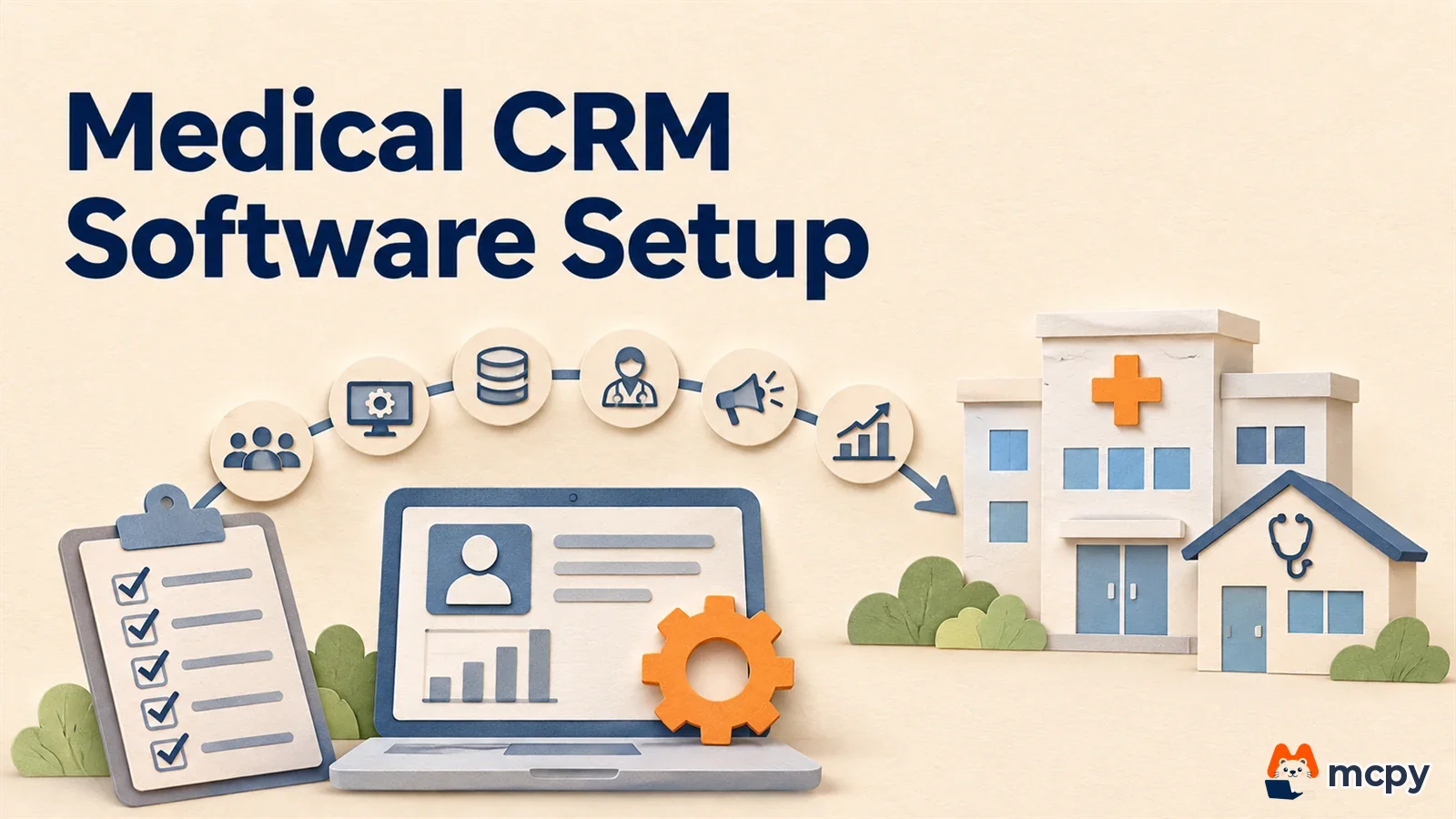
Medical CRM software gathers booking, visit and consultation records plus contact consent in one place, so a hospital can send patients the right notice at the right time and follow up on return visits. When you start, split informational messages such as appointment reminders from promotional messages such as events and return-visit offers. Send promotional messages only after the patient has consented. The order is: pick one problem, decide what data to store, separate the consent forms, prepare Alimtalk, set sending rules, and re-confirm consent every 2 years. All details are as of November 4, 2026.
What medical CRM software does and how it differs from EMR
On a day with many cancellations, the front desk calls patient after patient and consultations run late. Medical CRM software works like a regular shop's notebook. If you write down who came, when, and when they plan to return, the owner can check in at the right time without relying on memory. Just as a search service like Google collects page information and shows it when needed, a CRM collects patient information and sends notices when preset conditions are met. Unlike a shop notebook, though, patient data comes with legal limits.
A hospital CRM and an EMR (electronic medical record, software that keeps treatment records digitally) do different jobs. An EMR records what happened in treatment. A CRM manages booking, contact and consultation history so you can communicate with patients.
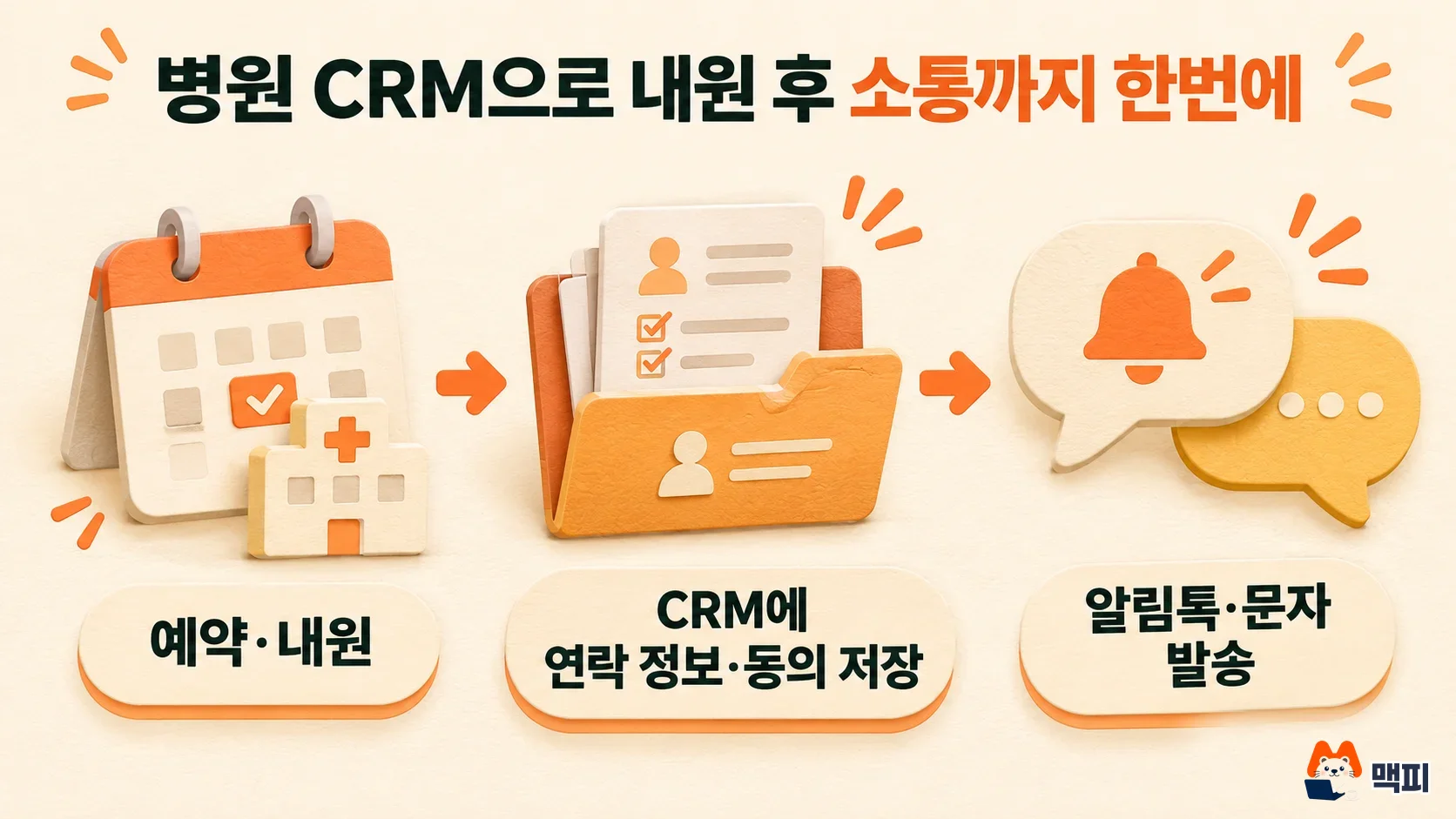
| Item | EMR (electronic chart) | Hospital CRM |
|---|---|---|
| Main purpose | Treatment and prescription records | Booking, contact and return-visit management |
| Main users | Medical staff | Front desk, consultation and marketing staff |
| Typical data | Diagnosis, prescriptions, test results | Contact details, booking schedule, consultation notes, marketing consent |
| How it reaches patients | Does not reach them directly | Alimtalk, text messages, call schedule management |
Medical CRM software messages: informational vs promotional
Messages sent from a CRM are either informational or promotional, and promotional messages need patient consent. Article 50 of Korea's Information and Communications Network Act says that to send commercial promotional information electronically, you must get the recipient's explicit prior consent. If the recipient refuses or withdraws consent, you cannot send. Between 9 p.m. and 8 a.m. the next day, you need separate prior consent. Ads must also show the sender's name, contact details and how to opt out.
According to the Kakao Business documentation, Kakao Alimtalk (Kakao's business messaging service inside KakaoTalk, Korea's dominant messenger) is an informational message service that can reach users who have not added your channel, and only templates approved by Kakao can be sent. The content guide in the same documentation says messages containing promotional content cannot be sent. So it is safer to send appointment details by Alimtalk, and to send events or checkup discounts as promotional text messages to patients who consented. The steps for preparing an Alimtalk channel and templates are covered separately in How to send Kakao Alimtalk and template review tips.
| Message example | Type | Condition before sending |
|---|---|---|
| Reminder for tomorrow's 10 a.m. appointment | Informational | Kakao-approved template, lawfully collected contact details |
| Return-visit offer 6 months after a checkup | Treat as promotional | Ad consent, opt-out method shown |
| Event notice for a non-covered procedure | Promotional | Ad consent, exclude 9 p.m. to 8 a.m. or get separate consent |
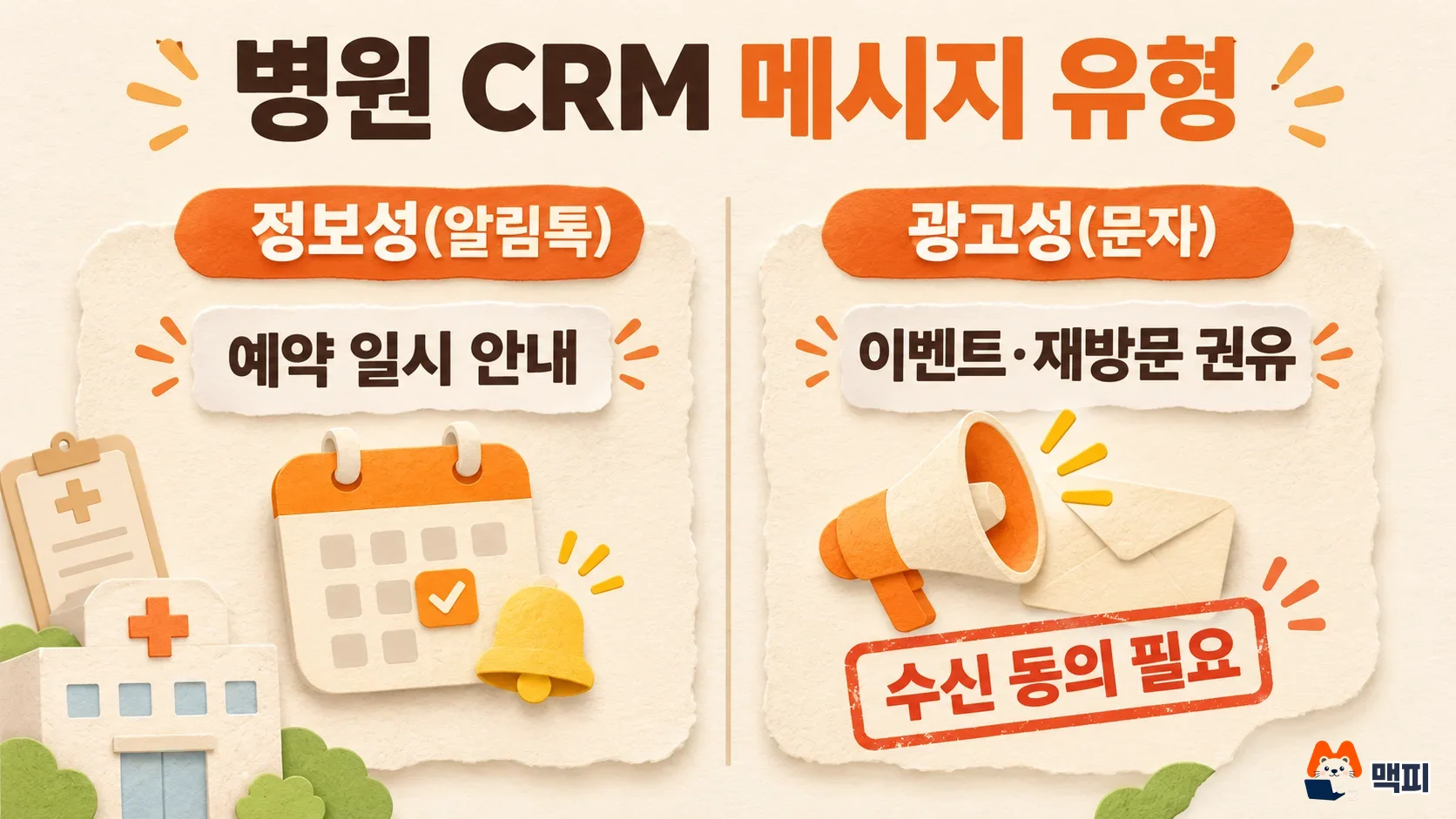
If you cannot tell whether a message is an ad, treat it as one and send it only to patients who consented. The return-visit offer in the table is this case. The Korea Internet & Security Agency (KISA) advises that you must not nudge people into ad consent with vague wording such as "benefit notice" or "information", so state clearly in the consent text that it is promotional information. Even after you get ad consent, KISA's illegal spam prevention guide requires you to re-confirm consent every 2 years from the date it was given.
How much patient data to put in medical CRM software
If you keep only contact details and booking schedules in the CRM, your scope of processing stays narrow. Once you add health information such as diagnoses or procedures, the burden grows. Article 23 of Korea's Personal Information Protection Act treats health information as sensitive information and in principle bars processing it. You can process it only if you inform the data subject and get consent separate from other consents, or if a law allows it. When you do process it, you must take security measures to prevent loss and leaks.
For this reason, we recommend storing only the items needed for notices in the CRM. Keep treatment details in the EMR. In the CRM, keep only contact-related data such as name, phone number, booking schedule, ad consent status and consent date. If staff tend to write disease names or symptoms in consultation notes, agree on a rule with the consultation team first. If your work requires handling health information in the CRM, check the separate consent wording, access permissions and access log management with your vendor. For the general concept and types of CRM, see What CRM means, its types and messaging cautions.
6 steps to set up medical CRM software
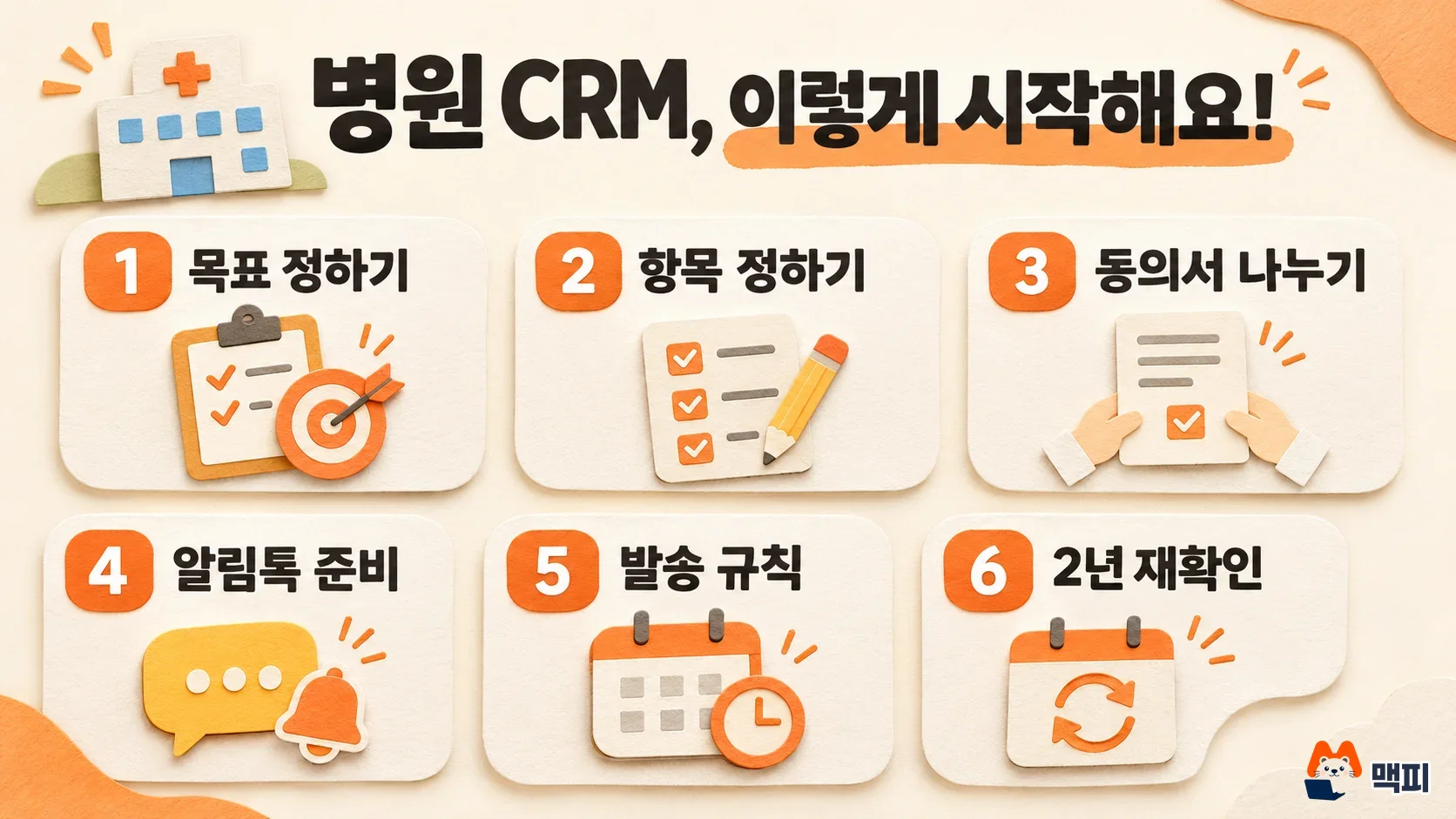
- Pick one problem to solve. A goal you can measure with numbers works best, such as reducing no-shows, where patients book but do not come.
- Decide what goes into the CRM (CRM means customer relationship management software). Start with the contact details, booking schedule and consent status needed for notices.
- Separate the consent forms. Do not mix consent to collect and use personal information with ad consent on one sheet, and state in the ad consent field that it is promotional information.
- Prepare the Alimtalk channel and templates. Before signing, ask how much the vendor handles: opening a KakaoTalk channel, registering the sender profile and applying for template approval. If you are reviewing a overseas CRM tool, first check whether it supports sending Korean Alimtalk.
- Set sending rules. Turn on informational messages first, such as a reminder the day before the booking. Send promotional messages only to patients who consented, and exclude 9 p.m. to 8 a.m.
- Record the consent date and schedule a re-check before the 2 years are up.
When setup is done, start with a small test. Send the appointment reminder template to two or three staff phones and check that the wording appears as intended. When you send a promotional text, check that the sender name and opt-out method are shown. For consent records, pick about ten patients and check that the consent date is saved in the CRM.
Then monitor for 4 weeks. On the CRM's sending results screen, look at the number of successful and failed sends. In the booking system, check whether no-shows dropped compared with the 4 weeks before setup. An Alimtalk arriving is not the same as a patient keeping the appointment, so you need to read both numbers together to judge success. Screen names differ by vendor.
Common mistakes when setting up medical CRM software
- Mixing ad consent into the single personal data collection form. It becomes hard to prove separately that the patient agreed to ads.
- Adding event wording to the end of an Alimtalk appointment reminder. Under Kakao's documentation, a message with promotional content cannot be sent.
- Writing disease names and symptoms in consultation notes. Health information is sensitive information, so the more of it piles up in the CRM, the heavier the management burden.
- Not recording the date consent was given. Consent must be re-confirmed every 2 years, and without a base date you cannot tell who is due.
Comparing ways to adopt medical CRM software
| Approach | Best for | What to check |
|---|---|---|
| Booking and text features built into the EMR | Small clinics that only need booking reminders | Whether it can manage ad consent and opt-outs |
| Dedicated hospital CRM service | Hospitals where return-visit management and consultation history matter | Whether it officially supports EMR integration, and how it stores health information |
| Alimtalk sending agency + spreadsheet management | Hospitals testing for the first time | You must manage consent records yourself and track the 2-year re-check schedule yourself |
If this is your first time, it is less risky to skip the dedicated hospital CRM at first. Test one informational booking reminder for 4 weeks, then add promotional return-visit messages once you see results. This order prevents the mistake of starting ad sends before you have a consent record system.
Frequently asked questions
Can I add one line of event wording to an Alimtalk appointment reminder?
No. Alimtalk can only carry informational messages, and the Kakao content guide says a message with promotional content cannot be sent. Send event notices separately to patients who consented to ads.
If a patient refuses messages, can I still send appointment reminders?
Paragraph 2 of Article 50 of the Information and Communications Network Act bars sending promotional information after a refusal or consent withdrawal. Informational notices such as appointment times are not ads, so they are separate, but keep promotional wording out of them.
Can I send appointment reminders after 9 p.m.?
The night-time limit in paragraph 3 of Article 50 applies to promotional information. Informational notices are not what this clause blocks. Still, it is better to send them during the day so patients are not bothered.
You have two things to do today. Check whether your current consent form has a separate ad consent field, and write one reminder message for the day before a booking without any event content. Once these two are set, you are ready to talk to a CRM vendor.
Found this useful? Share it
Latest posts
Kakao Share Thumbnail Not Showing? Here's the Fix (JavaScript SDK 2025)
Learn why Kakao Share thumbnails don't appear even with a valid imageUrl, and fix it using scrapImage to convert your URL into a KAGE CDN URL. Step-by-step guide.
How to Generate CRM User Manuals in 20 Minutes with Claude Code Sub-Agents
Learn how Claude Code sub-agents can analyze your CRM codebase and auto-generate user manuals and visual guidebooks in just 20 minutes. See the real-world results.
GEO Generative Engine Optimization: The Complete 2025 AI Marketing Strategy Guide
Learn what GEO (Generative Engine Optimization) is, how it differs from traditional SEO, and discover 5 proven AI marketing strategies to get cited by AI search engines in 2025.
Related projects
Get new posts by email
Insights on marketing, analytics, and dev, delivered to your inbox.