
Customer acquisition cost (CAC) is the marketing and sales spend needed to win one new customer. You calculate it by dividing the spend of a period by the number of new customers gained in that same period. The simple method that divides only ad spend leaves out salaries and overhead, so it comes out lower than the full method. State which scope you used, and read CAC together with LTV (the profit a customer leaves behind) before you make a decision.
Customer acquisition cost formula: why dividing ad spend alone is wrong
In CAC, the "C" stands for Cost and "AC" stands for Acquisition. The Inblog glossary (Inblog is a Korean blogging platform) describes CAC as the total marketing and sales cost of gaining one new customer. It writes the formula as (marketing cost + sales cost) ÷ number of new customers acquired. Cost items include ad spend and content production, but also marketing and sales salaries, tool fees, outsourcing and overhead. The same source warns that leaving out salaries and overhead makes CAC look lower than it really is. Wikipedia also separates the simple method, which divides only total marketing spend and excludes salaries and overhead, from the fully loaded method, which adds salaries, software, professional services and overhead.
The numerator is all the money spent to win those customers. The denominator is the new customers. Repeat buyers do not belong in the denominator. If you count orders from people who already bought before, CAC looks smaller than it is.
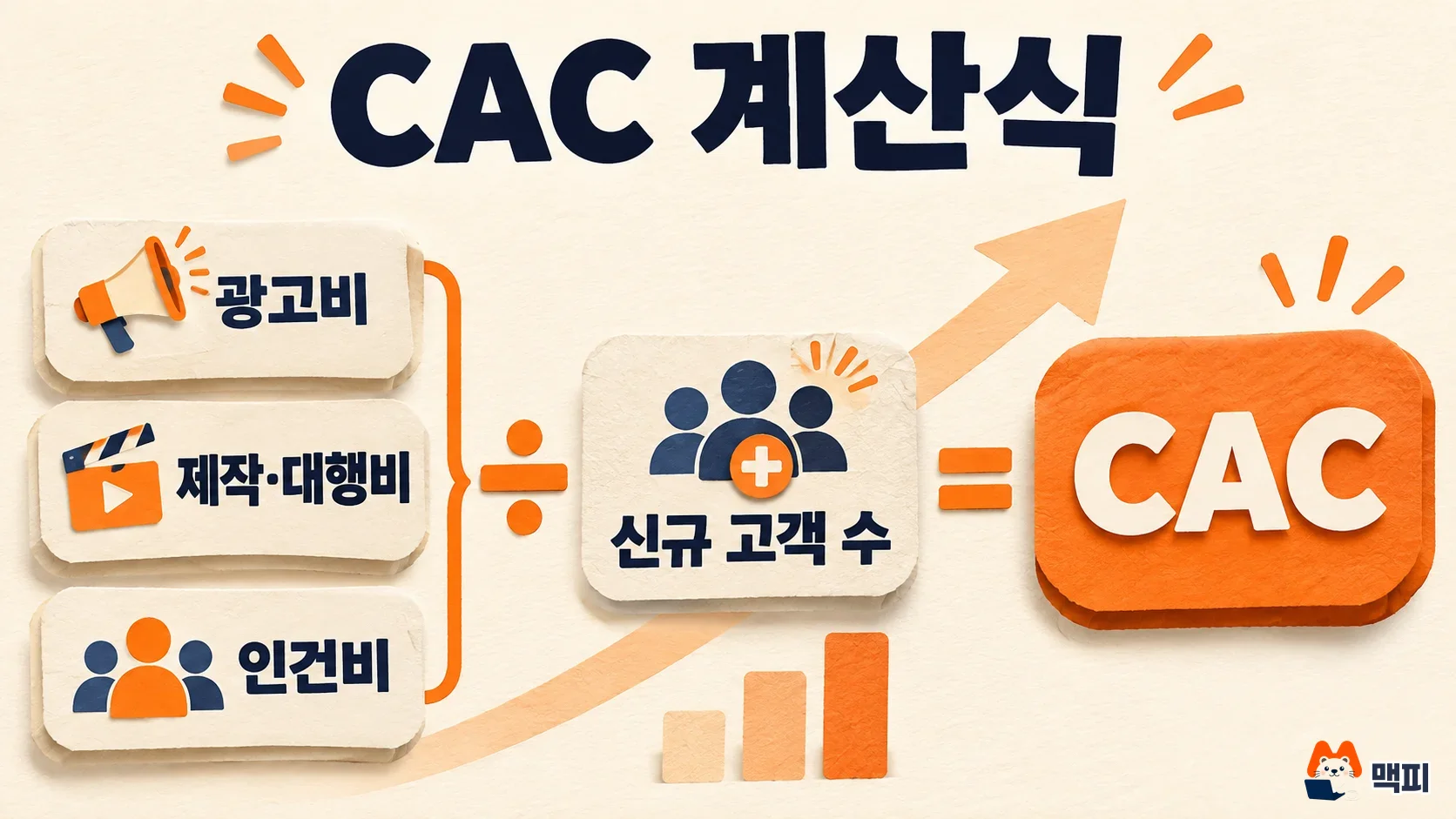
Figure 1. The CAC formula. The numerator includes costs beyond ad spend, and the denominator counts only new customers.
Customer acquisition cost example: KRW 60,000 or KRW 100,000 in the same month
Take one month of a small online store. The numbers below are made-up assumptions to show the method. The store gained 50 new customers in the month.
| Cost item | Amount (monthly) |
|---|---|
| Ad spend (search and social ads) | KRW 3,000,000 |
| Production and agency fees (creative production, agency commission) | KRW 800,000 |
| Marketing salary (the share of the staff member's pay spent on ads) | KRW 1,200,000 |
| Total | KRW 5,000,000 |
Dividing only ad spend by 50 new customers gives KRW 60,000. Adding production and agency fees gives KRW 3,800,000 ÷ 50 = KRW 76,000. Including salary gives KRW 5,000,000 ÷ 50 = KRW 100,000. Depending on the scope, the same month makes this a KRW 60,000 store or a KRW 100,000 store.
If you use the same scope every month, you can compare trends. So set the scope at the start and do not change it. If you want to look at ad efficiency alone, label the ad-spend-only value separately, for example "ad-spend CAC".
CAC vs CPA: what is the difference
The number you often see in ad dashboards is CPA (cost per acquisition, or cost per conversion). According to the Google Ads Help, target CPA is the average amount you are willing to pay for one conversion. The advertiser defines what a conversion is, so it can be a purchase or a consultation request. It counts a different thing than CAC does.
| Item | CAC | CPA |
|---|---|---|
| Divided by (denominator) | Number of new customers | Number of conversions (an action the advertiser defines) |
| Cost scope | Ad spend + production and agency fees + salaries, etc. | Usually ad spend |
| Repeat purchase orders | Excluded from the denominator | Included if counted as a conversion |
| Where to find it | Your own calculation (order data + cost ledger) | Ad manager reports |
In the example store, suppose ads drove 70 purchase conversions and 20 of them were repeat purchases. Then CPA is KRW 3,000,000 ÷ 70, about KRW 43,000. That is lower than the ad-spend CAC of KRW 60,000, which divides by the 50 new customers. If you read only the CPA on the ad screen and assume one customer costs KRW 43,000, you underestimate the cost. Splitting first purchases from repeat purchases inside purchase conversions has to be done in your own order data.
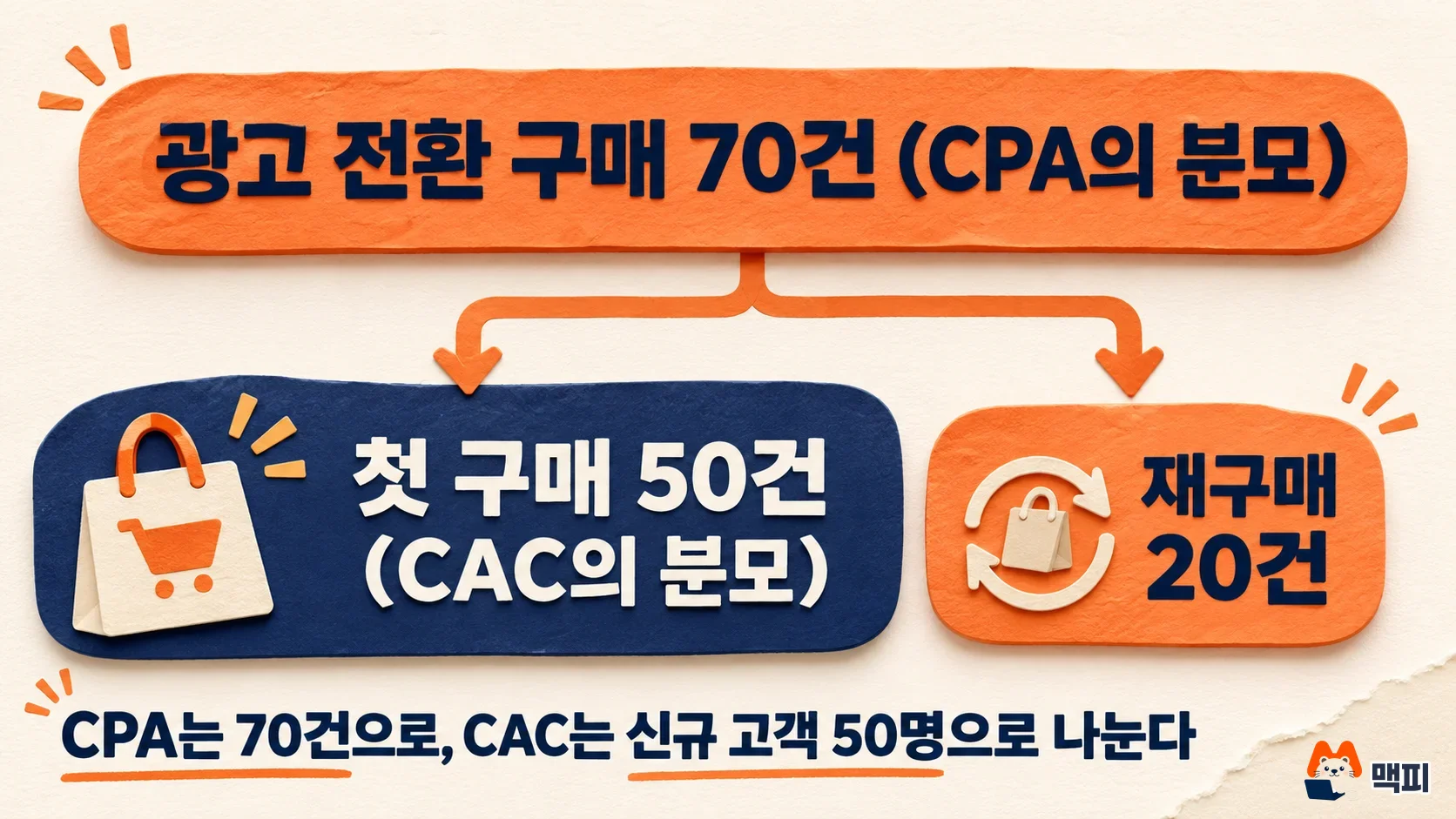
Figure 2. For the same ad conversions, CPA counts repeat purchases too, while CAC counts only new customers.
The link to conversion rate (CVR) is covered separately in CVR meaning and conversion rate calculation, and why Google Ads and GA4 numbers differ. The basics of ad terms such as CPC and CPA are in CPC meaning and a summary of CPM, CPA and CTR.
You can only judge CAC as high or low by comparing it with LTV
Whether a CAC of KRW 100,000 is expensive depends on how much profit that customer leaves behind. The Inblog glossary explains that if CAC is higher than a customer's lifetime value (LTV), losses grow as you grow. The same source says an LTV:CAC of 1:1 or below is a loss-making structure and 3:1 is a healthy benchmark. Wikipedia also calls 3:1 very good and says a higher ratio means there is room to add more customers. It varies by industry, so use it only as a reference.
To match the unit of CAC, calculate LTV on profit (gross profit), not revenue. Say a customer of the example store spends KRW 40,000 per order, buys 3 times a year, and stays for 2 years. Revenue is KRW 240,000. With a gross margin of 50%, LTV is KRW 120,000.
| Item | Amount |
|---|---|
| LTV (profit basis) | KRW 120,000 |
| CAC (everything included) | KRW 100,000 |
| CAC (ad spend only) | KRW 60,000 |
With the full CAC of KRW 100,000, LTV:CAC is 1.2:1, which barely leaves a margin. With the ad-spend-only KRW 60,000, it is 2:1, which looks comfortable. One choice of cost scope changed the judgment. The need to match LTV and CAC on the same period and the same scope also ties in with the metric definition principle in KPI meaning and a summary of marketing metrics.

Figure 3. Comparing the profit one customer leaves (LTV) with the cost of winning one customer (CAC).
Metrics that look at return on ad spend are compared separately in the difference between ROI and ROAS. Unlike those metrics, CAC looks at one customer at a time. Also check the payback period. The profit from a first purchase is KRW 40,000 × 50% = KRW 20,000, so recovering a CAC of KRW 100,000 takes five purchases. At 3 purchases a year, that is about 20 months, so under the 2-year assumption it is only just recovered. In this case, first work on lowering CAC or raising order value and repeat purchase count.
Where to get the numbers for a customer acquisition cost calculation
CAC is not a metric that an ad manager or GA4 shows directly. You have to collect the numerator and denominator separately.
- Ad spend: collect the cost for the same period from the ad manager. To see cost in GA4, you need to link the property to Google Ads or similar, or import cost data. According to the GA4 All channels performance report help, ROAS is the revenue of the selected key event divided by total ad spend. Google Analytics and Google Ads attribute differently, so the numbers can differ even for the same period.
- VAT: check on screen whether the cost in the ad manager includes VAT or not, and match it to the same basis as your accounting ledger. Mixing one side with VAT and the other without changes CAC.
- Non-ad costs: take production and agency fees, and the marketing share of salaries, from the accounting ledger or settlement statements. If the staff member also does other work, split by the share of time spent on marketing.
- New customers: from the order data in your store admin or CRM, count only customers who bought for the first time in that period. Conversions on the ad screen can include repeat orders, so do not use them as they are.
- Calculation: divide the sum of steps 1 and 2 by step 3.
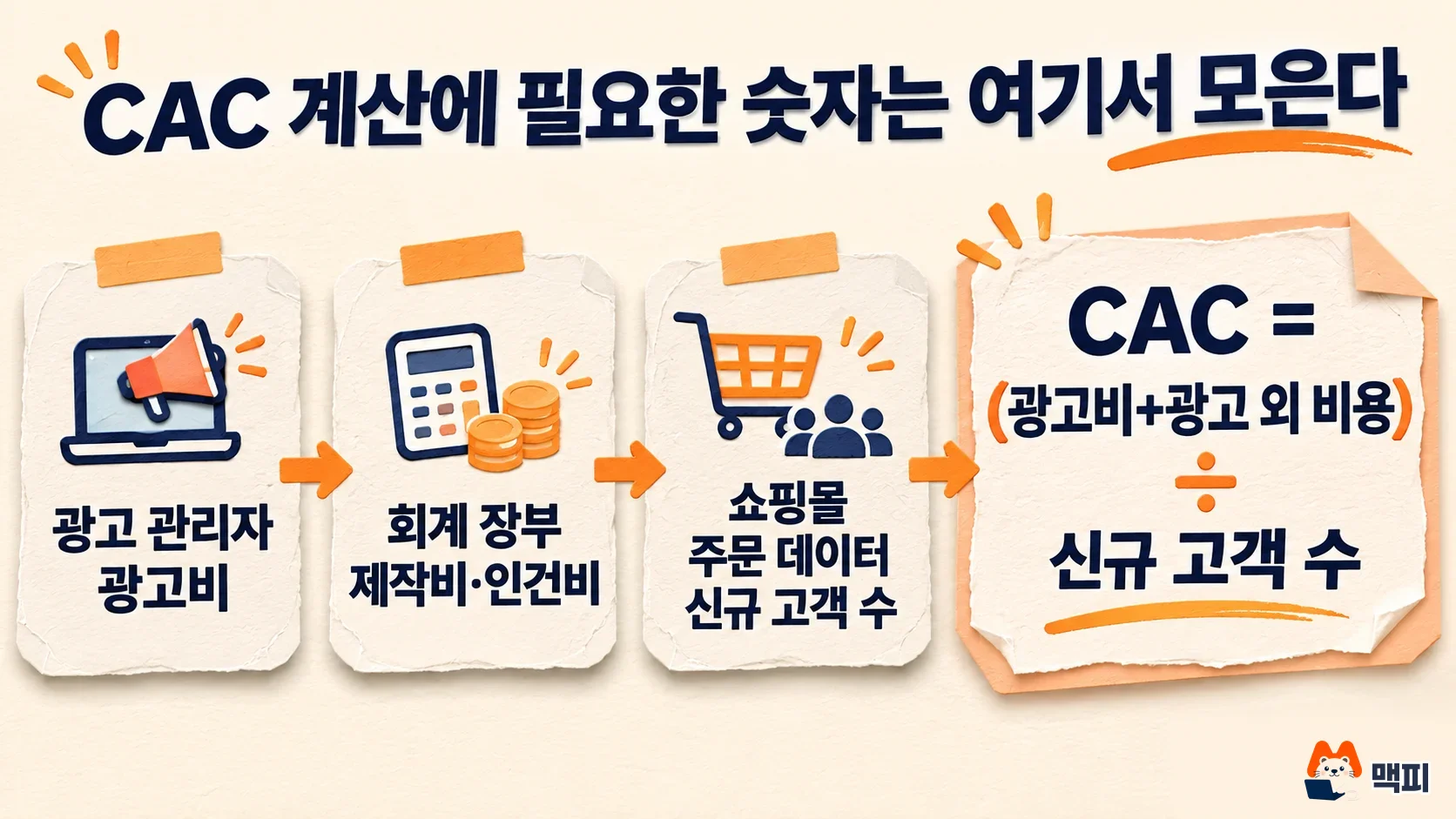
Figure 4. Sources of the numbers for CAC. Ad spend comes from the ad manager, non-ad costs from the accounting ledger, and new customer count from order data.
You judge success by whether you can calculate the value with the same scope next month and compare. Two months in a row with the same scope show a trend. With only one month, there is no baseline for comparison. A guide on calculating the profit a customer leaves behind is planned separately, so here you can keep it simple with order value, purchase count and margin, as in the example above.
What to do now: collect three numbers for last month, which are ad spend, non-ad costs and first-time customer count. Calculate CAC once and note the scope you used. If you calculate again next month with the same scope, you can compare the two values.
Customer acquisition cost FAQ
Is a lower CAC always better?
No. The Inblog glossary explains that if LTV:CAC is too high, you may be underinvesting in marketing and missing growth opportunities. Do not chase a low CAC alone. Look at the ratio to LTV and the payback period together.
Should free users or trial sign-ups count as new customers?
CAC divides cost by the customers gained in return for that spend, so putting free sign-ups in the denominator breaks the match with LTV. If you want to track the cost of free sign-ups, give it a separate name such as "sign-up acquisition cost".
How should a sole proprietor include labor cost?
If the owner runs the ads personally, set a notional amount for that time and include it. Even without an exact value, using the same basis every month lets you compare trends. This basis is the author's suggestion and not an official definition.
Found this useful? Share it
Latest posts
Kakao Share Thumbnail Not Showing? Here's the Fix (JavaScript SDK 2025)
Learn why Kakao Share thumbnails don't appear even with a valid imageUrl, and fix it using scrapImage to convert your URL into a KAGE CDN URL. Step-by-step guide.
How to Generate CRM User Manuals in 20 Minutes with Claude Code Sub-Agents
Learn how Claude Code sub-agents can analyze your CRM codebase and auto-generate user manuals and visual guidebooks in just 20 minutes. See the real-world results.
GEO Generative Engine Optimization: The Complete 2025 AI Marketing Strategy Guide
Learn what GEO (Generative Engine Optimization) is, how it differs from traditional SEO, and discover 5 proven AI marketing strategies to get cited by AI search engines in 2025.
Related projects
Get new posts by email
Insights on marketing, analytics, and dev, delivered to your inbox.