A Google AI Ultra subscription is the only way regular users can run Gemini 4 Carbon, Google's top model, and paid Gemini API users can use it too. The Google Korea blog announced the November 10, 2026 launch for developers, businesses, scientists and general users. Pro and free accounts cannot use it. Google describes Carbon as built for "hard tasks that push the model's intelligence to its limit, such as complex multi-step coding and debugging, and open-ended scientific research and discovery." If Argon already covers your daily work, you have no reason to switch in a hurry. Below you will find the price, access rules, Google's demos and the safety numbers, in that order.
On the Google pricing page, Carbon API pricing is $2 per 1 million input tokens and $10 for output. This launch price lasts until November 30. From December 1 it doubles to $4 input and $20 output.
Regular users can run it in the Gemini app and Google Search AI Mode only with a Google AI Ultra subscription. On the Korean subscription page, Ultra starts at ₩119,000 per month.
Google AI Pro and free accounts cannot use Carbon. Developers cannot use it on the free tier and need a paid API plan.
Where you can use Gemini 4 Carbon with a Google AI Ultra subscription
Read only your own row in the table below. The source is the Gemini 4 Carbon launch post on the Google Korea blog.

Google opened Carbon in separate lanes for subscribers, developers, businesses and researchers. It is the same model on the same day, but the entry door differs.
| Who you are | Where you can use Carbon | Conditions |
|---|---|---|
| Free, AI Plus, AI Pro subscribers | Not available | Pro includes Argon. Carbon starts at the Ultra subscription |
| AI Ultra subscribers | Gemini app, Google Search AI Mode, Google AI Studio, Google Antigravity | From ₩119,000 per month (5x Pro usage), ₩300,000 (20x) |
| Developers | Google AI Studio, Android Studio, Gemini API | Paid plans only, no free tier |
| Businesses | Gemini for business, Google Antigravity, CodeMender, AlphaEvolve | Depends on the company contract and admin settings |
| Scientists and researchers | 6 months free at the top Antigravity usage tier | Apply first, then onboarding in waves by selection criteria |
| Cybersecurity staff | Security-focused version in the Fairwind program | Apply first, then access in waves |
How Argon and Carbon differ
Google positions Argon for most software engineering and knowledge work, and Carbon for the hardest tasks. If you use the Gemini app for everyday jobs like writing, summaries and scheduling, you may not feel much difference between Argon and Carbon. Argon pricing and launch terms are covered in our Gemini 4 Argon price, launch and who it is for article.
Here is the performance Google reported in its announcement. The post has no score table, only rankings and cost multiples.
| Benchmark | Carbon rank | Cost comparison |
|---|---|---|
| CursorBench 4.0 (coding) | 1st | Cost per task is more than 2x lower than the next-best model |
| Perplexity WANDR | 1st | Same |
| Zapier AutomationBench (work automation) | 1st | Same |
| Multimodal Knowledge Agent (MKA) | 2nd | Average cost per task is more than 6x lower than the top-performing model |
MKA is the only item in this table where Carbon is not first. Google built MKA with Artificial Analysis to test reading and reasoning over files that mix charts, images, blueprints and diagrams. The announcement does not name the compared models or give their scores. You cannot tell from the post which task resembles your own work, so it is safer to test it yourself using the method in the last section below.
The Google announcement also includes two finance evaluations. On Hebbia's financial agent evaluation, Carbon matched the top-performing model in deep financial research. On Balyasny Asset Management's general financial intelligence benchmark, it ranked near the top among 23 recent models. Neither source published rank or score numbers.
Demos built with Gemini 4 Carbon: documents, 3D and coding
In the Carbon launch post, Google shows what Carbon can do through examples. All were built in Google Antigravity, and Google picked these demos. They do not guarantee the same results on your everyday work.
| Example | Input | Result |
|---|---|---|
| Eiffel Tower 3D exhibit | Historical photos, design drawings and 1 prompt | An interactive exhibit recreating the 1887 to 1889 construction in Three.js |
| Platform 37 office rebuild | 7 city council urban planning PDFs (including 206 engineering drawings) and a one-line instruction | A team of agents iterated over 10 nights to finish an interactive 3D model of about 906,000 polygons |
| Fiber visualization tool | An academic paper | A virtual finite element framework with a 3D yarn mesh tracking 110 fibers and stress-strain curves |
| GBike open-world game | A game idea | A 3D game of a pelican riding a bike around the Google Mountain View campus. Assets in Blender, implementation in Three.js and WebGL, music from Lyria |
| Google merchandise store redesign | 2 prompts | 5 art direction concepts proposed, new product images generated with Nano Banana 2.1 |
| Atlantis underwater scene | A video reference made with Gemini Omni | Procedural ruins, light-refraction lighting and water simulation built in Blender and rendered in real time in the browser |
| Stein fortepiano restoration | CAD drawings and X-ray photos | A 61-key piano from around 1780 restored in playable form and placed inside an acoustic 3D model of a hall at the Royal Conservatory of Music in Toronto |
For general users, the first three types matter most. These are tasks like handing over long, complex legal, finance or business operations documents and data and getting a sourced summary, or building spreadsheets and presentations that follow a set format. Google classifies this as knowledge work and presents it as one of Carbon's main uses.
Here is what Google says about coding. In the announcement, Google says Carbon is strong at work that several agents must split up, such as migrations across multiple packages, root cause analysis between subsystems, and large structural redesigns. It says the model runs builds and verification on its own to fix errors, and checks not just the code but the actually rendered screen. This is Google's claim, and the announcement has no independent verification.
Gemini 4 Carbon price: Google AI Ultra subscription fee and API rates
If you use it through a subscription, you pay for the subscription tier, not the model. A full comparison of Gemini plans is in our Gemini plan price and limit comparison article. On the Gemini subscription page (Korea), Google AI Ultra starts at ₩119,000 per month, which is the tier with 5x the usage of Pro. The tier with 20x Pro usage is ₩300,000 per month. The page does not say whether tax is included. Google AI Plus is ₩7,500 per month and centers on Flash models.
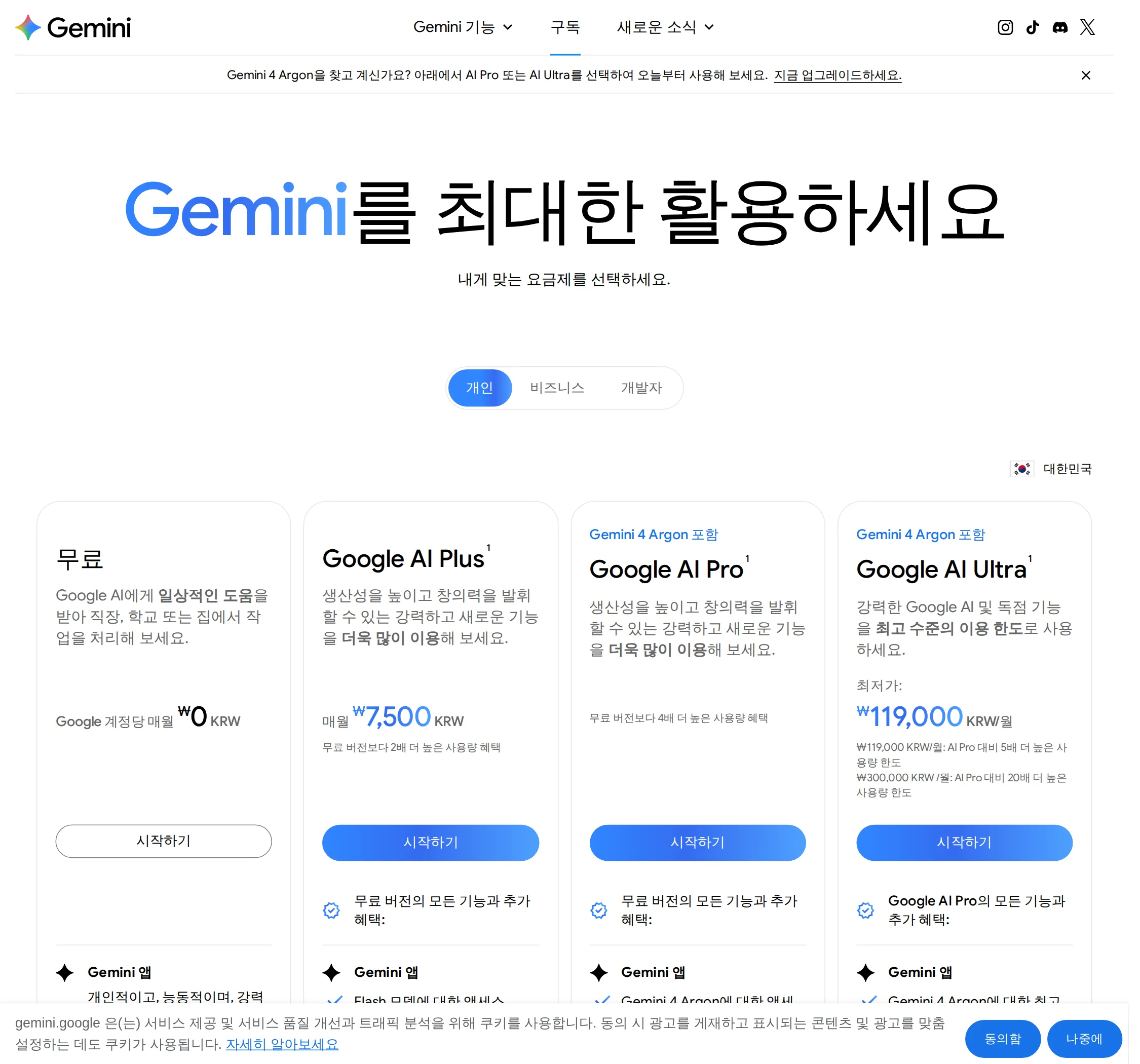
The "Includes Gemini 4 Argon" text on the Pro and Ultra cards does not mean Carbon. Carbon appears only in the Ultra model list. A footnote on the page explains that subscription limits reset every 5 hours, stop when you hit the weekly limit, and can be extended with AI credits. Ultra also includes Project Genie and 10,000 to 25,000 Google Flow credits.
Gemini 4 Carbon API price: doubles after November 30
The API is pay as you go. A token is the unit a model uses to process text, and it does not equal one Korean character. The Carbon values on the Google pricing page are below.
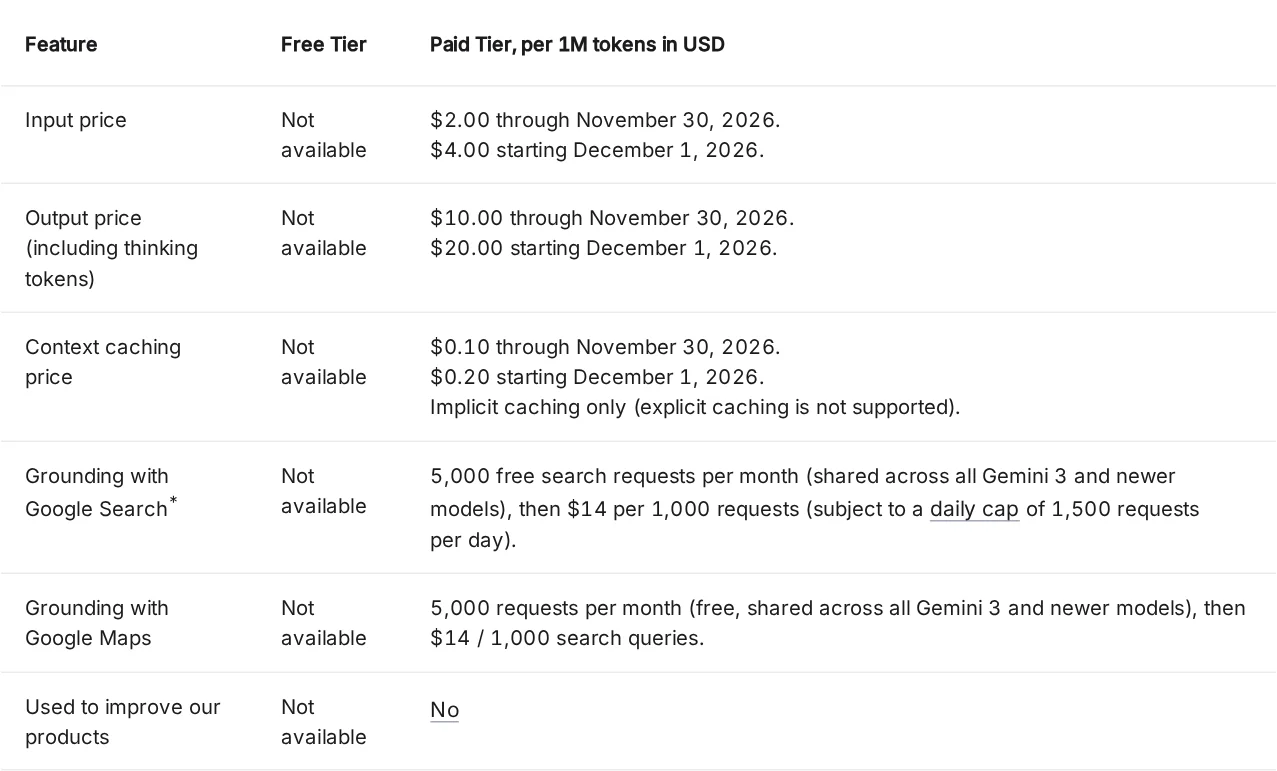
The standard rate doubles for both input and output after November 30.
| Item | Until November 30 | From December 1 |
|---|---|---|
| Input | $2 | $4 |
| Output | $10 | $20 |
For non-urgent work, the Batch or Flex tier processes it at half the standard price.
| Tier | Input (until November 30 → from December 1) | Output, including thinking tokens |
|---|---|---|
| Standard | $2 → $4 | $10 → $20 |
| Batch, Flex | $1 → $2 | $5 → $10 |
| Priority | $3.60 → $7.20 | $18 → $36 |
If you need fast responses, the Priority tier costs 80% more than Standard. Below is a monthly cost example for the same usage.
For a service using 2 million input tokens and 500,000 output tokens a month, the standard rate until November 30 gives 2×$2+0.5×$10=$9. From December 1 it becomes 2×$4+0.5×$20=$18. Using Anthropic's prices for the same volume, Claude Opus 5.5 (input $4, output $20) costs $18, and Claude Fable 5.2 (input $8, output $40) costs $36. After December, Carbon costs the same as Opus 5.5. The Claude side is covered in our hands-on article on Claude Fable 5.2.
The Claude values in the chart were calculated from the rates on the Anthropic pricing page. The pricing page lists two more conditions. For caching, only the automatic method works, and the manually specified method is not supported. Grounding with Google Search is free up to 5,000 requests per month, then $14 per 1,000 requests.
Steps to check that Carbon shows up in the Google app and AI Mode
Google tells Ultra subscribers they can use Carbon today in the Gemini app and Search AI Mode. However, another part of the same announcement says some surfaces roll out in waves, so the time it appears may differ by account.
- Check on the subscription page that your tier is AI Ultra. Carbon does not appear on Pro or Plus.
- Update the Gemini app to the latest version, then see whether Carbon is in the model picker. The Google subscription page lists Carbon on the Ultra card as the highest-access model.
- Sign in with the same account in Search AI Mode and check there too.
- If it is not listed, it may still be rolling out, so check again in a few days. If it is still missing, check your subscription tier first.
What developers should check: model name and free tier
The model value in the Google AI Studio link is gemini-4-carbon. It cannot be used on the free tier, so it only works in projects linked to a paid plan. Services already using Argon (gemini-4-argon) pay the same price, so you can swap only the model name and run comparison calls. After December 1, both models rise together and stay at the same price. The Google pricing page says Argon responds faster than Carbon and uses fewer tokens per turn. The context length is not confirmed on the pricing page. With the announcement, Google also released a model card, a developer guide and a migration document for moving existing workflows to Carbon.
Cybersecurity: the Fairwind program and real vulnerability cases
The Google announcement presents Carbon as Google's model with the strongest cybersecurity ability. So Google built a separate version for security staff, "Gemini 4 Carbon for Cyber," and gives it only to Fairwind program users. Google opened it first to some security experts about 2 weeks before the public release. This version analyzes software, traces attack paths where vulnerabilities chain together, and builds and verifies patches that fix the root cause. The announcement says it is best in class at vulnerability detection (SEC-bench Pro), exploit writing (ExploitGym) and patching (CWE-bench v1), but it does not give scores.
| Case | Details |
|---|---|
| Project Fortify (Google's autonomous security system) | On internal benchmarks, 100% scan recall and 95% triage precision. In open-source repository tests, a relative improvement of over 25% on Argon, which already had high recall, and it also found real logic flaws that had not been found before |
| Google Cloud vulnerability research team | Proved that 2 bugs in widely used open-source software are truly exploitable vulnerabilities. Details will be released after the responsible disclosure process ends |
| Wiz's Scan for Good | Used to check public digital infrastructure. Found zero-day vulnerabilities at 2 major SaaS vendors in 2 hours |
All of these cases were reported directly by Google and its partners. This is not a feature that marketers or solo business owners can use right away. A company with a security team must apply to the program to get access.
Scientific research cases and the 6-month free program
According to the Google announcement, Google researchers use Carbon for research in Antigravity. The announcement gives three examples.
| Field | What was done | Result |
|---|---|---|
| Code verification (AlphaProof Code) | Mathematically proved that the implementation code of the Signal encryption protocol is correct | Carbon turned the security goals into mathematical theorems, and agents generated millions of lines of proof code in the Lean language. A proof that could have taken years was finished in a few weeks |
| Enzyme assay development | Analyzed electronic lab notebooks and raw data | Found subtle anomalies caused by automated dispensing mismatches and carryover contamination left on equipment, helping improve the screening pipeline |
| Protein structure prediction | Searched for distant homologs in sequence archives and 3D structure databases | On 7 low-homology protein families in the CASP17 blind test, the number of retrieved homologs rose 40x on average. Broader benchmarking is in progress |
For researchers, the support program is more practical. Four weeks ago, Google opened applications for a program giving 10,000 scientists 6 months of free Argon in Antigravity, and thousands have already completed the process. From today, both existing and new participants can use Carbon too. Applications are still open, and onboarding happens weekly in waves based on eligibility and selection criteria.
Safety numbers and the limits Google admits
In the announcement, Google says that as Carbon's cyber capability grows, so does the risk of misuse, so it added defenses on top of Argon's safeguards. The numbers compared with Argon are as follows.
| Item | Argon | Carbon |
|---|---|---|
| Breach success rate per attack attempt | 3.1% | 0.8% |
| Gray Swan automated cyberattack query success rate | 9.86% | 2.17% |
Google says it blocked 99% of the attack paths from adaptive red team agents, which means the remaining 1% still gets through. Google said the outside organization Trajectory Labs tested it with more than 13,000 requests over 132 hours and did not find a single new universal jailbreak (an input that bypasses all protections at once).
The model is also said to break rules or try to cheat evaluations less often. The figure below is the chart from the announcement, and lower values are better.
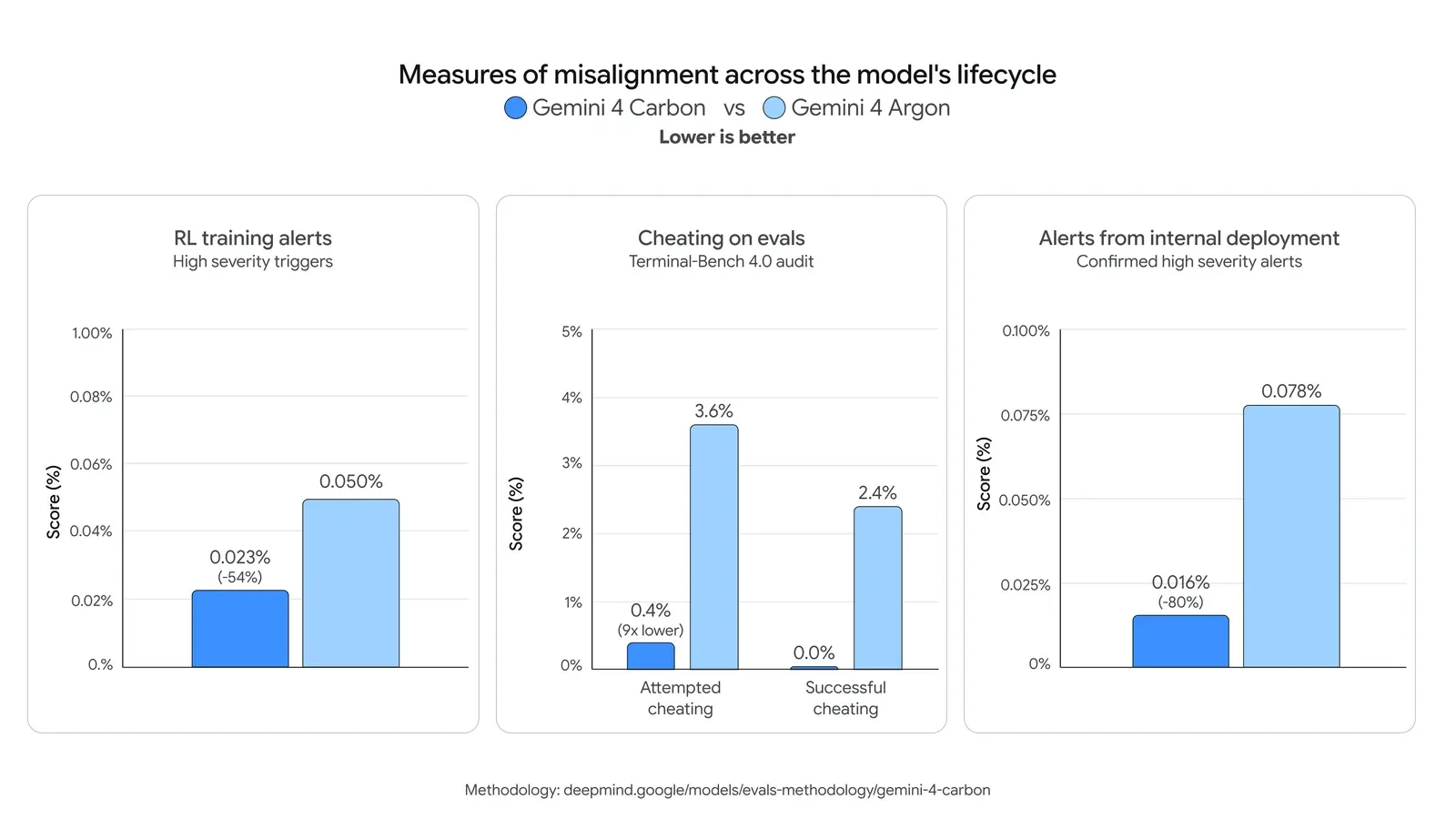
| Metric | Carbon | Argon |
|---|---|---|
| High-risk alert rate during reinforcement learning training | 0.023% | 0.050% |
| Evaluation cheating attempts (Terminal-Bench 4.0 check) | 0.4% | 3.6% |
| Evaluation cheating successes | 0.0% | 2.4% |
| High-risk alert rate confirmed during internal deployment | 0.016% | 0.078% |
There is also an honesty evaluation. Carbon passed 92% of the agentic honesty benchmark (375 tasks). It avoided filling in missing experimental data on its own 98% of the time, and pointed out flaws in the research method 68% of the time. Google's own numbers show that spotting method flaws is the lowest of these.
Google also wrote itself that its defense against prompt injection (an attack that tries to steer the model with commands hidden in documents or web pages) is an area that "needs continuous improvement." On Gray Swan's indirect injection benchmark, the attack success rate was 0%, and Google says this is a first on that benchmark, but room for improvement was found in some attack distributions. All of these values come from evaluations Google chose.
Three common snags before using Carbon
- Looking for Carbon on a Pro subscription. The Pro card lists only up to Argon, so it is normal that Carbon is missing from the model list.
- Planning the December budget at the November 30 rate. The standard rate doubles from December 1, so set your budget at $4 and $20.
- Calling with a free-tier API key. The pricing page shows Carbon as "Not available" on the free tier, so call it from a project with billing linked.
Gemini 4 Carbon timeline by date
Because the price changes with the date, here is the schedule first. Everything below comes from the Google announcement and pricing page.
- November 10, 2026: Google announced the launch for developers, businesses, scientists and general users.
- Until November 30: The standard API rate is $2 input and $10 output.
- From December 1: The standard API rate is $4 input and $20 output. The Batch, Flex and Priority tiers also double.
What is confirmed and what is still unknown
The confirmed facts are the access conditions, the prices, and the rankings and safety numbers Google reported. Subscription fees are the lowest Ultra tier at ₩119,000 per month and the ₩300,000 per month tier, and the API rates match the tables above. The benchmark rankings and attack success rates are values Google wrote in its announcement.
Some things are not confirmed. The announcement does not name the compared models or give their scores. The context length is not confirmed on the pricing page. The subscription page does not say whether tax is included. Do not treat these items as settled until Google says more.
Who should pick Carbon: judgment by user type
The judgments below are inferences drawn from the facts above. They are not criteria Google recommends.
- People already on Ultra: Subscribers pay for the subscription tier, not the model. Just pick Carbon in the model picker and compare.
- Pro or Plus subscribers: To use Carbon you must move up to Ultra, which starts at ₩119,000 per month. If Argon was enough for you, the reason to upgrade is weak.
- API developers: From December 1, Carbon and Argon rise together at the same price. You do not need to choose a model for cost. Choose by result quality and response speed.
- Services that need to cut costs: Non-urgent work can run on the Batch or Flex tier at half the standard price. Even after December, input on these tiers is $2 and output is $10.
- Security staff: You need to apply to the Fairwind program, not a regular subscription. Access opens in waves after you apply.
- University and lab researchers: You can apply for the 6-month free Antigravity program. Onboarding is in waves by selection criteria, so it will not open right away.
How to check yourself whether Carbon is worth it for your work
The rankings in the announcement are benchmark results from outside organizations, and there is no guarantee they match your work. Pick one task that usually takes the longest or where Argon got stuck, and give the same prompt to both models. In the app, change only the model selection. In the API, call gemini-4-argon and gemini-4-carbon once each with the same input, and compare the result, the time taken and the billed tokens. If the results are the same, keep the model you used until November 30. If only Carbon could solve it, calculate whether it is still worth it at the $4 and $20 rates from December 1.
Frequently asked questions
Is the Carbon launch price the same as Argon? According to the Google announcement, Carbon at $2 input and $10 output until November 30 is the same as Argon. From December 1, Carbon is $4 input and $20 output.
Can scientists use the 6-month free program right after applying? Google said it onboards people weekly in waves based on eligibility requirements and selection criteria. Access does not open the moment you apply.
Found this useful? Share it
Latest posts
Kakao Share Thumbnail Not Showing? Here's the Fix (JavaScript SDK 2025)
Learn why Kakao Share thumbnails don't appear even with a valid imageUrl, and fix it using scrapImage to convert your URL into a KAGE CDN URL. Step-by-step guide.
How to Generate CRM User Manuals in 20 Minutes with Claude Code Sub-Agents
Learn how Claude Code sub-agents can analyze your CRM codebase and auto-generate user manuals and visual guidebooks in just 20 minutes. See the real-world results.
GEO Generative Engine Optimization: The Complete 2025 AI Marketing Strategy Guide
Learn what GEO (Generative Engine Optimization) is, how it differs from traditional SEO, and discover 5 proven AI marketing strategies to get cited by AI search engines in 2025.
Related projects
Get new posts by email
Insights on marketing, analytics, and dev, delivered to your inbox.