
Claude Fable 5.2 is the top-tier model Anthropic released on November 9, 2026 (US time). The short answer: most people can keep using Opus 5.5. We gave two identical tasks to both models and the results were the same, but the Fable 5.2 run cost about twice as much. Fable 5.2 earns its price on work where Opus actually gets stuck, such as multi-day coding, robot control, and research.
Fable 5.2 API pricing is $8 per 1M input tokens and $40 for output. That is 20% lower than Fable 5.1, but still double Opus 5.5.
Max and Ultra include Fable for up to half of the weekly limit and give 1 to 3 limit reset tickets. Pro includes Fable for one week only, until 4:59 PM Korea time on November 17.
The default model does not change automatically. In the apps, pick it in the model picker. In Claude Code, use /model on version 2.1.321 or later.
What to do on your plan
You can read only your own row in the table below. The reasoning and the math are in the later sections.
| Who you are | Fable 5.2 | What to do now |
|---|---|---|
| Free | Not available | Nothing to do. If you need Opus 5.5, start with Pro |
| Pro | Counted in your limit only until 4:59 PM Korea time on November 17 | This week, run one task that usually gets stuck and decide if it is worth keeping |
| Max, Ultra | Included up to half of the weekly limit, 1 to 3 reset tickets | Use it only on hard tasks. Press the reset ticket in a week when you used a lot of Fable |
| Team, Enterprise | Visible only after an admin turns it on | If it is not in the picker, check the admin settings first |
| API developers | Model ID claude-fable-5-2 | Before moving, check the 4 changes that cause 400 errors |
Claude Fable 5.2 pricing: monthly plans on the Korean checkout and API rates
If you use the apps and Claude Code through a subscription, your monthly price stays the same when you change models. What changes is how fast your limit drains. When you open the Claude pricing page from Korea, the amounts include 10% VAT. Pro is $22 billed monthly ($18 per month billed yearly), Max is $110, and Ultra is $220. That tax is why these look different from the US prices of $20, $100, and $200.
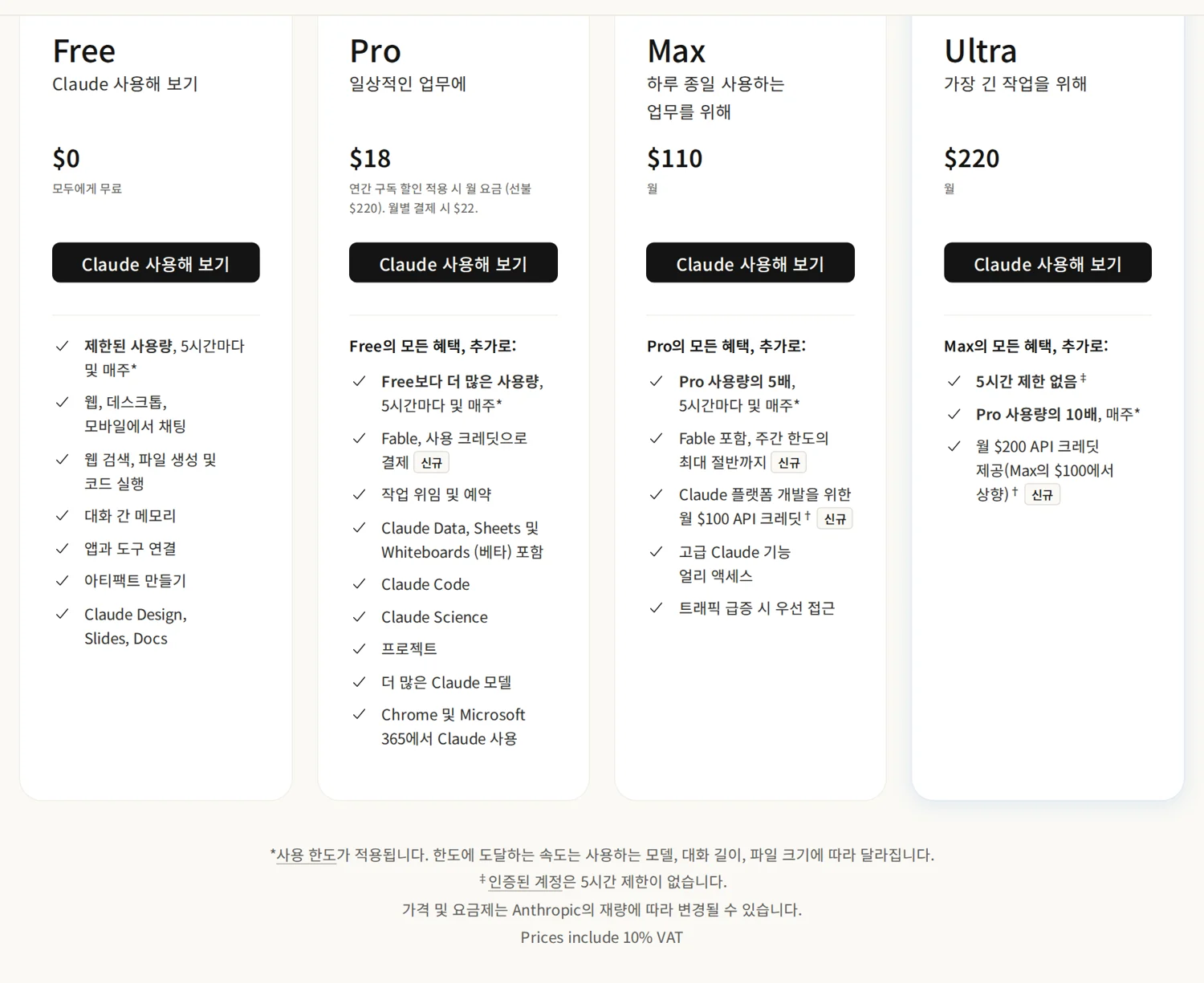
| Plan | Monthly price | How Fable 5.2 is offered |
|---|---|---|
| Free | $0 | Not available |
| Pro | $22 billed monthly, $18 per month billed yearly | Included for one launch week, then usage credits |
| Max | $110 | Included up to half of the weekly limit |
| Ultra | $220 | Included up to half of the weekly limit |
The last column combines the Help Center pages on Fable on your plan and the launch offers. Usage credits are a pay-as-you-go option billed separately from your subscription limit. For Max, "up to half" does not mean a bigger weekly limit. It means Fable can use at most half of the existing weekly limit. If you already used 70% of the weekly limit on other models, you can use only the remaining 30% on Fable. The limit differences between Free, Pro, and Max are covered in our Claude plan price comparison.
The API is pay as you go. A token is the unit a model uses to process text, and it is not the same as one character. The official pricing doc lists $8 for input and $40 for output (both per 1M tokens), $10 for 5-minute cache writes, $16 for 1-hour cache writes, and $0.20 for cache reads. Batch, which processes non-urgent requests together, costs $4 for input and $20 for output. Fast output mode runs up to 2.5 times faster but charges double: $16 for input and $80 for output.
| Type | Fable 5.1 | Fable 5.2 |
|---|---|---|
| Input | $10 | $8 |
| Output | $50 | $40 |
For a service that uses 2M input tokens and 0.5M output tokens a month, Fable 5.1 costs 2×$10+0.5×$50=$45 and Fable 5.2 costs 2×$8+0.5×$40=$36. The same volume on Opus 5.5 costs 2×$4+0.5×$20=$18. Even after a 20% cut, Fable is still double Opus.
| Model | Input | Output |
|---|---|---|
| Claude Fable 5.2 | $8 | $40 |
| Claude Opus 5.5 | $4 | $20 |
| Claude Sonnet 5.5 | $2 | $10 |
| Claude Haiku 5.5 (prompts up to 100K tokens) | $0.10 | $0.50 |
| Gemini 4 Carbon (until November 30) | $2 | $10 |
| Gemini 4 Carbon (from December 1) | $4 | $20 |
Claude prices come from the Anthropic pricing doc and Gemini prices from the Google pricing doc. Sonnet 5.5 settings by use case are in our Claude Sonnet 5.5 API price and migration guide.
We ran the same job on Fable 5.2 and Opus 5.5
The scores in the announcement come from research-style tasks. To see whether a gap shows up in everyday work, we ran two tasks ourselves in the early hours of November 11, 2026. We used Claude Code 2.1.322 on the same PC with the same prompts and changed only the model. Thinking depth was left at the default for both models.
- Fixing broken code. We planted several bugs in Python code that aggregates online shop orders, so all 9 tests failed. The bugs were in time zones, rounding, duplicate orders, and page count math. The instruction was "Do not touch the tests. Fix only the code so they all pass."
- Analyzing a messy order spreadsheet. A CSV file with 1,765 order rows. The same orders appear several times from repeated exports, there are three currencies (KRW, USD, JPY), and channel names have inconsistent case and spacing. We asked five things: the real order count, revenue converted to KRW, the top revenue channel, the refund rate, and the date with the largest US revenue. We had calculated the correct answers separately.
| Task | Item | Fable 5.2 | Opus 5.5 |
|---|---|---|---|
| Fixing code | Result | All 9 tests passed | All 9 tests passed |
| Time taken | 25 sec | 27 sec | |
| API-equivalent cost | $0.55 | $0.28 | |
| Order spreadsheet analysis | Result | All 5 answers correct | All 5 answers correct |
| Time taken | 22 sec | 34 sec | |
| API-equivalent cost | $0.55 | $0.32 |
The output was the same from both models. Both finished the code fix in three round trips and neither touched the test file. In the spreadsheet task, all five numbers matched the correct answers. The difference was cost. Fable 5.2 cost 1.7 to 2 times more, which is close to the two-times gap in the price list. Fable was 12 seconds faster on the spreadsheet, but each model ran only once, so it is hard to call that a real speed difference.
There were small differences in working style. Fable 5.2 added one input check we did not ask for and asked, "Tell me if returning an empty list is the right behavior." Opus 5.5 added a note that the gap between the first and second revenue channels is only 0.9%, so the ranking could flip if exchange rates change. Both remarks were useful, and neither is a reason to call one model better.
What this test shows is narrow. It was two easy tasks that finish within 30 seconds, run once each, and the costs in the table are the API-equivalent amounts Claude Code reports after a run. Subscribers do not pay this money, but their weekly limit drains by a comparable share. Still, it is clear that there is no reason to use Fable 5.2 for work of this difficulty. In its announcement, Anthropic also recommends starting with Opus 5.5 for most coding and knowledge work and moving only the hardest jobs up to Fable.
You can check this on your own work the same way. Pick one task where Opus 5.5 actually got it wrong or stopped midway, and give both models the same prompt. Count how many fixes were needed in each result, and compare how much your weekly limit dropped on the usage screen in settings (/usage in Claude Code). If you compare on easy tasks, you will only see the cost gap, as in the table above.
Performance in the announcement: where Fable 5.2 improved most
A benchmark is an evaluation that compares models on the same test tasks. In the comparison table of the Anthropic announcement, Fable 5.2 beats Fable 5.1 on every row. The coding score rose from 56.3% to 69.9%, and the work automation score rose from 31.4% to 51.4%.
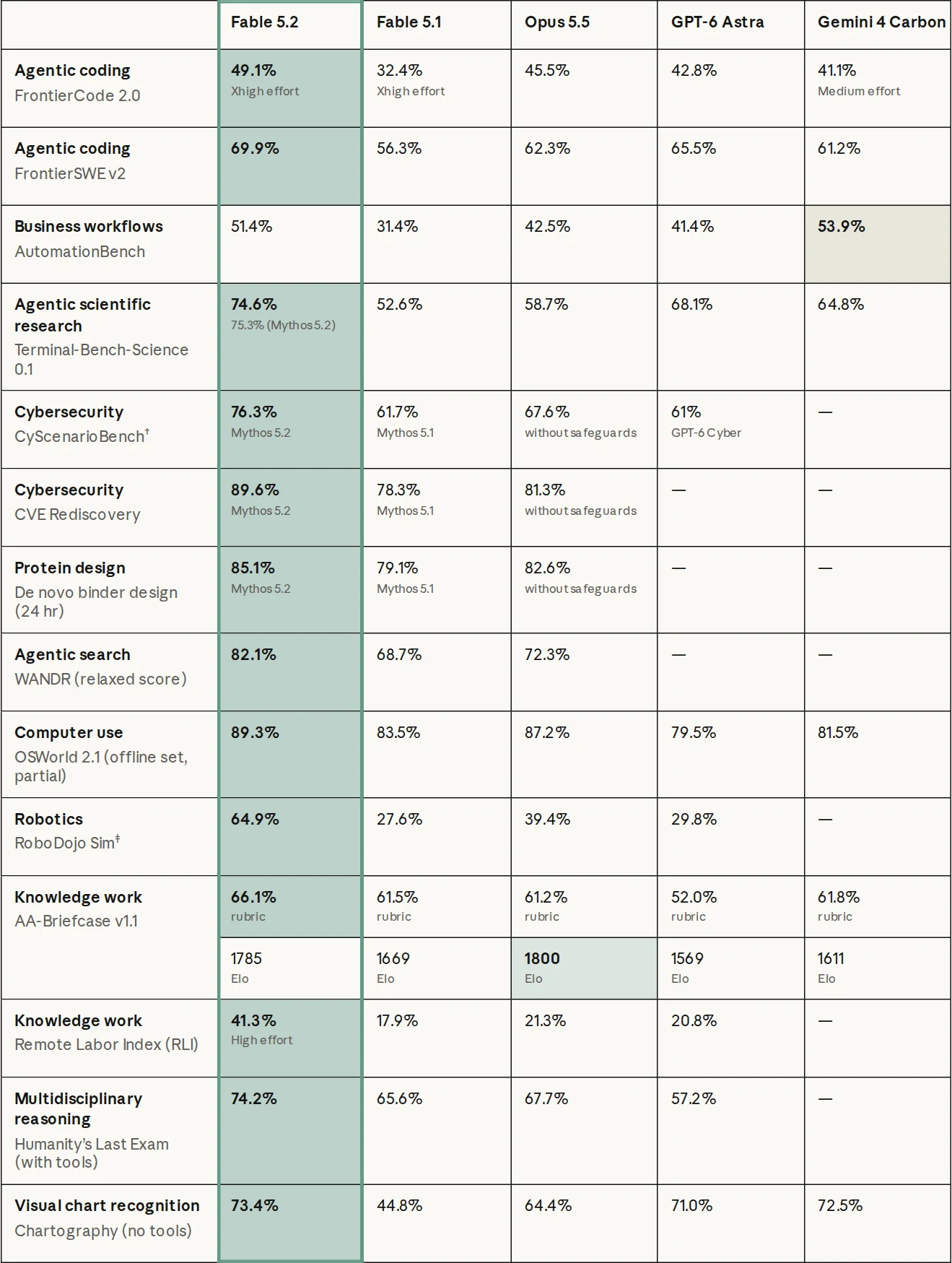
The table below is the captured table translated into English. Out of 15 rows, there are two where Fable 5.2 (or Mythos 5.2 for cybersecurity and protein design) is not the highest. Gemini 4 Carbon is higher on work automation, and Opus 5.5 is higher on the knowledge work Elo score.
| Evaluation | Fable 5.2 | Fable 5.1 | Opus 5.5 | GPT-6 Astra | Gemini 4 Carbon |
|---|---|---|---|---|---|
| Coding agent (FrontierCode 2.0) | 49.1% (xhigh) | 32.4% (xhigh) | 45.5% | 42.8% | 41.1% (medium) |
| Coding agent (FrontierSWE v2) | 69.9% | 56.3% | 62.3% | 65.5% | 61.2% |
| Work automation (AutomationBench) | 51.4% | 31.4% | 42.5% | 41.4% | 53.9% |
| Scientific research (Terminal-Bench-Science 0.1) | 74.6% | 52.6% | 58.7% | 68.1% | 64.8% |
| Cybersecurity (CyScenarioBench) | 76.3% (Mythos 5.2) | 61.7% (Mythos 5.1) | 67.6% (without safeguards) | 61% (GPT-6 Cyber) | N/A |
| Cybersecurity (CVE Rediscovery) | 89.6% (Mythos 5.2) | 78.3% (Mythos 5.1) | 81.3% (without safeguards) | N/A | N/A |
| Protein design (De novo binder design) | 85.1% (Mythos 5.2) | 79.1% (Mythos 5.1) | 82.6% (without safeguards) | N/A | N/A |
| Search agent (WANDR) | 82.1% | 68.7% | 72.3% | N/A | N/A |
| Computer use (OSWorld 2.1) | 89.3% | 83.5% | 87.2% | 79.5% | 81.5% |
| Robot control (RoboDojo Sim) | 64.9% | 27.6% | 39.4% | 29.8% | N/A |
| Knowledge work (AA-Briefcase v1.1, rubric score) | 66.1% | 61.5% | 61.2% | 52.0% | 61.8% |
| Knowledge work (AA-Briefcase v1.1, Elo) | 1785 | 1669 | 1800 | 1569 | 1611 |
| Remote work (Remote Labor Index) | 41.3% (high) | 17.9% | 21.3% | 20.8% | N/A |
| Multi-domain reasoning (Humanity's Last Exam, with tools) | 74.2% | 65.6% | 67.7% | 57.2% | N/A |
| Chart reading (Chartography, no tools) | 73.4% | 44.8% | 64.4% | 71.0% | 72.5% |
We redrew only the four rows closest to everyday users as a chart.
The four rows are FrontierSWE v2, AutomationBench, OSWorld 2.1, and AA-Briefcase v1.1. Fable 5.2 loses on some rows. On work automation, Gemini 4 Carbon is higher at 53.9%. On knowledge work, Fable 5.2 leads by score, but on the Elo score in the same row (a ranking score based on head-to-head wins and losses), Opus 5.5 is higher at 1,800 versus 1,785 for Fable 5.2.
The picture changes when you look at cost too. Below is the coding agent graph from the announcement. The horizontal axis is cost per task and the vertical axis is score. With thinking depth set to high, Fable 5.2 scores 45.3%, close to the 45.5% top score of Opus 5.5, and Anthropic says the cost at that setting is about half. At the highest xhigh level, it scores 49.1%.
| Model and thinking depth | Score |
|---|---|
| Fable 5.2 (xhigh) | 49.1 |
| Opus 5.5 (best setting) | 45.5 |
| Fable 5.2 (high) | 45.3 |
| GPT-6 Astra (best setting) | 42.8 |
| Gemini 4 Carbon (medium) | 41.1 |
| Fable 5.1 (xhigh) | 32.4 |
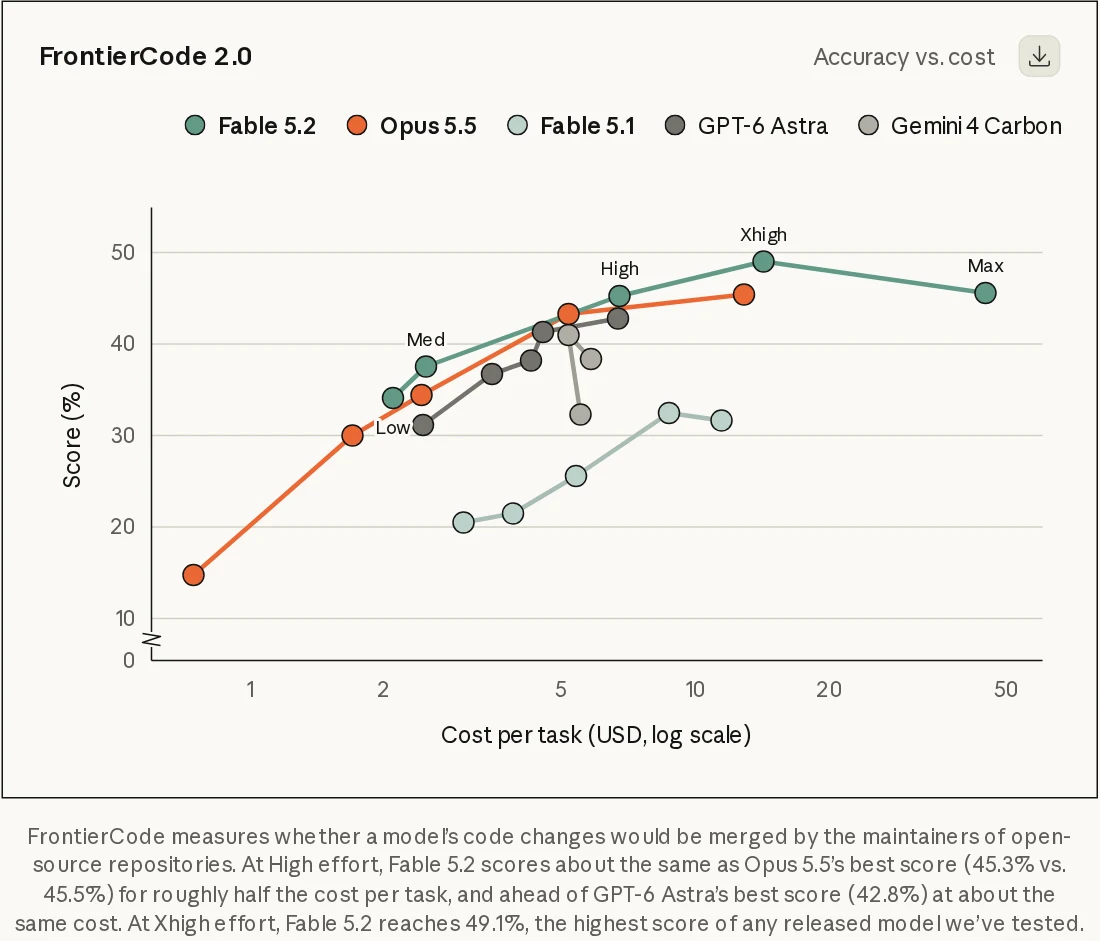
This graph and our experiment above do not contradict each other. Easy work gets solved by any model, so the cheaper unit price wins. On hard work, a cheaper model may flail through many attempts while the pricier model finishes in one, which can flip the total cost. So the test is not the price list. It is whether Opus gets stuck on this job.
The row with the biggest jump is robot control. In an evaluation where the model moves a virtual two-armed robot using only camera images, the score rose from 27.6% for Fable 5.1 to 64.9%. Anthropic ran this evaluation internally.
| Model | Average success rate |
|---|---|
| Fable 5.2 | 64.9 |
| Opus 5.5 | 39.4 |
| Gemini 4 Argon (run by Anthropic, high) | 34.2 |
| GPT-6 Astra (run by Anthropic) | 29.8 |
| Fable 5.1 | 27.6 |

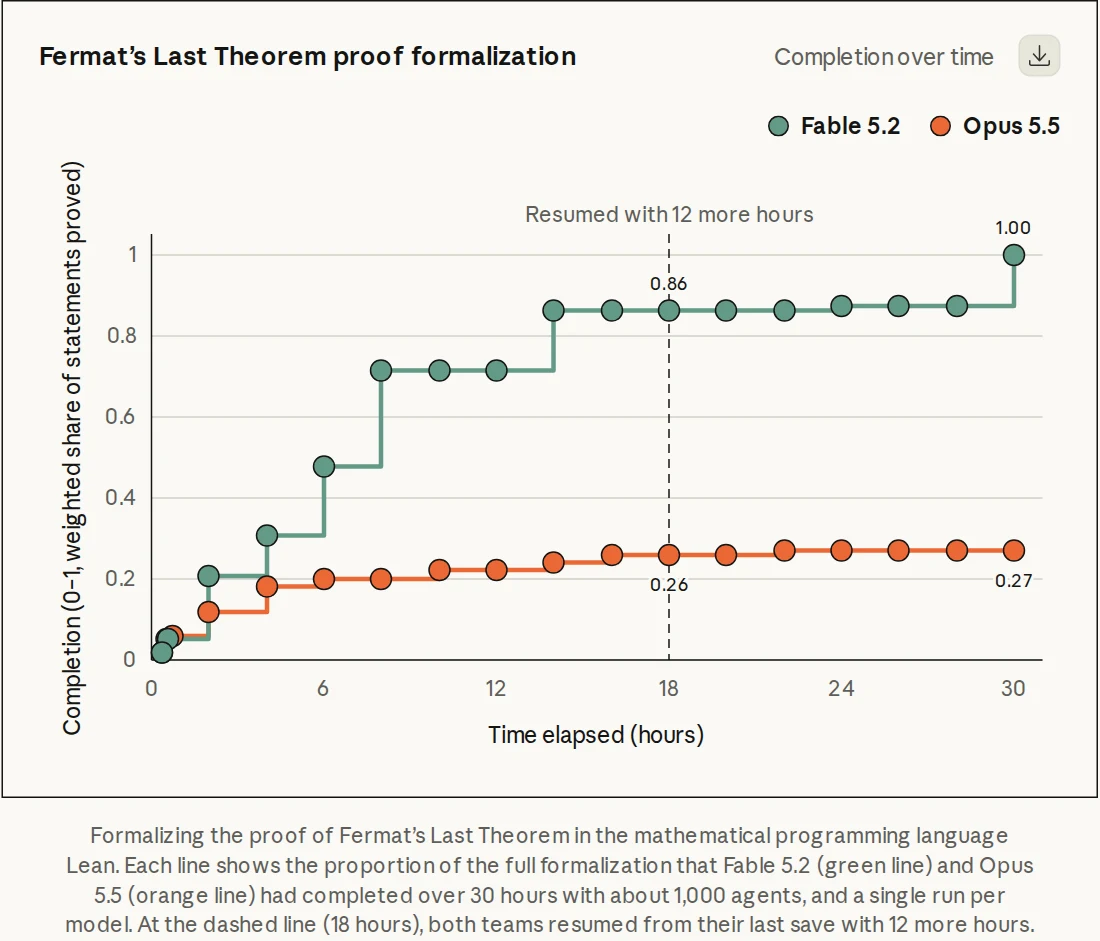
A math proof case shows well how models diverge on long tasks. Formalization means translating a math proof into a language a computer can verify step by step. According to the announcement, about 1,000 Fable 5.2 agents finished formalizing the proof of Fermat's Last Theorem in 30 hours. Opus 5.5 with the same setup finished 26% in 18 hours and then made almost no progress.
| Elapsed time | Fable 5.2 | Opus 5.5 |
|---|---|---|
| 18 hours | 0.86 | 0.26 |
| 30 hours | 1.00 | 0.27 |
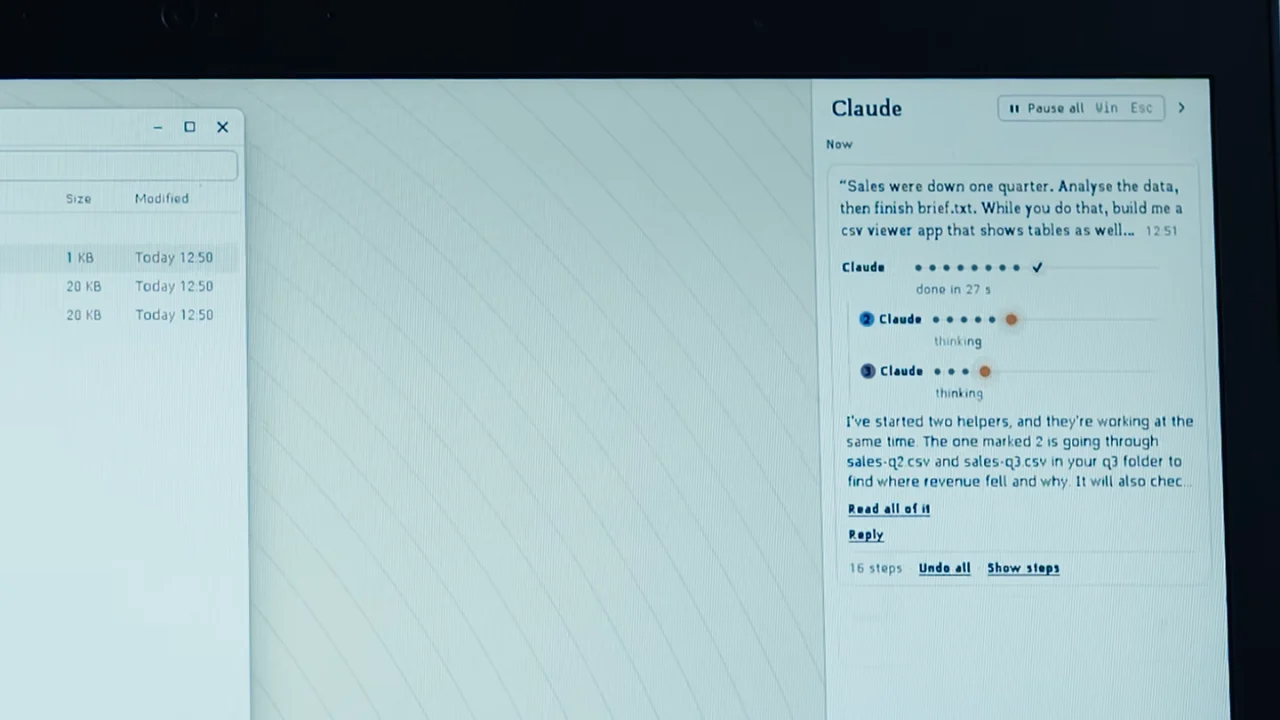
Among the coding cases, the operating system prototype stands out. According to the announcement, one engineer started from an empty folder and ran more than 1,000 sub-agents for 8 days, and an operating system that boots on a laptop came out. In the demo video, the user picks "Talk to Claude about this" from a file window menu, then asks it to analyze quarterly revenue data, finish a document, and even build an app that shows a table. In the right-hand panel, Claude launches two helpers at once to read the two quarters of data separately.
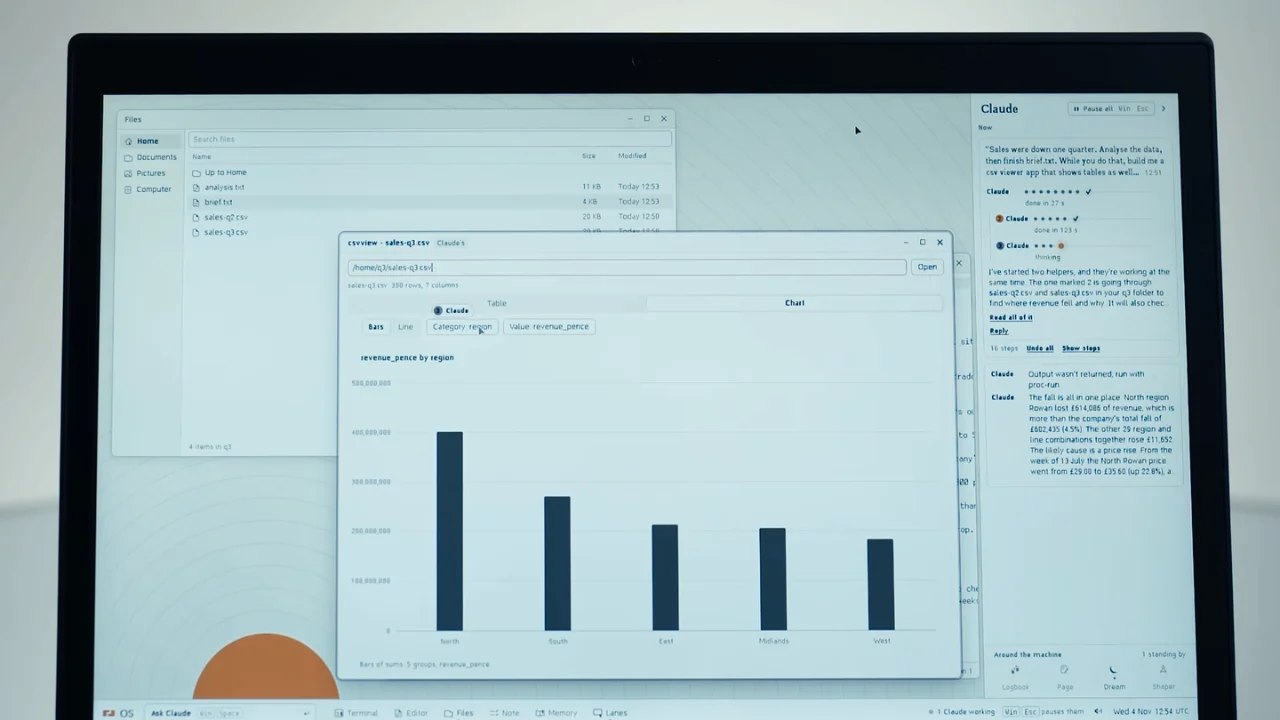
A few seconds later, the CSV viewer app that was just built opens and draws a revenue bar chart. The scene is meant to show that both the operating system and the apps running inside it were made by the model.
The hardware cases are three electronic devices: a voice assistant hub, a USB speakerphone, and a handheld virtual pet device. Each was handed off with a one-paragraph instruction. The order of work given in the announcement is below.
| Step | What it did |
|---|---|
| Spec | Wrote the device spec itself |
| Parts | Chose parts that can be bought from US distributors |
| Circuit board | Routed a 4-layer board |
| Enclosure | Designed the case |
| Software | Wrote the program that runs on the device |
| Result | Each board was ready for manufacturing within a day, and all three devices worked without circuit fixes |
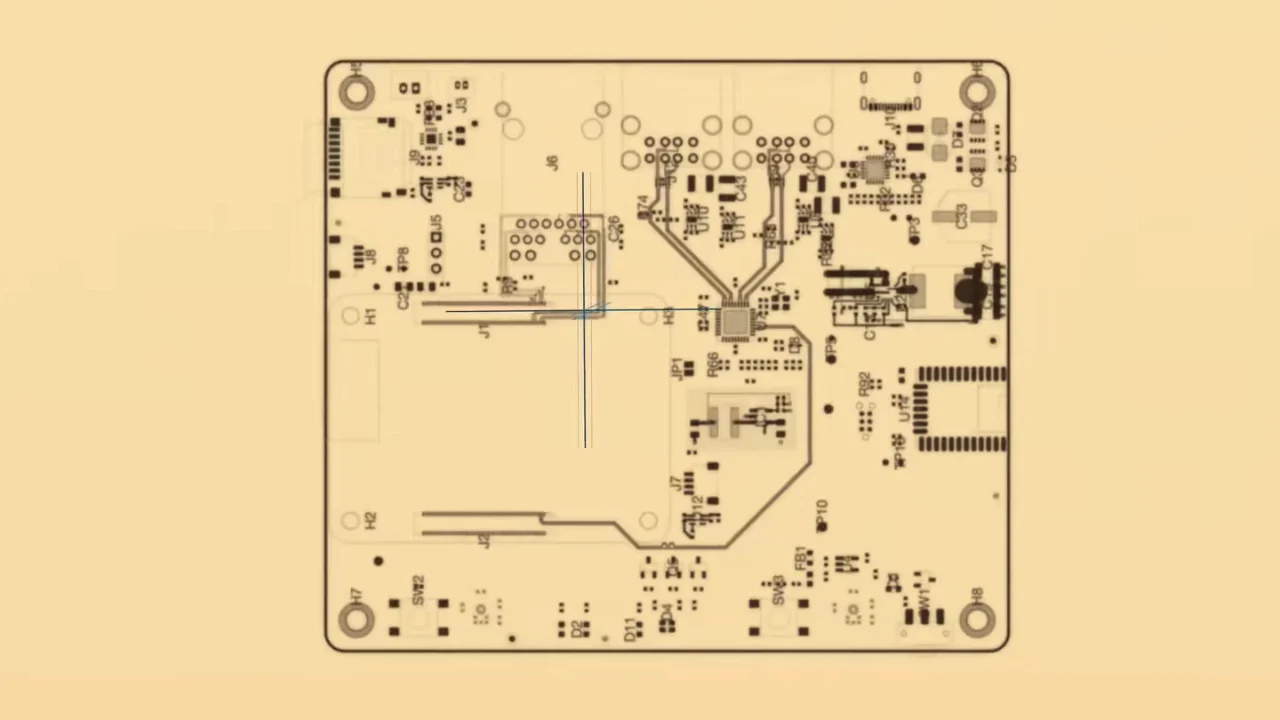
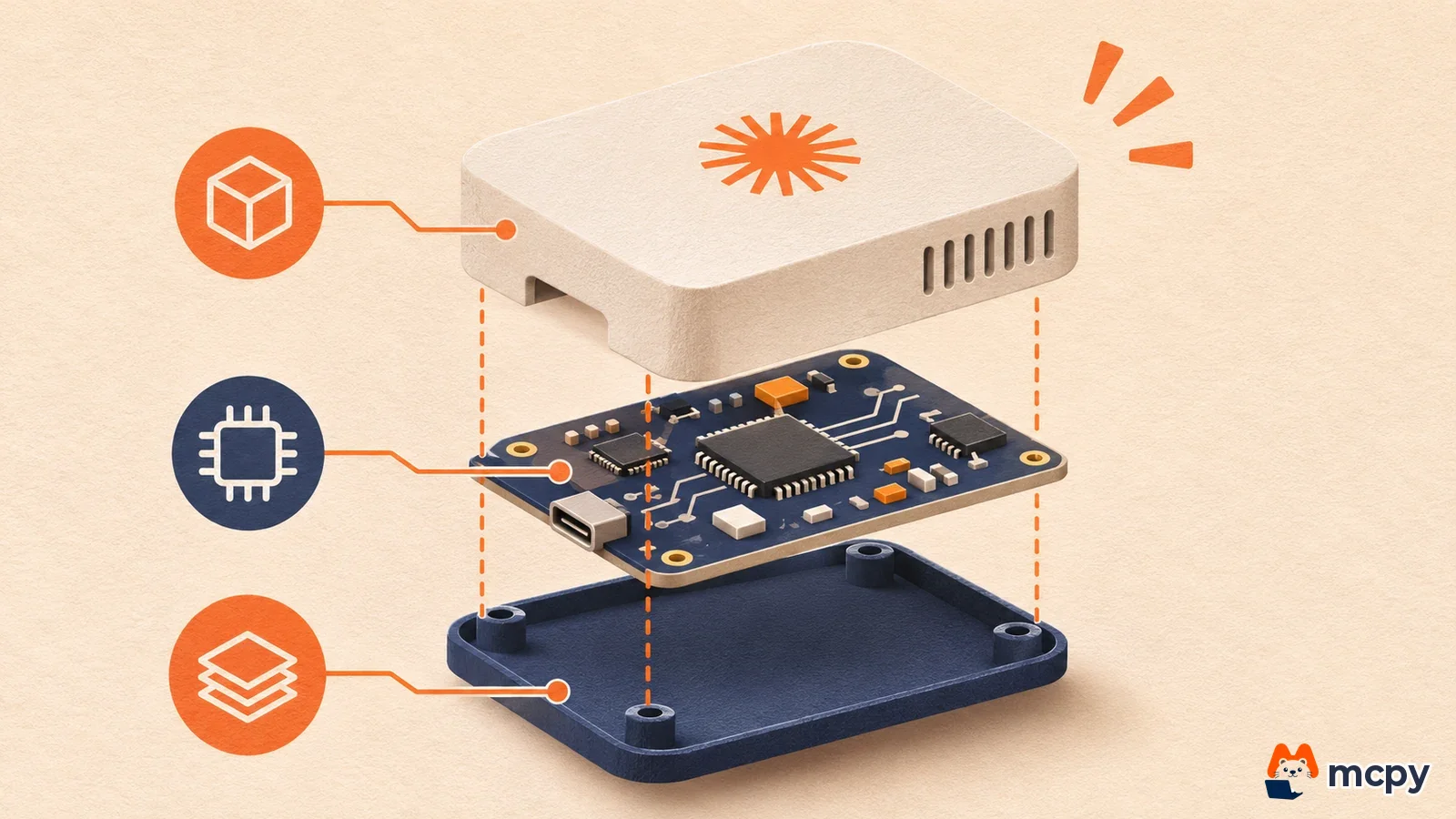
The design carries over into the board and case. The scene below shows the top of the case, the circuit board, and the base plate spread apart vertically.
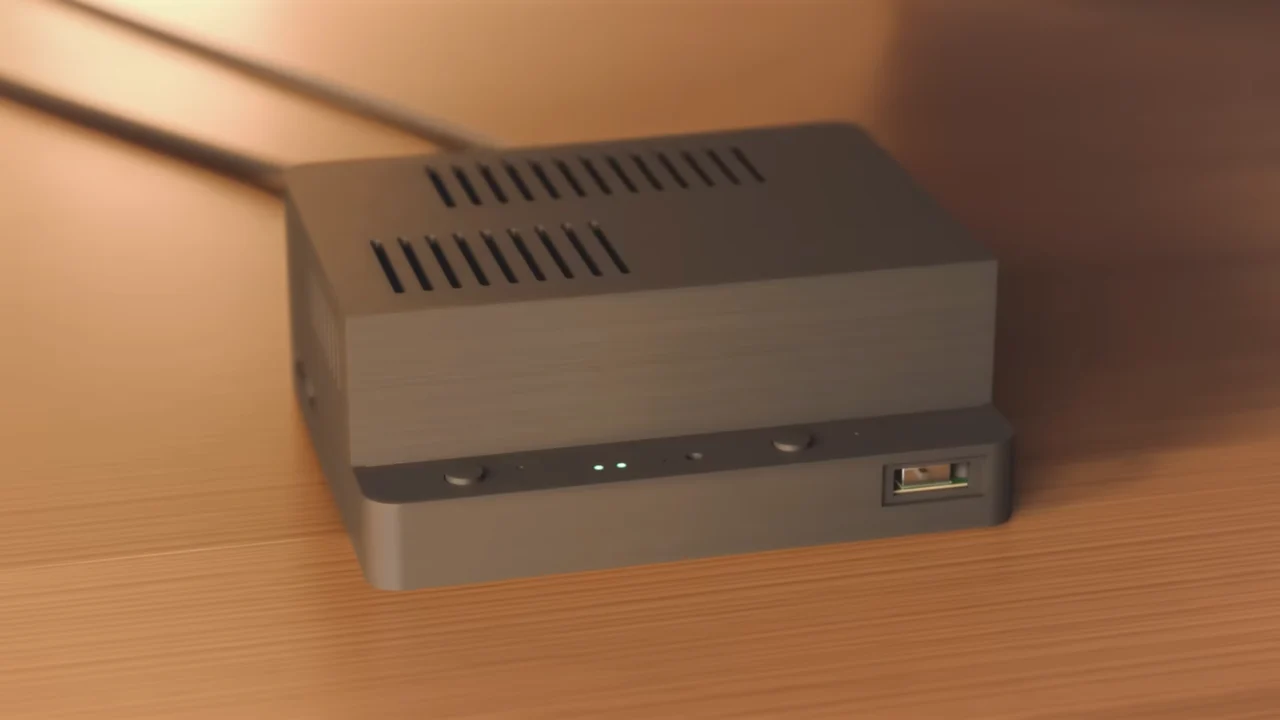
The last scene shows the assembled, powered-on device on a desk.
Keep three conditions in mind when reading these numbers and cases. Anthropic ran the evaluations itself, and some were run only internally. Unless marked otherwise, scores were measured at the highest thinking depth each model can use. The customer cases in the announcement were picked by the company, and the announcement says no outside organization reviewed this article.
Plan terms and the launch reset tickets
According to the Help Center page, Fable 5.2 is available on all paid plans (Pro, Max, Ultra, Team, Enterprise), and Free is not covered. According to the launch offers page, the launch offer splits into two tracks by plan. Pro and Team standard seats get Fable included for up to 50% of the subscription limit for one week, until 11:59 PM US Pacific time on November 16, 2026 (4:59 PM Korea time on November 17), plus 1 reset ticket. Max, Ultra, and Team premium seats get 1 to 3 tickets depending on how long they have subscribed.
| Time since first paid billing | Reset tickets |
|---|---|
| Under 6 months | 1 |
| 6 to 12 months | 2 |
| Over 12 months | 3 |
The launch offer has three conditions. First, only accounts whose paid billing started before 10:00 AM US Pacific time on November 9, 2026 (3:00 AM Korea time on November 10) qualify. Second, if you cancel and come back, the length is still counted from your first billing date. Third, the deadline to use reset tickets on Max, Ultra, and premium seats is 11:59 PM US Pacific time on March 8, 2027 (4:59 PM Korea time on March 9), and for Pro and standard seats it is the November 16 date above. Free, Enterprise standard seats, and self-serve or usage-based Enterprise are not eligible.
A reset ticket restores only the amount of your weekly limit that was spent on Fable. For accounts with a 5-hour limit, that window is fully refilled. It does not increase the limit itself. Taking the worked example from the official notice: if you used 80% of the weekly limit, with 50% on Fable and 30% on other models, 30% remains after the reset. Only the 50% spent on Fable disappears. Once used, a ticket cannot be undone, and it expires after the deadline. Since only Fable usage is restored, pressing it after heavy Fable use gives back more.
You use the ticket in the Claude web settings. On the Korean screen, there are two steps.
- Open the usage screen in Claude web settings (Settings > Usage on the English screen).
- In the "Reset limits" area, press the "Reset for free" button next to "Reset Fable" (the Korean screen shows this as a button that means "reset for free").
The screen shows the ticket's expiration date and a note that says, "Refills your Fable allowance and restores the Fable usage deducted from your weekly limit. It does not reset your entire weekly usage." The expiration date on the screen below, "Mar 9, 2027, 4:59 PM GMT+9", matches the Max and Ultra deadline converted above.

When you press the button, your Fable usage is restored right away. To check, see whether the weekly limit bar on the same screen went down. In Claude Code, the /usage command shows the same bar. If you cancel or downgrade your plan, any unused reset tickets disappear.
How to switch to Claude Fable 5.2 in the Claude app and Claude Code
The default model does not change automatically. The launch offers page also says the default model stays the same and that you should pick Fable yourself in the model picker. On Claude web, desktop, and mobile, open the model picker at the bottom right of the input box and choose "Fable 5.2". Cowork needs the latest desktop app. The app's default thinking depth (shown as "Effort" on the screen) is medium per the announcement, and you change it on the "Effort" row at the bottom of the picker.
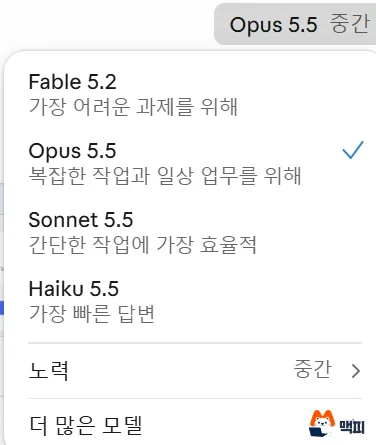
| Item | Description on screen |
|---|---|
| Fable 5.2 | For the hardest tasks |
| Opus 5.5 (selected by default) | For complex work and everyday tasks |
| Sonnet 5.5 | Most efficient for simple tasks |
| Haiku 5.5 | Fastest answers |
| Effort | Medium (tap to change) |
| More models | Opens the list of older models |
Claude Code needs version 2.1.321 or later. According to the 2.1.321 entry in the Claude Code changelog, Fable 5.2 is now the default Fable model. The steps are as follows.
- Check the version with
claude --versionin a terminal. If it is lower than 2.1.321, update Claude Code to the latest. - Open
/modelin Claude Code and check that Fable 5.2 is selected. - If you need to reproduce an earlier result, go back to 5.1 with
/model claude-fable-5-1.
On the PC used for this article, it showed the output below. It is higher than 2.1.321, so you can go straight to /model.
$ claude --version
2.1.322 (Claude Code)
Claude Code installation and plan limits are in our Claude Code install and plan guide, and the reasons your limit drains fast are in our Claude Code token usage guide. If you previously picked Fable 5.1 in /model and saved it, you move to the new Fable without any action. According to the changelog, Pro and Max move right away, and Team and Enterprise move after the organization allows it. In the model picker, "More models" is now the unnumbered bottom row, and older models open below it.
If your company uses Team or Enterprise, then per the Help Center page, Fable 5.2 stays off until an admin turns it on. Seven days after launch, it is automatically added to any role that has at least one Fable model turned on, and places where the default model is set to Fable move to 5.2 unless an admin blocks it first. If the model does not show in the picker, check the admin settings before suspecting an account problem.
Cyber and life science work belongs to Mythos 5.2
Fable 5.2 and Mythos 5.2 are the same model. The difference is the safeguards. Fable has safeguards in cyber and life sciences, so high-risk cyber work such as penetration testing or writing attack code, and most life science research questions, are blocked. For blocked requests, Opus 4.8 answers in cyber and Opus 5 answers in life sciences. Anthropic says blocks dropped by about 55% overall compared with Fable 5.1.
Per the announcement, only organizations that passed the cyber verification program (which security professionals apply for) or the life science verification program (which researchers apply for) can use Mythos 5.2. Claude Security, the security scanning tool, is available to Enterprise customers and now uses Mythos 5.2.
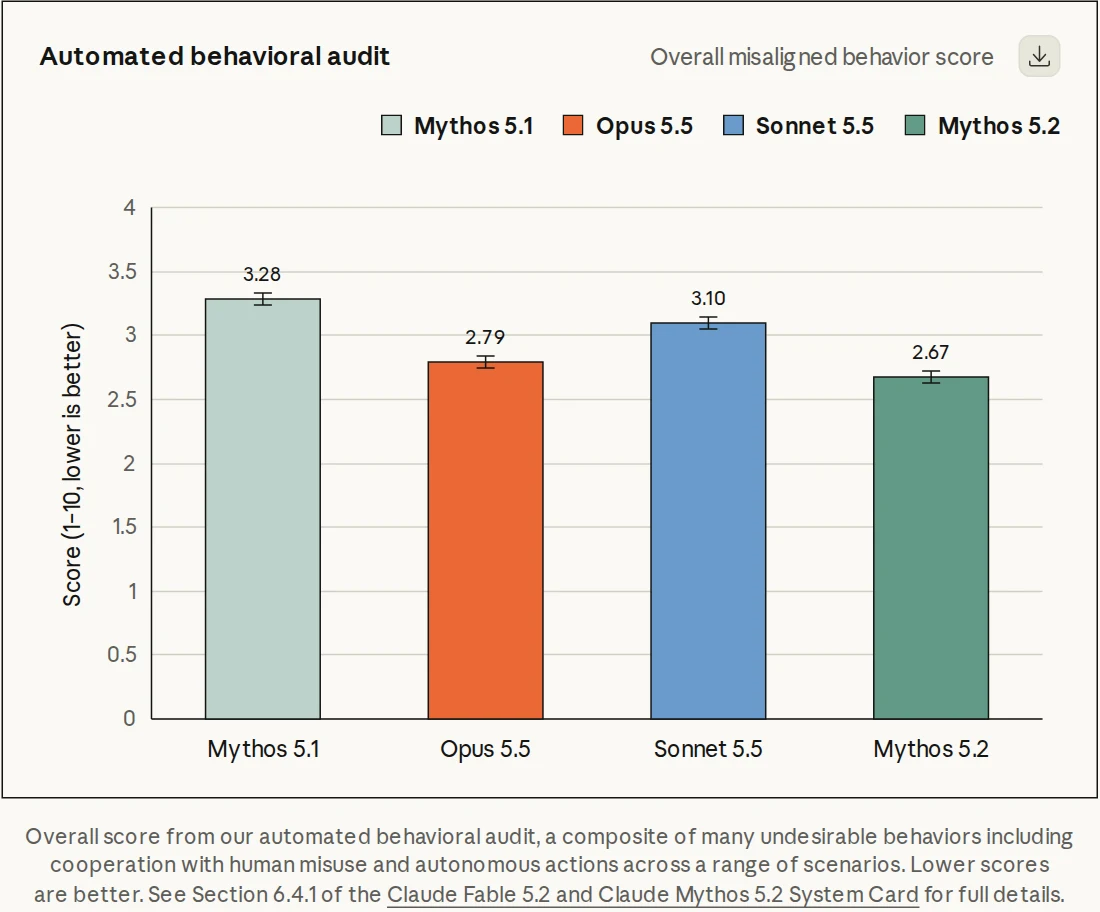
The announcement also has safety evaluation results. Anthropic's automated behavioral audit scores, from 1 to 10, how much a model helps with human misuse or takes actions on its own that it was not asked to take, and lower is better. Mythos 5.2 scored 2.67, lower than Mythos 5.1 (3.28) and Opus 5.5 (2.79). Anthropic also ran this evaluation itself.
| Model | Score |
|---|---|
| Mythos 5.2 | 2.67 |
| Opus 5.5 | 2.79 |
| Sonnet 5.5 | 3.10 |
| Mythos 5.1 | 3.28 |
4 checks for API developers and the setting changes
Developers who build requests directly with the API should check the 4 changes in the official What's new doc before switching the model ID to claude-fable-5-2. If Claude Code, claude.ai, managed agents, or the Agent SDK build your requests, there is no code to change.
- Code that edits earlier turns before resending. If you resend an earlier thinking block after the system prompt, tool list, or earlier messages changed, you get a 400 error with the message "The block is bound to a different conversation". Fable 5.1 applied this check only to accounts created after August 31, 2026, but 5.2 applies it to all accounts.
- Routers that switch models midway. According to the official preserved thinking doc, thinking blocks made by Fable 5.2 can be read only by Fable 5.2 and Mythos 5.2. If you hand off to another model, the block is dropped and that turn's reasoning does not carry over, but the request succeeds and the dropped block is not billed.
- Computer use tool. Declaring the old
computer_20251124tool causes a 400 error on every platform except Amazon Bedrock. Switch to thecomputer_toolset_20260801toolset. The method is in the computer use tool doc. - Advisor tool (beta). If you use Fable 5.2 as the executor model, the advisor must also be
claude-fable-5-2orclaude-mythos-5-2. Any other model returns a 400 error.
There are also two request rules. Adaptive thinking is always on, so adding budget_tokens or turning thinking off causes a 400 error, and forcing tool_choice to any or a specific tool also causes a 400 error. If you need JSON that matches a schema, use auto with strict: true. The API default effort (thinking depth) is high, the context is 1M tokens, and the maximum output is 128k tokens. If easy requests are slow or expensive, lower the effort for just those requests. How to fix 400 errors item by item is in our Claude Haiku 5.5 API 400 error guide.
Availability covers the Claude API, Amazon Bedrock (anthropic.claude-fable-5-2), Claude Platform on AWS, Anthropic-managed and Google-managed on Google Cloud, and Microsoft Foundry. Both models require 30-day data retention, so they cannot be used under zero data retention (ZDR) agreements unless Anthropic separately allows it. After moving by following the migration guide, check that the model field in a test response is claude-fable-5-2 and that the usage tokens look normal.
Frequently asked questions
Can I keep using Claude Fable 5.2 on the Pro plan? Until November 16 (US time), it is included for up to 50% of your subscription limit. After that, you can use it only if you turned on usage credits, and you pay for what you use.
Do I have to run out of my limit before using a Claude Fable 5.2 reset ticket? No. You can use it any time before the deadline. Only Fable usage is restored, so it pays off most after heavy Fable use.
What if I cannot see Claude Fable 5.2 in Claude Code? First check that your version is 2.1.321 or later. On a Team or Enterprise account, also check that an admin turned Fable on.
I use Opus 5.5. Should I switch to Claude Fable 5.2? If your usual work finishes fine on Opus, there is no reason to switch. When we ran two identical tasks, the results were the same and Fable cost about twice as much. Choose Fable only for hard tasks where Opus gets it wrong or stops.
Found this useful? Share it
Related posts
Related projects
Get new posts by email
Insights on marketing, analytics, and dev, delivered to your inbox.