
Gemini 4 Hydrogen (gemini-4-hydrogen) is a model Google made generally available (GA) in the Gemini API on November 12, 2026. Google's Gemini API changelog describes it as a model built for speed and efficiency, suited to everyday coding and agent work (tasks where AI uses tools and handles many steps on its own). The same changelog says it is available on the free tier, and paid pricing is $1.50 per 1 million input tokens and $7.50 for output. A token is the unit a model uses to process text. It is not the same as one character.
Hydrogen went GA on November 12. It works on the free tier, and standard paid pricing is $1.50 for input and $7.50 for output. The price list shows no schedule for a price increase.
The thinking level setting gains a new, deepest option, xhigh, and the default is high. Among Google models, only Hydrogen supports xhigh.
To move from 3.8 Flash, change the model ID and remove sampling values such as temperature and explicit caching. Right now 3.8 Flash costs half as much.
Which Gemini 4 Hydrogen setup fits how you use it
This announcement appears in the API docs changelog. The changelog has nothing that links it to Gemini app subscription plans. If you only use the app, there is nothing to change. If you call the Gemini API from code or automation tools, find your row in the table below.
| How you use it | Hydrogen | What to do now |
|---|---|---|
| Google AI Studio or API free tier | Free to use | Pick gemini-4-hydrogen from the model list and try it |
| Paying for 3.8 Flash | Twice the price (until December 31, 2026) | Do not rush. Measure the quality difference first |
| Paying for 4 Carbon | Cheaper than Carbon on both input and output | Compare both models on the same questions, then decide. Google's docs have no performance comparison of the two |
| Antigravity agent (preview) | Hydrogen is the default model | Set a token cap (max_total_tokens) first |
Gemini 4 Hydrogen API pricing and free tier
The Standard price on Google's pricing page is $1.50 per 1 million input tokens and $7.50 for output. The output figure includes thinking tokens, which the model uses before it answers. So a short answer can still raise your output bill if the model thinks for a long time. The same page lists no schedule for a Hydrogen price increase.
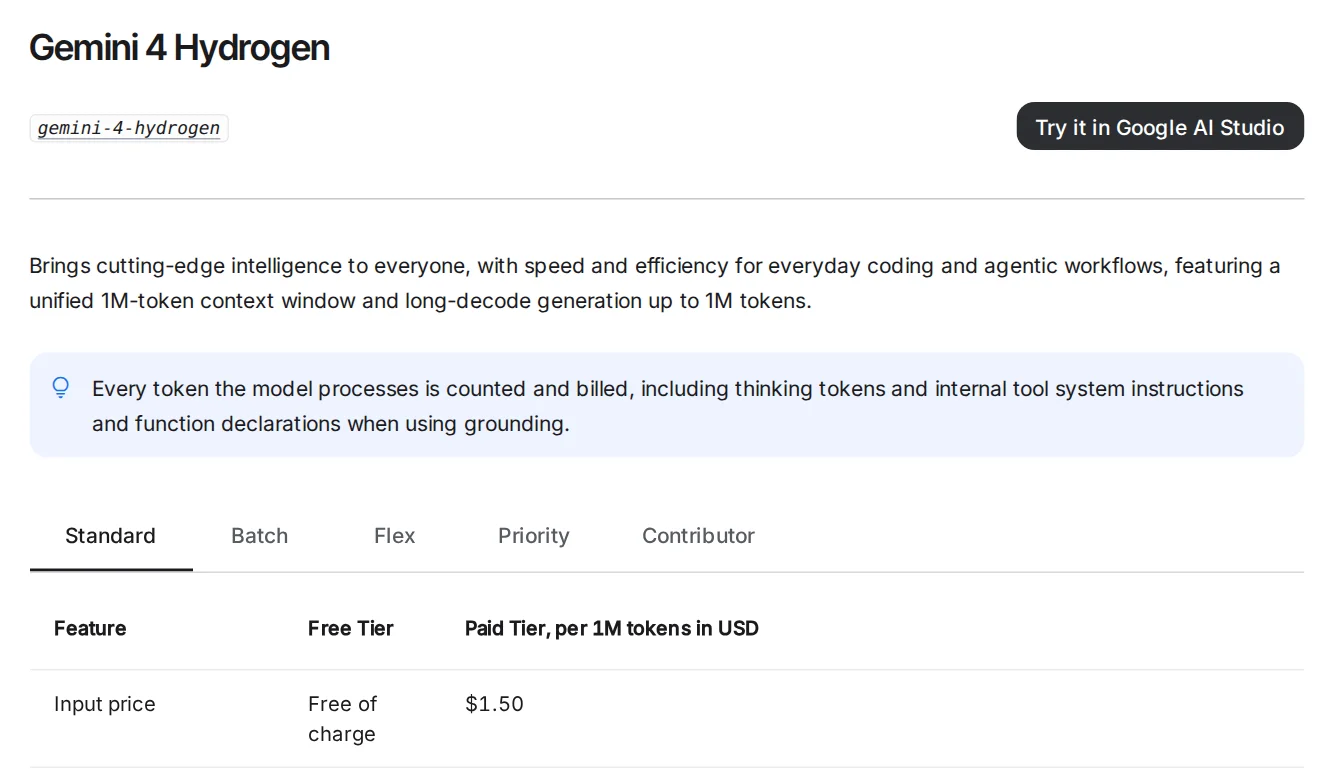
Here is the table from Google's pricing page in text form. Batch and Flex cost half of Standard and are paid-only.
| Type | Free tier | Standard | Batch / Flex | Priority |
|---|---|---|---|---|
| Input | Free | $1.50 | $0.75 | $2.70 |
| Output (including thinking tokens) | Free | $7.50 | $3.75 | $13.50 |
| Context cache | Free | $0.075 | $0.0375 | $0.135 |
The pricing page does not list per-minute or daily request limits for the free tier. Grounding with Google Search (a feature that backs answers with search results) is not available on the free tier. On the paid tier, the first 5,000 requests per month are free, shared across Gemini 3 and later models, and after that it costs $14 per 1,000 requests.
Price comparison with 3.8 Flash and 4 Carbon
Using Standard prices from Google's pricing page, Hydrogen is cheaper than Carbon and more expensive than 3.8 Flash. 3.8 Flash has a discounted price until December 31, 2026, and from January 1, 2027 it costs the same as Hydrogen. Carbon's price doubles from December 1. The changelog and pricing page have no performance comparison table for Hydrogen and Carbon, so this article does not claim that either one is better by any amount.
Say one call uses 100,000 input tokens and 20,000 output tokens (including thinking tokens). Hydrogen costs $0.30 (input $0.15, output $0.15). The same call costs $0.15 at the current 3.8 Flash price, $0.40 on Carbon until November 30, and $0.80 from December 1. At 1,000 calls a day, that is $300 for Hydrogen, $150 for 3.8 Flash, and $400 to $800 for Carbon. This math leaves out caching and batch. Carbon's launch price and access terms are covered in our Gemini 4 Carbon launch article.
Thinking level xhigh: when to raise it and when to lower it
The thinking level sets how long the model thinks before it answers. According to Google's thinking docs, Hydrogen supports four levels, low, medium, high, and xhigh, and the default is high. The default for 3.8 Flash, 4 Carbon, and 4 Argon is medium.

| Level | Trait | Best for |
|---|---|---|
low | Fewest tokens and lowest latency | Fast chat, bulk processing |
medium | Fewer tokens and quick responses | Interactive coding, building UI mockups |
high (default) | Balance of intelligence and speed | Complex coding, agent runs, multimodal work |
xhigh (new) | Uses the most tokens and thinks the deepest | Hard multi-step problems that high cannot solve |
This part affects cost directly (based on the default change item in the migration guide). Thinking tokens are billed at the output rate, so the default moving from medium to high alone can increase output tokens for the same request. Google notes that using xhigh for simple text extraction or JSON generation can cause overthinking and use up the whole output limit. To cut cost, it recommends dropping to low or medium instead of lowering the limit.
What improved in Hydrogen
Google's Hydrogen change guide lists four improvements over 3.8 Flash, but this is Google's own description. Code quality is better. When evidence is thin, the model flags missing context instead of guessing. It batches read and search tool calls together. It also reads tables, charts, dense PDFs, images, audio, and video more accurately. For video, it also supports picking specific frames to examine (agentic video understanding).
There is only one quantitative figure. Google says made-up claims dropped by more than 5 times compared with 3.8 Flash. The guide does not say what tasks or method were used, and there is no benchmark table. Because the company stated this figure itself, you need to check whether your own workload sees the same effect, using the method in the section below.
Output length also changed. A single response can run up to 65,536 tokens. Longer writing, called long decode, is possible up to 1,048,576 tokens through background runs or follow-up calls. Unlike 3.8 Flash, input, thinking, and output share one 1,048,576-token window.
How to migrate from 3.8 Flash and confirm it worked
The behavior changes listed in Google's migration guide are below. If you are not a developer, you can skip this section.
| Item | 3.8 Flash | 4 Hydrogen |
|---|---|---|
| Default thinking level | medium | high |
minimal level | Not supported | Returns an error |
| Explicit caching | Available | Not supported (implicit caching only) |
temperature, top_p, top_k | Applied | Ignored by the server even if sent |
| Input and output limits | 1M input, 64K output, separate | Input, thinking, and output share a 1,048,576-token window |
- Change the model ID from
gemini-3.8-flashtogemini-4-hydrogen. - Remove
temperature,top_p,top_k, and explicit cache calls (cachedContents) from your code. - Check
max_output_tokens. This value caps thinking tokens and the answer combined, so a low value like 8,192 can cut answers off midway. Raise it to 65,536 or remove it. - If you use
minimal, change it tolowor higher. - If you triggered tool calls with JSON text inside system instructions, switch to function calling or structured output. If you leave it as is, you may get a
MALFORMED_FUNCTION_CALLerror.
To confirm success, we suggest sending the same 20 to 50 evaluation questions to both models and comparing (the numbers are McPy's suggestion and are not in Google's docs). Check whether answers were cut off (the finish reason), how much output tokens grew including thinking tokens, and whether accuracy improved. Run both medium and high, and if accuracy is similar, pick the cheaper one. Hydrogen currently costs twice as much as 3.8 Flash, so the test for switching is whether quality makes up that gap.
Antigravity agent and its default model
According to Google's Antigravity agent docs, Antigravity is a managed agent in the Gemini API. It handles reasoning, code execution, file management, and web browsing in a Google-run Linux sandbox with a single API call, and its default model is Hydrogen. For harder development and reasoning work, you can change the model value in agent_config to gemini-4-carbon. It is currently in preview and billed pay-as-you-go.
An agent repeats many steps on its own and can use a lot of tokens. If you set max_total_tokens in agent_config, the task ends in an incomplete state when it hits the limit, so it works as a spending cap. For account-level caps, see how to set them in our Google Cloud spend caps article.
Other changes to know about
Two more articles are worth reading when you switch models. New projects on the paid tier store requests by default, so Hydrogen requests may be included, and how to turn that off is in our Gemini API request storage default article. Access terms for Carbon and Argon, the other models in the 4 series, are in our Gemini 4 Argon price and launch article.
Frequently asked questions
Is Gemini 4 Hydrogen free to use?
Google's pricing page shows free-tier input and output as free. However, Batch and Flex modes and Grounding with Google Search are not available on the free tier, and the page has no request limit figures.
Does Hydrogen accept image or video input?
According to Google's model page, it accepts text, images, video, audio, and PDF as input, and the output is text. It does not support image or audio generation or the Live API.
Is 3.8 Flash going away soon?
The Hydrogen entry in Google's changelog has no notice of 3.8 Flash being shut down or auto-switched. According to the pricing page, the 3.8 Flash price rises to $1.50 for input and $7.50 for output from January 1, 2027.
Found this useful? Share it
Latest posts
Kakao Share Thumbnail Not Showing? Here's the Fix (JavaScript SDK 2025)
Learn why Kakao Share thumbnails don't appear even with a valid imageUrl, and fix it using scrapImage to convert your URL into a KAGE CDN URL. Step-by-step guide.
How to Generate CRM User Manuals in 20 Minutes with Claude Code Sub-Agents
Learn how Claude Code sub-agents can analyze your CRM codebase and auto-generate user manuals and visual guidebooks in just 20 minutes. See the real-world results.
GEO Generative Engine Optimization: The Complete 2025 AI Marketing Strategy Guide
Learn what GEO (Generative Engine Optimization) is, how it differs from traditional SEO, and discover 5 proven AI marketing strategies to get cited by AI search engines in 2025.
Related projects
Get new posts by email
Insights on marketing, analytics, and dev, delivered to your inbox.