
Influencer seeding means sending products in advance to plant the seeds of word of mouth. In practice, it is a marketing method where you send a product for free and the influencer posts a voluntary review. Unlike a paid sponsorship, where you pay a fee and get a promised post, seeding does not guarantee a post. The cost is mostly the product cost plus shipping. A review posted after receiving a free product can count as an economic interest under the Korea Fair Trade Commission (KFTC) rules, so advertisers should explain how to disclose it before shipping.
Influencer seeding means sending products and hoping for reviews
Agency materials describe seeding as providing products to influencers for free and receiving reviews. One marketing agency guide uses seeding and gifting as the same term, and notes that sending a product does not guarantee a post. AMPM Insight says this makes seeding hard to control, but reviews do not look like ads, which is an advantage.
Influencer seeding differs from paid sponsorship and trial groups
The three methods differ in what the advertiser gives and what they get back. In seeding, you give only the product and leave the decision to post to the influencer. In a paid sponsorship, you pay a fee and agree on timing and message. In a trial group (chemheomdan, Korea's organized review program), you give a product or a visit-based service and set conditions for writing the review.
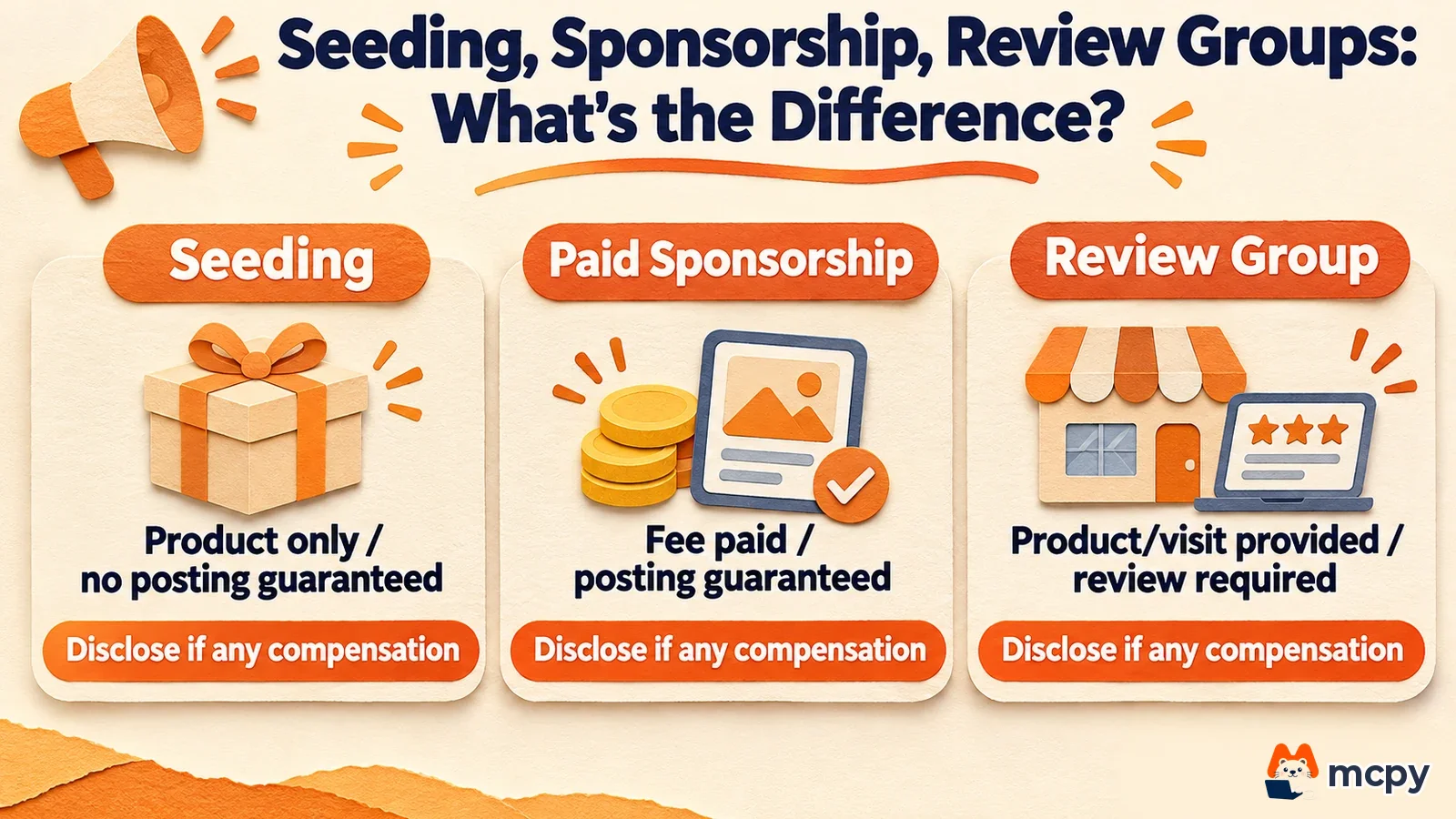
| Type | What the advertiser gives | Post guaranteed | Message control | Cost structure |
|---|---|---|---|---|
| Influencer seeding | Product | No | Low | Product cost, shipping, management time |
| Paid sponsorship | Fee (product can be included) | Yes | High | Fixed fee per post |
| Trial group | Product or service | Depends on review terms | Medium | Product cost and operating cost |
AMPM Insight explains that a new brand that needs to build reviews in search results first fits seeding, while a short promotion or a need for high shooting quality fits a paid sponsorship. For trial group post labeling by platform, see TikTok trial group sponsorship disclosure rules.
Influencer seeding works in 5 steps
The process starts with setting a goal and ends with checking the post and its disclosure.
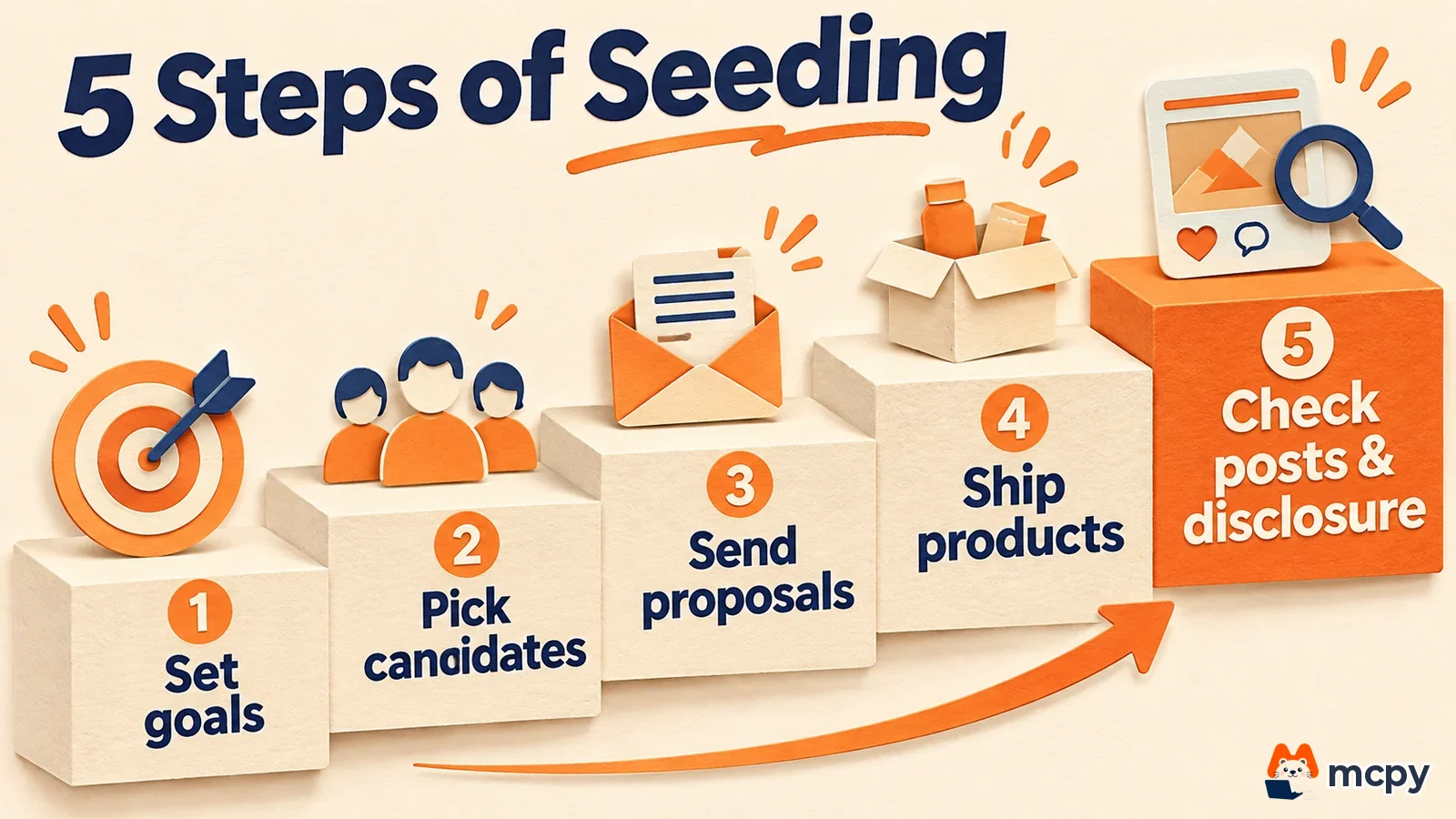
- Set a goal. Narrow down to one thing you want from seeding, such as the number of reviews visible in search results or an early reaction check, rather than sales.
- Choose candidates. 1Point splits followers into nano (1,000 to 10,000), micro (10,000 to 100,000) and mid-tier (100,000 to 500,000). It advises early-stage brands to look at customer fit and engagement on recent posts before audience size.
- Send the pitch. OpenAds reports that the same template pitches flood influencers, so the real reply rate is around 5%. It recommends a personalized message that links the influencer's content to your product.
- Ship the product. Include a disclosure guide with the product. Follow the disclosure section below for what it should say.
- Check the post and disclosure. Open the post URL, then log the disclosure position and the reactions in the tracking sheet.
For how to turn on the sponsorship label on Instagram and find creators, see how to do influencer marketing.
Influencer seeding cost: calculate the price per posted review
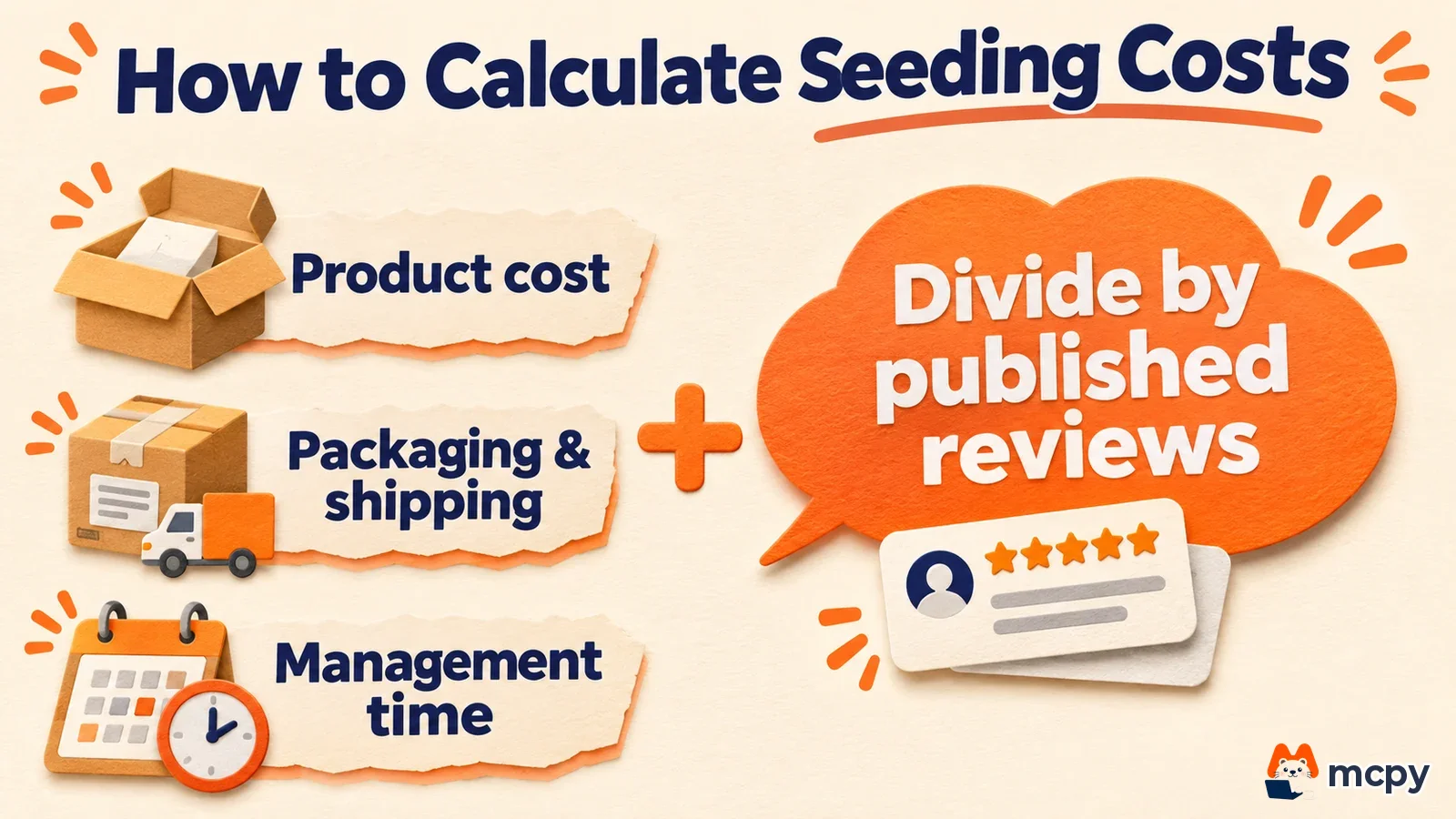
Divide the total cost by the number of posted reviews, not by the number of products sent, to see the real cost. The 1Point article above treats seeding cost as product cost plus packaging and shipping. It adds that if you send to many people, you should also count the time spent on shipping and schedule management. The numbers below are assumptions to help you understand.
| Assumption | Value |
|---|---|
| Product cost | KRW 15,000 |
| Packaging and shipping | KRW 4,000 |
| Number sent | 30 people |
| Total cost (product cost plus shipping, labor excluded) | KRW 19,000 × 30 = KRW 570,000 |
| At a 20% posting rate (6 posts) | KRW 95,000 per review |
| At a 10% posting rate (3 posts) | KRW 190,000 per review |
| Posting rate | Cost per review |
|---|---|
| 30% (9 posts) | 63,333 |
| 20% (6 posts) | 95,000 |
| 10% (3 posts) | 190,000 |
When the posting rate is cut in half, the cost per review doubles. Use this unit cost as the baseline when you compare against a paid sponsorship quote. After the first shipment, log the actual results in the tracking sheet and apply them to the next round.
Free product reviews also need a sponsorship disclosure
The Korea Fair Trade Commission says economic interest includes cases where an advertiser gives a recommender or endorser cash, free products or services, discounts and similar benefits. This explanation appears in the KFTC press release on the revised guidelines, issued on December 2, 2025, and in the Seoul Shinmun report covering it. It means a free product is also a form of economic compensation.
From December 1, 2024, blog posts must show the economic interest disclosure in the title or at the beginning. The KFTC press release gives the same positions. The MTN report gives examples such as adding "[Ad]" to the title or putting a line saying compensation was received on the first line of the body. The same report says compensation received later on a conditional basis, such as a commission on a purchase link, also needs disclosure.
This is confusing for seeding because advertisers often do not require a post. Even if you did not ask for one, the person who received the product may post a review. So we recommend including a guide with the disclosure method when you ship. The guide should say to write the disclosure in the same language as the post, and for blogs to place it in the title or at the beginning. If a post without disclosure goes up, the whole seeding campaign of the advertiser can get tied to a hidden ad (backad) controversy. For disclosure positions by channel and the penalty criteria, see hidden ad rules and how to disclose sponsorship.
A tracking sheet checks your seeding results
Create the columns below in one spreadsheet and use one row for each person you shipped to.
| Column | What to record | Success criterion |
|---|---|---|
| Ship date and product | Date sent and contents | Receipt confirmed |
| Post URL | Address of the published post | Opened on the check date set for your goal |
| Disclosure position | Title, beginning, first hashtag, etc. | Visible without scrolling or tapping "more" |
| Reaction | Views, saves, comments | Compared with the average of earlier posts |
| Reuse permission | Consent to use as ad material | Received by message or DM |
AMPM Insight recommends getting permission to use well-received reviews on official channels or as ad material, and keeping the relationship going with influencers who left positive reviews.
Frequently asked questions
Are seeding and gifting the same thing?
In the industry, they mean almost the same. 1Point describes seeding (gifting) as providing a product and hoping for a voluntary post.
Can I send products to nano influencers with few followers?
Yes. 1Point advises early-stage brands to first narrow down candidates who fit the product, rather than looking at size. Choose based on the reach and engagement of their recent posts.
Can I use a review as ad material after it is posted?
Get the author's permission first. Record whether you received reuse consent in a separate column of the tracking sheet.
If you have a product to send this week, add one line of disclosure wording to the shipping guide and create the first row in your tracking sheet.
Found this useful? Share it
Latest posts
Kakao Share Thumbnail Not Showing? Here's the Fix (JavaScript SDK 2025)
Learn why Kakao Share thumbnails don't appear even with a valid imageUrl, and fix it using scrapImage to convert your URL into a KAGE CDN URL. Step-by-step guide.
How to Generate CRM User Manuals in 20 Minutes with Claude Code Sub-Agents
Learn how Claude Code sub-agents can analyze your CRM codebase and auto-generate user manuals and visual guidebooks in just 20 minutes. See the real-world results.
GEO Generative Engine Optimization: The Complete 2025 AI Marketing Strategy Guide
Learn what GEO (Generative Engine Optimization) is, how it differs from traditional SEO, and discover 5 proven AI marketing strategies to get cited by AI search engines in 2025.
Related projects
Get new posts by email
Insights on marketing, analytics, and dev, delivered to your inbox.