
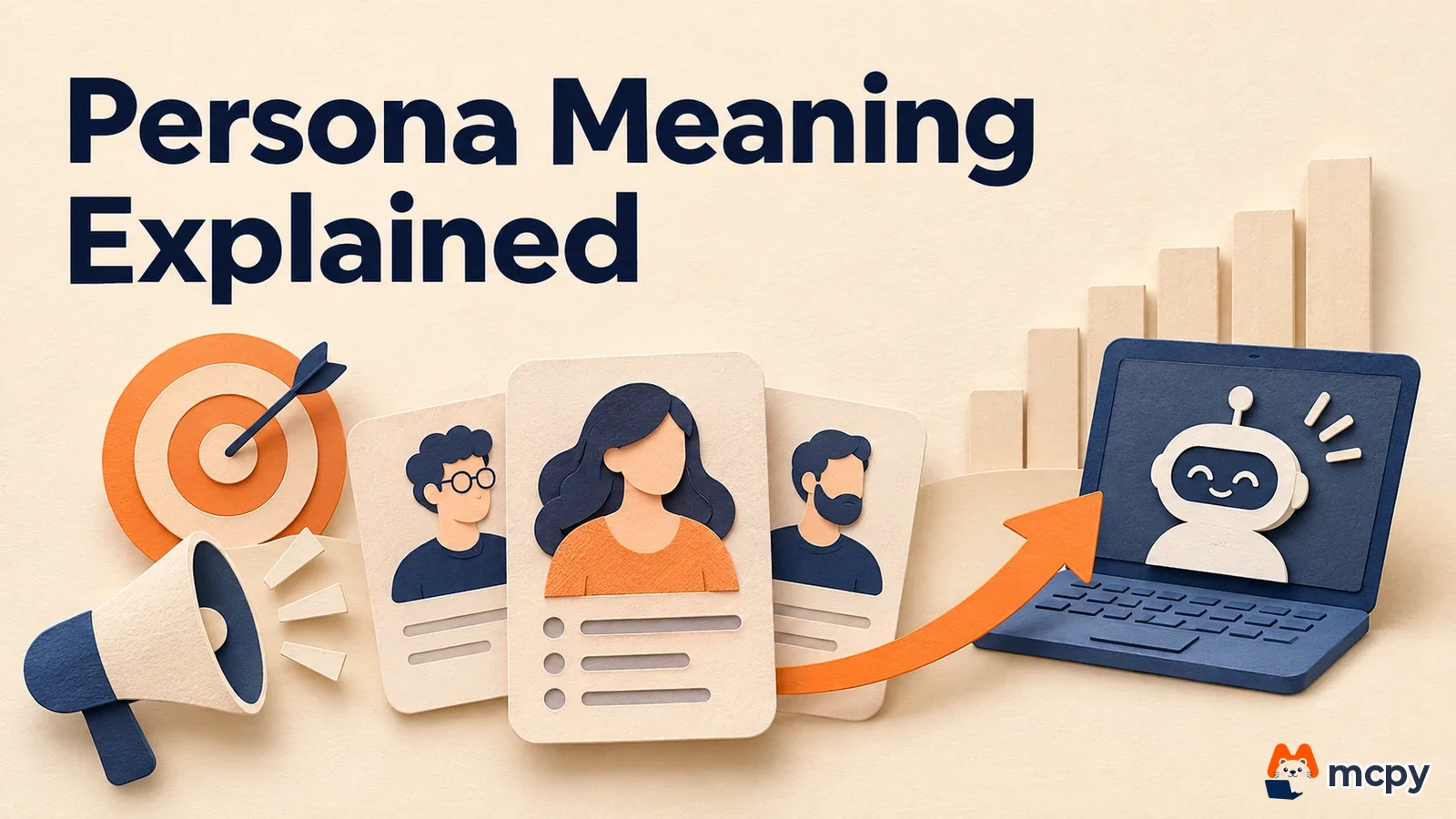
Persona meaning, in plain terms, is "the image or role a person shows to the outside world." In marketing, a persona is a fictional person who represents your target customer. In psychology it is a mask shown to society. In AI prompts such as ChatGPT, it is a role you assign to the responder. Marketing and AI personas share one purpose: they narrow "whose point of view to judge from" down to one person. Below you will find the meaning by field, the items to put on a customer persona, 5 steps to build one, and the result of a test I ran to see whether adding a persona changes an AI answer to the same request.
Persona meaning in psychology, marketing, film and AI
In every field, persona carries the same base idea: "a role or character that shows on the outside." The Standard Korean Dictionary from the National Institute of Korean Language lists only two senses, a Christian term (an independent personal entity) and an art term (a sculpture of a human body). So the everyday meaning has to be learned from usage in each field.
| Field | Meaning | Example |
|---|---|---|
| Psychology | A mask, the outward face shown to society. Carl Jung described it as "a kind of mask designed to make a definite impression on others" (Wikipedia: Persona) | A calm team lead at work, a playful person at home |
| Film and pop culture | An actor a director treats as an alter ego and casts again and again, or the many sides one person shows in different situations (multi persona) | "That director's persona actor," a main account and a second account |
| Marketing and UX | A fictional person who represents the target customer. You write a name, age, daily routine and worries | "A 33-year-old marketing team associate who buys coffee within a 15-minute lunch break" |
| AI prompts | The role, tone and point of view you give the AI | "You are a cafe manager with 5 years of experience" |
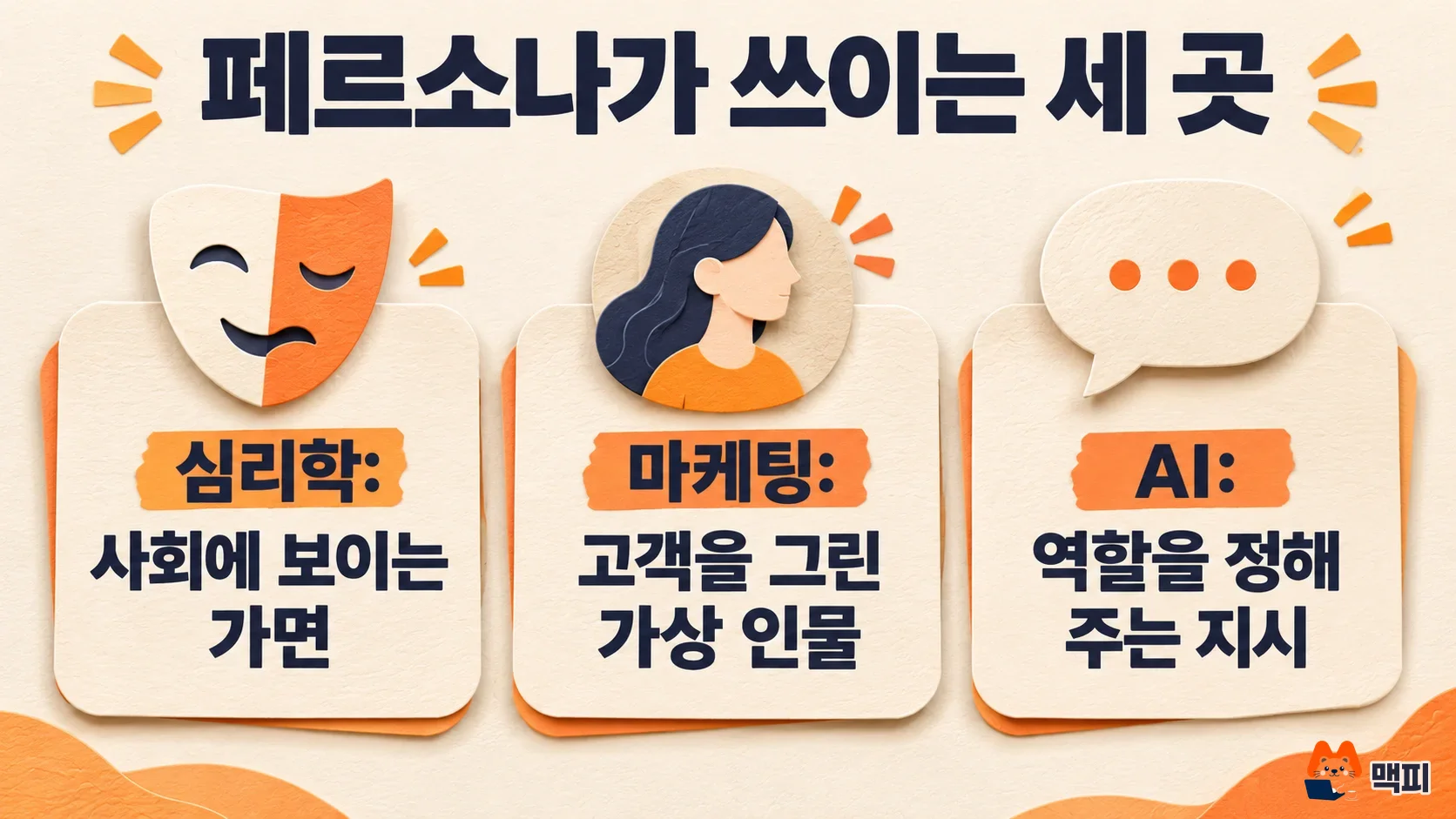
Most people who search for "persona meaning" want the first two rows of the table. But people who work in blogging or advertising actually use the third and fourth rows. This article covers those two. A marketing persona is used to picture the customer in detail before positioning, the last step of STP strategy for choosing ad targets. The full framework is in STP strategy meaning and examples.
A customer persona card lists only the items that change decisions
In its article on personas, Nielsen Norman Group (a UX research firm) defines a persona as "a fictional, yet realistic, description of a typical or target user of the product." It says a persona includes a name, age, photo, a one-line summary, product experience and frequency of use, goals and worries, and a quote that shows attitude. The same article says that even though the person is fictional, it should be built from research on real people, and that details which do not affect design decisions should be left out. Too much detail buries the useful information.
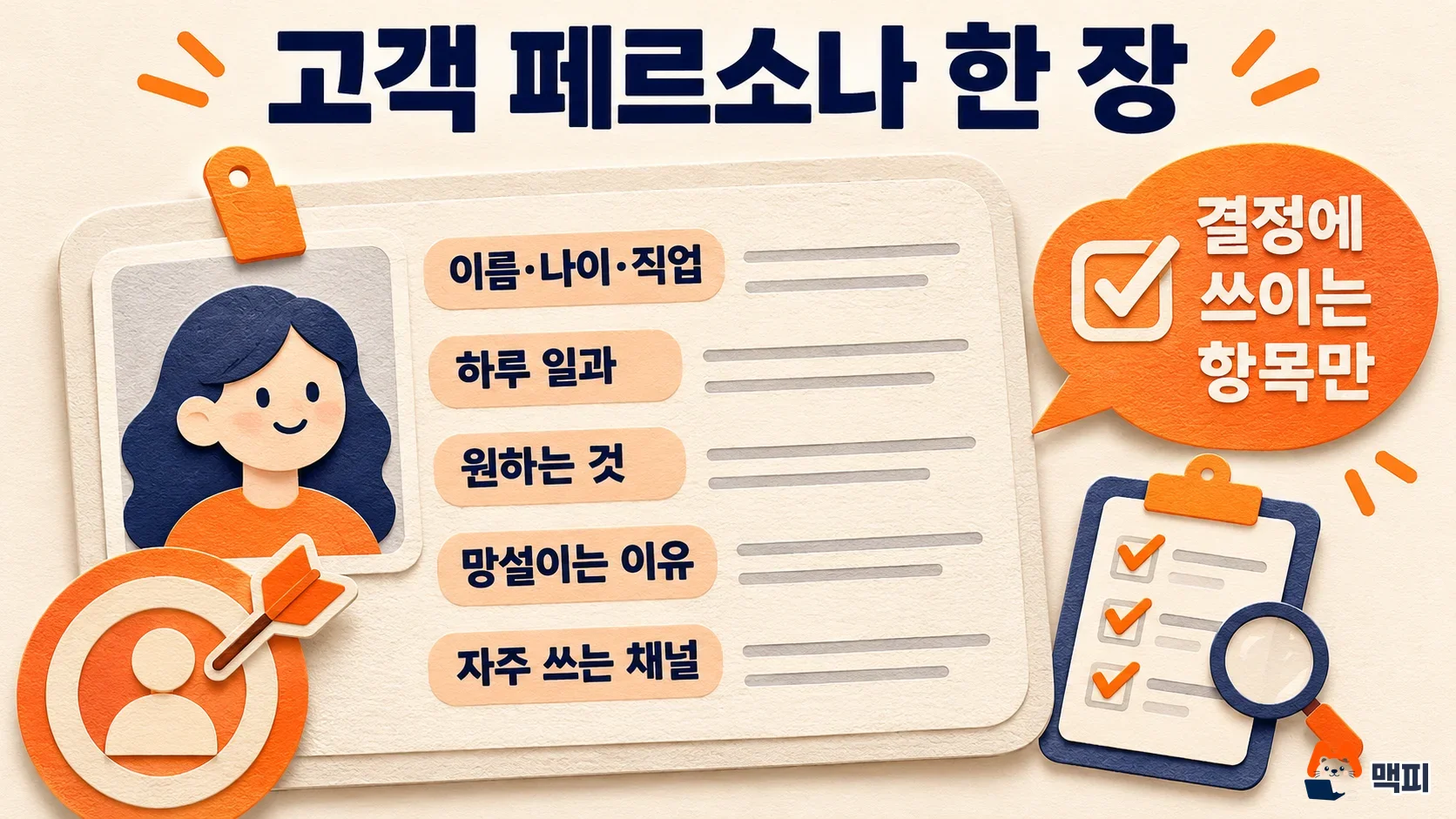
If you pair each item with the decision it changes, it is easier to decide what to keep and what to cut.
| Item to write | Decision it changes |
|---|---|
| Job and daily routine | The days and hours to run ads |
| What they want | The first sentence of the ad copy (the benefit) |
| Reasons for hesitation | Questions to answer first on the product page, and where to place reviews and refund info |
| Sense of price | Product bundles and discount style |
| Favorite channels | Ad media choice (search, Instagram, Kakao, etc.) |
Skip any item that changes none of these decisions, such as hobbies or favorite music. More items look impressive, but they make it harder for your team to remember the persona.
How to create a customer persona in 5 steps
A persona is not a made-up character profile. It is a summary that bundles what customers said into one person. The order is collect, group, draw, write and fix.
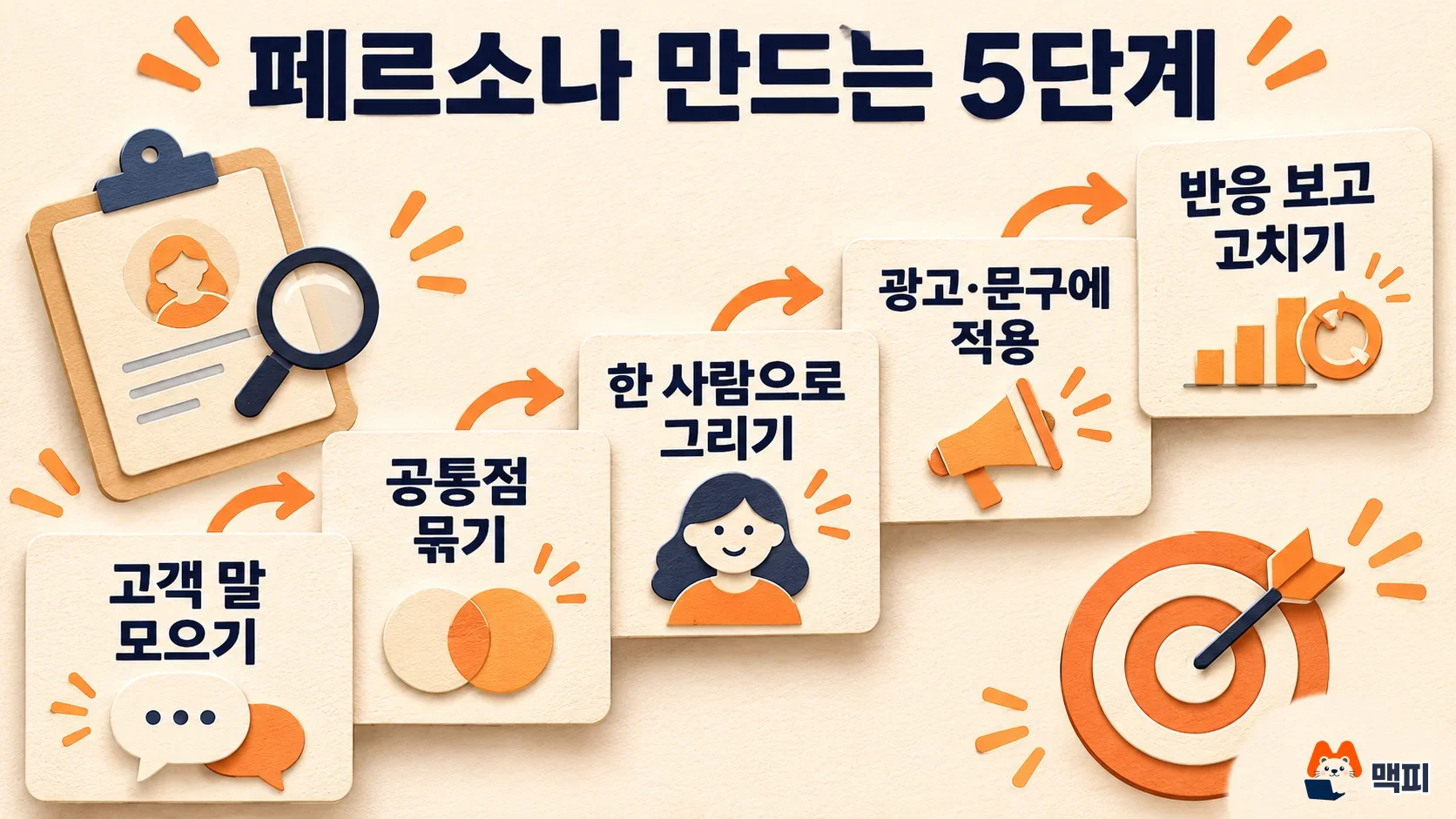
- Collect customer words. Copy the exact phrases customers used in purchase reviews, inquiry chats, cancellation and refund reasons, and conversations with regulars. Do not summarize. Keep the tone, so you can reuse it in ad copy later.
- Group the common points. Group the comments that repeat the same reason. There is no fixed rule for how many counts as a repeat. Maekpi treats a comment as one group when three or more people say the same thing. This rule stops a few strong opinions from looking like they represent everyone.
- Draw one person. Pick the largest group and fill in the card from Figure 2: name, age, daily routine, what they want and why they hesitate. If you have several groups, build the one with the largest sales share first. Making several cards at once blurs who each ad is written for.
- Apply it to ads and copy. Move the card's "what they want" into the first sentence of the ad, and "reasons for hesitation" into the first screen of the product page. Choose ad media from "favorite channels."
- Check responses and fix. If the ad click rate or the inquiries differ from what you expected, the card is wrong, so fix the card. Review it every quarter, or whenever the product or price changes.
Nielsen Norman Group advises that personas should be based on user research, that you can use one or several, and that you should merge groups that are too similar. If you are an early startup with no customers yet, start step 1 as a "hypothesis." Build a temporary card from the customer you imagined in your business plan, then adjust each item using reviews and inquiries from about 20 first buyers. This number is not a standard. It is a suggestion based on what you can collect within a month.
Take a small cafe near an office district as an example. Suppose reviews repeat "I have to be out within 10 minutes after lunch," "If the line is long I just walk by," and "Over 5,000 won makes me think twice." The card would be filled in like this. Name: Jisu, a 33-year-old marketing team associate who buys coffee within 15 minutes after lunch. What she wants: fast pickup and a price around 5,000 won. Why she hesitates: the waiting line. For a winter new-menu ad written with this card, starting with "15 minutes after lunch is enough" fits Jisu's decision better than starting with "taste." This example is a fictional case made for explanation.
An AI prompt persona changes how the same copy request is answered
Giving a persona to AI works in the opposite direction from the customer persona above. A customer persona pictures "the person who will read what I write," while an AI persona sets "the point of view of whoever writes or judges the text." The OpenAI prompt engineering guide recommends opening the instructions with an Identity section that states purpose, tone and goals, and shows an example of setting a persona through a developer message. Combine the two and you get this method: "attach the customer persona card to the AI and have it write or choose copy from that person's point of view."
To see whether this method really changes the copy, I tested one request on November 14, 2026. The request was "Write 3 lines of promo copy for a small neighborhood cafe's Instagram post about its new winter menu item (chestnut latte)." I ran each version once with Claude Haiku 5.5 (claude -p). For the second run, I shortened the Jisu card above to two sentences and put it before the request.
| Case | Summary of the copy | Response time | Cost |
|---|---|---|---|
| No persona | "How about a warm chestnut latte on a winter night?" and similar lines, focused on aroma and foam | 4.3 seconds | About 0.0057 dollars |
| With Jisu persona | "15 minutes after lunch is enough. Grab it and go." and similar lines, including a time benefit. It added a note to check whether 15 minutes matches the real wait time | 7.7 seconds | About 0.0061 dollars |
| Case | Response time |
|---|---|
| No persona | 4.3 |
| With Jisu persona | 7.7 |
Once the persona was attached, Jisu's situation of "15 minutes after lunch" moved into the copy. But this is one request run once per case. It does not mean the copy will always come out this way, and it does not tell you which version gets more clicks. The AI sometimes turns the persona's "15 minutes" into a promise, so a person must check whether the real store can serve within 15 minutes. To compare the results, post both versions as real ads and measure the response. That method is covered in 5 steps in our A/B testing guide. For ChatGPT prompt writing in general, see the ChatGPT prompt writing guide.
A persona becomes useless in these cases
| Mistake | Problem it causes | How to fix it |
|---|---|---|
| Writing from imagination, without customer words | The person only makes sense inside the team and does not match ad results | Collect original reviews and inquiries first, and take sentences from them |
| An average person like "women in their 20s to 40s" | It is unclear who you are writing for, so the copy turns flat | Write one person's name and situation in specific terms |
| Too many items | The team cannot remember it, so nobody uses it | Keep only the items that change decisions |
| Writing customers' personal data as is | Real names and contact details remain in the document | Change the name to an alias and remove identifying details |
After you build a persona, check whether it worked where you used it. Look at whether the click rate of ad copy or product pages fixed by the card, and the content of inquiries, changed from the earlier period. If customer inquiries keep showing a hesitation that is not on the card, fix the card in step 3 before you fix the copy in step 4.
Frequently asked questions
Are persona and target the same thing?
No. A target is the conditions of a group, such as "office workers in their 20s and 30s." A persona describes one person inside that group, down to name and situation. Set the target first, then make it concrete with a persona.
How is a brand persona different from a customer persona?
A brand persona decides what kind of person the company sounds like (a friendly neighbor, a trusted expert and so on). A customer persona pictures the person who hears that voice. For branding in general, see branding meaning and how to raise awareness.
How many personas should I create?
One is enough at first. Build one for the customer group with the largest sales share, apply it to your ads, and add one at a time when another group's response is clearly different.
Found this useful? Share it
Latest posts
Kakao Share Thumbnail Not Showing? Here's the Fix (JavaScript SDK 2025)
Learn why Kakao Share thumbnails don't appear even with a valid imageUrl, and fix it using scrapImage to convert your URL into a KAGE CDN URL. Step-by-step guide.
How to Generate CRM User Manuals in 20 Minutes with Claude Code Sub-Agents
Learn how Claude Code sub-agents can analyze your CRM codebase and auto-generate user manuals and visual guidebooks in just 20 minutes. See the real-world results.
GEO Generative Engine Optimization: The Complete 2025 AI Marketing Strategy Guide
Learn what GEO (Generative Engine Optimization) is, how it differs from traditional SEO, and discover 5 proven AI marketing strategies to get cited by AI search engines in 2025.
Related projects
Get new posts by email
Insights on marketing, analytics, and dev, delivered to your inbox.