
Marketing and AI changes for week 1 of October 2026 (September 28 to October 4) come down to three themes: lower AI model prices, more ad measurement tools, and a new rule for counting views. OpenAI and Anthropic released models at the same price point of $2 per million input tokens and $10 per million output tokens. ChatGPT ads now have conversion measurement and customer list targeting. YouTube's public view count now starts from the first frame.
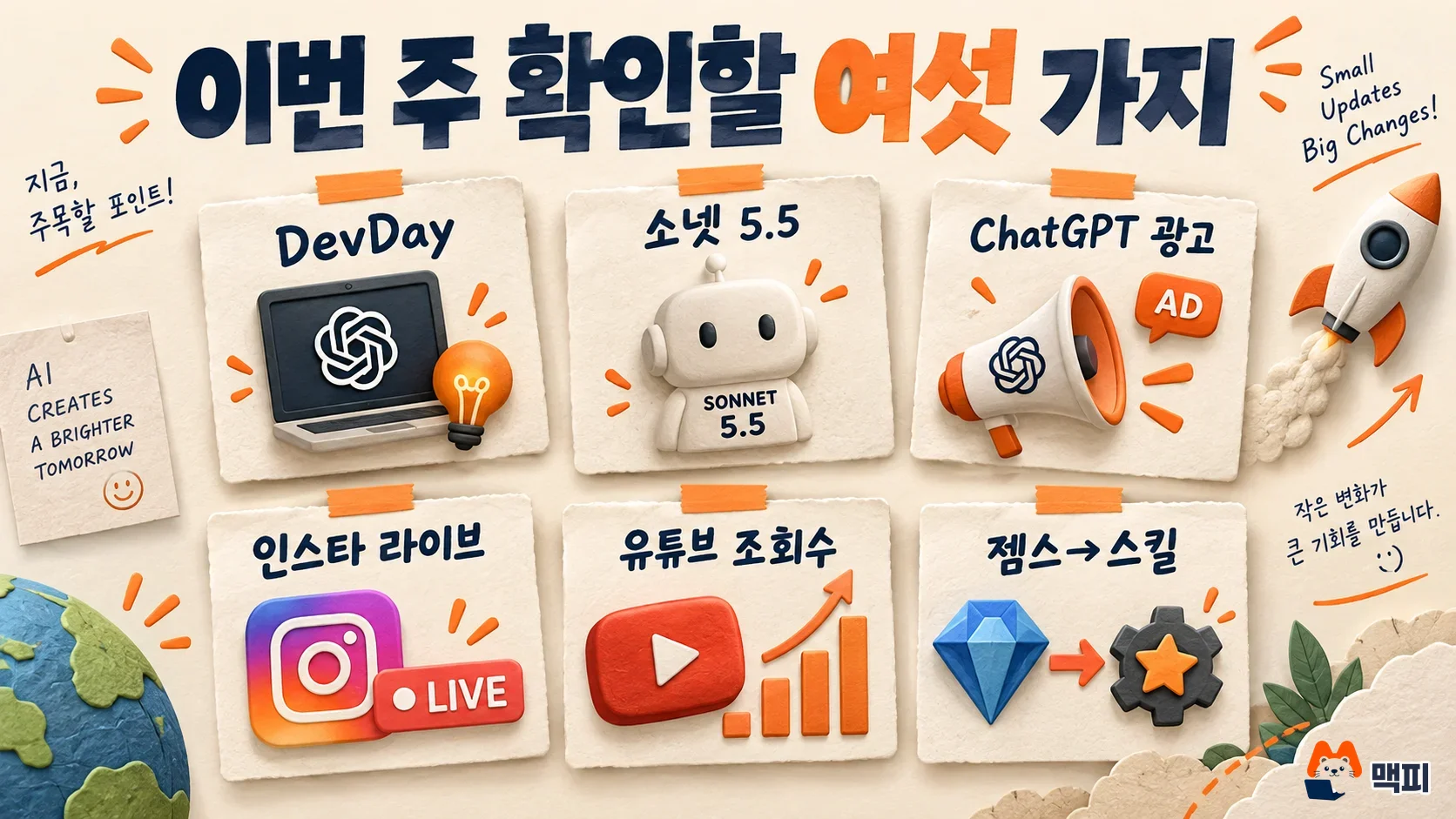
Advertisers and marketers have six items to check this week. Below, each item covers what changed and who should check what. Each item also links to a more detailed MCPY article.
OpenAI DevDay 2026 announcements recap

OpenAI made more than 20 announcements at DevDay on September 29. The two that matter most to marketers are the always-on agent Dots and GPT-6.1 Sol at one fifth the price.
OpenAI's DevDay 2026 recap covers models, ChatGPT, Codex, the API and security tools in one place. GPT-6.1 Sol delivers performance close to GPT-6 Astra at one fifth of Astra's price. Per MCPY's summary, it costs $2 for input and $10 for output per million tokens, the units of text a model reads and writes. Dots is an always-on agent built on GPT-6 Astra. It works 24 hours a day on its own cloud computer, connects to more than 4,000 apps, and can be called from ChatGPT, Slack and Teams.
Teams that run chatbots or automations through the API should first test how quality and cost change after switching to Sol. Subscribers should check whether their plan includes Dots. For details, see MCPY's DevDay 2026 recap, GPT-6.1 Sol price comparison and ChatGPT Dots requirements articles.
Claude Sonnet 5.5 API price and what to check before migrating
Anthropic released Claude Sonnet 5.5 on September 28. The price is $2 per million input tokens and $10 per million output tokens, the same as Sonnet 5. It matches OpenAI's Sol, released the same week, so developers can now test the two models side by side. The chart below compares the prices of the two models.
According to the Claude Platform release notes, the default context window is 1 million tokens and the maximum output is 128,000 tokens. Code written for Sonnet 5 can break in five places. The way to turn off thinking changed from disabled to between_tools. The any and tool values of tool_choice, which force tool use, return a 400 error. Older versions of the computer use tool are not accepted, and the advisor tool rejects Sonnet 5 as an advisor. Thinking blocks are tied to the account and the model.

Developers who use Sonnet 5 through the API should search their code for the five items in the migration guide. Teams that only use it for marketing automation can send one test request to see whether changing the model name is enough. MCPY's Claude Sonnet 5.5 price and use case guide shows starting settings by use case.
ChatGPT ads pixel and Conversions API setup
ChatGPT ads can now use a pixel (a tracking code placed on a website) to measure visitor actions, a Conversions API to send conversions directly from your server, and custom audiences to target by customer list.
According to the Conversions API documentation, server events require id, type, timestamp_ms and data. The time must fall within the last 7 days and must not be more than 10 minutes in the future. When you use the API together with the pixel, the same event ID means only the first event to arrive is counted and later duplicates are ignored. Custom audiences are uploaded as a UTF-8 CSV or TXT file (up to 500MB). For inclusion and bid adjustment, the published plan requires 25,000 matched users. Exclusion audiences have no minimum size, and they cannot be used in campaigns that target the European Economic Area and Switzerland.

Advertisers should first install the pixel and check that test events arrive. Then they send server events with the same ID and confirm there is no double counting. The setup order is covered in MCPY's ChatGPT ads pixel and Conversions API setup guide, and list targeting is covered in the customer list targeting guide.
Instagram Live ads launch in Korea

Meta opened Instagram Live ads to advertisers and agencies worldwide on September 29. Media reported the launch in Korea on September 30.
The Meta for Business announcement pairs this feature with partnership ads. It describes showing a creator's live broadcast to users with high purchase intent. Instructions for creating these ads are in the Meta Business Help Center. Korean conditions and placements follow the Madtimes report, from a Korean advertising trade outlet.
Advertisers who run live commerce should first check two things in Ads Manager: whether the live ads menu is open, and whether the account type meets the conditions. Placements, targeting conditions and a pre-launch checklist are in MCPY's Instagram Live ads conditions and setup guide.
YouTube view count change and engaged views

Since August 24, YouTube counts public views from the first frame of playback. The old view count has been renamed engaged views.
According to the official YouTube blog, the same definition applies to Shorts, long-form videos, podcasts and live streams, and the monetization criteria stay the same. Videos that autoplay on the home page also count as public views, so the number on screen can differ from how many times people actually watched. The Korean outlet Madtimes reported that the ad platform Agentio analyzed more than 75,000 videos and found engaged views averaged 60% of public views. This figure comes from an outside company's analysis.
Teams that report creator collaborations or music marketing results by view count should put public views and engaged views side by side in YouTube Studio. They should also compare reports from before and after August 24 separately. Views in Google Ads use separate definitions by ad format. MCPY's YouTube view count guide has the checking steps.
Gemini Gems shutdown and the switch to Skills

Google is replacing Gems with Skills in the Gemini app and Workspace. Enterprise Gems stop working on March 1, 2027.
According to the Google Workspace Updates post, Skills are reusable instructions that you can stack in a single prompt, and they use an open Markdown format. They roll out to enterprise and business users on October 5 and 13. Education users can keep using Gems until June 1, 2027. Existing Gems are not migrated automatically, so you need to rebuild them as Skills. Skills do not sync between the Gemini app and the Workspace apps, so you need to create them in each one.
Teams that use Gems for marketing copy or report templates should copy the instructions from their current Gems now. When Skills become available, they should rebuild them in both the app and Workspace. The schedule and rewriting steps are in MCPY's Gemini Gems shutdown and Skills transition guide.
Found this useful? Share it
Latest posts
Kakao Share Thumbnail Not Showing? Here's the Fix (JavaScript SDK 2025)
Learn why Kakao Share thumbnails don't appear even with a valid imageUrl, and fix it using scrapImage to convert your URL into a KAGE CDN URL. Step-by-step guide.
How to Generate CRM User Manuals in 20 Minutes with Claude Code Sub-Agents
Learn how Claude Code sub-agents can analyze your CRM codebase and auto-generate user manuals and visual guidebooks in just 20 minutes. See the real-world results.
GEO Generative Engine Optimization: The Complete 2025 AI Marketing Strategy Guide
Learn what GEO (Generative Engine Optimization) is, how it differs from traditional SEO, and discover 5 proven AI marketing strategies to get cited by AI search engines in 2025.
Related projects
Get new posts by email
Insights on marketing, analytics, and dev, delivered to your inbox.